Feeds:
Posts
Comments

Archive for July, 2018

[NOT ATTENDED: July 7, 2018] The Struts

The Struts are another buzz band from England.  Aside from having a band name that is way too close to The Strokes, I don’t actually know all that much about them.

Usually I listen to a warm up band at least a little before going to see them.  But for whatever reason, I never listened to The Struts.

And that’s all for the best, I suppose.  The parking situation outside of BB&T was crazy, bordering on nightmarish.

Sarah and I briskly walked to the stadium, glanced at merch, didn’t even stop to use the bathroom (crazy long lines) and as we got to our seat the lights dimmed for The Foo Fighters.

All I can say is that vocalist Luke Spiller did a decent Freddie Mercury when he came out to sing Under Pressure with the Foo Fighters.

Read Full Post »

SOUNDTRACK: HALF MOON RUN-Live at Massey Hall (December 1, 2016).

I hadn’t heard of Half Moon Run before this show.  They are a Canadian band who put out their second album a year or so before this show.

So it’s pretty impressive to have gotten a gig at Massey Hall and to have the crowd be that crazy about you after just two records.

There’s a lot to like about the music–great moody sounds, and spectacular drumming, but there’s also something really “pretty” about the singer that makes me wonder if they are too commercial.  Or if I should even care.

The band consists of four guys and they each play a multitude of instruments.  Devon Portielje is lead vocalist.  He plays guitar and on one particular song a smashing drum. Conner Molander plays keys mostly but also guitar and he sings too.  Dylan Phillips is the drummer but he also plays keys and Isaac Symonds plays percussion as well as mandolin guitar and keys.

I love the old-sounding keyboards of “21 Gun Salute.”  There’s a latter-period Radiohead vibe on this song with the eerie backing vocals and the ringing guitar.  I’m not sure if the guitar solo actually works with the song, though.

“Call Me in the Afternoon” starts with Portielje taking of his shirt (to whoops of course).  He has an undershirt on at least.  Rather than playing the guitar, he plays a small drum and throws the sticks into the audience.  There’s some nice harmonies on this song but again, it’s the drums that are very cool.  I also like the unexpected bass line that runs through the song.

“Everybody Wants” is from the newer album.  It introduces a resonator guitar which brings a whole new sound ( I thought it was a banjo at first).  This is a ballad but it builds slowly over the song with great backing vocals–soaring notes–and then it takes off at the end with some more tremendous drums (I love that one of the drummers (can’t tell them apart) is playing one-handed while paying keys with the other).

“Give Up” is an older song which also has a Radiohead kind of feel in the guitar/piano pattern.  It’s a slower moodier song and the strings come out for this song.  String are provided by Quatuor Esca:  Sarah Martineau, Camille Paquette-Roy, Edith Firzgerald, Amelie Lamontagne.

“Consider Yourself” opens with thumping drums and feedback before shifting to an almost gothy-dancey keyboard melody.  It’s cool and even moodier when the piano is added but the chorus is big and brash with a big noisy ending.  It’s a pretty great song and sounds quite different from their other ones.  It’s on the second album where I guess they diversified their sound more.

“She Wants to Know” opens with staccato note and voices and “Full Circle” has a nice interplay of acoustic guitar and electric lead with more of those thumping drums and the audience is right there to sing the chorus–it was their first single.

It’s interesting that the majority of this show is songs from their first album.  Is that editing or did they just want to play their earlier stuff?

I’m going to have to check out their studio recordings to see what they sound like.

[READ: January 25, 2018] “Credit Gone Away”

This is an excerpt from the novel Broken Glass, translated by Helen Stevenson.

This excerpt is listed as a monologue and it is just that–a full-page and a half of unbroken text.  I found it more than a little confusing because it seems to be a tirade against a bar. And I assume the bar is called Credit Gone Away (at least something is called that–it’s a weird name for a bar).  The Church people opposed the bar right away.  Saying it would be the end of Sunday mass, slippery slope until everyone is gong straight to Hell

Then the weekend and bank holiday cuckolds waded in saying that it was Credit Gone Away’s fault that their wives no longer cooked for them.   And another group of complaints from ex-alcoholics. (more…)

Read Full Post »

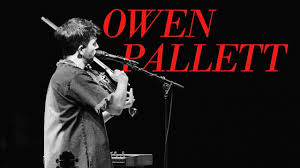
SOUNDTRACKOWEN PALLETT–Live at Massey Hall (December 1, 2015).

Owen Pallett founded the band Final Fantasy (which was pretty much him anyhow).  Since 2010 he has been recording under his own name.  His music is orchestral and complex, but also distinctly weird.  He loves to explore sounds, but he also knows how to throw in some catchy melodies as well.

He says he has played Massey Hall before but this is the first time as a solo performer. He wants to take advantage of the beautiful-sounding room and comfortable seats.

The songs he plays are a mix of new ones and Final Fantasy songs as well.

On “That’s When the Audience Died” (Final Fantasy), he picks out a complicated pizzicato on the violin and loops it (he mutters, I hope that worked) and then he launches a great melody over the top.  He has a great singing voice as well.  The lyrics are consistently clever and interesting.  The end of the song is amazing with the sounds he ekes out of his violin.

He says he took violin lessons but wasn’t into it because the violin leaves a mark on your neck.  He quit it because it ruined all his “sexual dreams,” and he switched to guitar and piano.  He was always really into composing–he loved Béla Bartók and György Sándor Ligeti–he wanted to make music you’d see in a Stanley Kubrick film.

There’s beautiful looping with the pizzicato as he plays the solos live.

“This Lamb Sells Condos” (Final Fantasy) is really quite funny if you know the story behind it, which I didn’t.  But here it is

This song is a comic interpretation of Brad J. Lamb, a figure in the Canadian real estate business (who used to live in the same building as Owen Pallett’s boyfriend), with allusions to elements of the Dungeons & Dragons role-playing game:

This snarky look at Lamb:

When he was a young man, he conjured up a firemare
Burnt off both his eyebrows and half a head of hair
And then as an apprentice, he took a drowish mistress
Who bestowed upon his youthfulness a sense of champagne chic
His seduction, his seduction to the world of construction
Now his mind will start to wander when he’s not at his computer
And his massive genitals refuse to cooperate
No amount of therapy can hope to save his marriage

Before he did Final Fantasy he played bad country music in bad country bars–because he had a violin.

“Tryst with Mephistopheles” rocks with a band (Matthew Smith and Robbie Gordon) and even some synths.  The drums really propel the song forward.

When he created Final Fantasy he had a guitar, a violin, a bed and some books.  He borrowed a looping pedal and got good with it.  He wanted to be the best violin looper.

“The Riverbed” is with a string quartet and has a fast ripping opening melody–dark and very cool.

He says now that he’s making a record in which he’s not thinking about how to play it live.  He’s just trying to make sounds–not thinking about performance or how to tour it.

So he’s playing new songs in traditional formal.  He conducts the orchestra and sings “On a Path.”  if t his is the “traditional format,” I’m very curious to hear what the non-traditional way is.  It has a fantastic vocal melody and is incredibly catchy.

The final song is “This is the Dream of Win and Regine” (yes of Arcade Fire).  It’s an older Final Fantasy song and has some great references to Montreal:

Montreal might eat its young, but Montreal wont break us.

There’s some great thumping beats throughout until the great dramatic ending.

Pallett had been on my radar, but I’m sold after seeing this show.

[READ: July 3, 2018] “The First World”

This story is bookended in an interesting way.  It starts with the narrator saying that his marriage had come to an end.  An unexpected consequence was that a series of men confided in him about their marriages past or present–not old friends, they stayed quiet, but people he’d had at arm’s length.  A contractor, the dermatologist etc.  People felt free to say wheat they wanted.

And then it was over, the men disappeared for about a decade during which time the narrator remarried.  And then Arty resurfaced.

Arty ran into him on Ninth Avenue and insisted they grab a drink.   He said there was something he’d like the narrator’s opinion on.

Arty had to talk about Gladys, the former nanny of his two girls. Gladys was is nanny for seven years, gave the girls all kinds of love and then left when the kids were old enough not to need her anymore. She got a new job in Chelsea for a younger child.

It was while working for this new family that Gladys lost her husband, Roy.  He had died while in the hospital and they were billing her for one hundred and ten grand.  She didn’t want to fight it because she was waiting for her green card.

Arty’s wife had cut off ties with Gladys (and didn’t want to talk to Arty either).   Not long after the divorce, Gladys rang him up and asked for $500, explaining what had happened to Roy.

She had agreed to a payment plan for the $110,000, but times had been tough.  She asked Arty for $500.

The bulk of the story is Arty’s impassioned telling of Gladys’ story.  How everything seemed to go wrong for her.  She moved back to Trinidad bit was not welcomed with opened arms.  She tried to find work but was unable.  And so regularly, she asked Arty for another loan, a loan that he knew he would never see.

She has even stayed with Arty when he pays for her ticket to visit her grown up son.

The narrator wants to get out of the conversation, but Arty has bought yet another round. The narrator has an amusing aside about how he lost his wallet and paid for his round with cash from his back pocket.

The story is bookended with the narrator returning home. The way the whole piece ends with him imagining his wallet being returned shows how differently two people can live and ponders what their attitudes have to do with it.

Read Full Post »

SOUNDTRACKTHE HIDDEN CAMERAS-Live at Massey Hall (August 4, 2016).

I watched the Peaches concert before this one and so my first exposure to Joe Gibb, who is The Hidden Cameras, was as a guy dressed in bondage singing gruffly to Peaches.  I saw also that he music was described as “gay church folk music.”

Imagine my surprise when Joe Gibb came out on stage in a gold suit with a big old rockabilly guitar.

In the interview he explains that he has been working on this record for about ten years, but he always had other records that came first.  He was thrilled to finally put out this one out because it is “light compared to the dark previous albums.”

This album Home on Native Land was recorded over 10 years with guest appearances by Rufus Wainwright, Feist, Ron Sexsmith, Neil Tennant, Bahamas and Mary Margaret O’Hara including original compositions as well as covers of “Dark End Of The Street” and “Don’t Make Promises” by Tim Hardin and Canadian classic “Log Driver’s Waltz”

It opens with “Counting Stars” which is a catchy shuffling song about not getting into heaven.  There’s a wild piano solo followed by a wild guitar solo.

“Ode to an Ah” is but 2 minutes long and the lyrics are simple “Ah Ah ha Yea, oo ooh ooh yea.”  It’s a fun diversion before the cover of “The Dark End of the Street.”  It’s a nice version of the classic

Then he invites Leslie Feist to come and help sing “Log Driver’s Waltz,” nt a song you expert to hear Feist singing but she sounds great singing it.

He then says he’s “so excited for our next guest…Ron Sexsmith.”  Ron is tuxed up and sings two songs: “Twilight of the Season
and “Don’t Make Promises.”

After playing those new songs he goes back to a much earlier album for “Music is My Boyfriend,” a bouncy organ-fuelled dance rocker.

Then it’s to 2016’s Age for “Carpe Jugular’ A synthy bouncy dance number, which is a lot more what I assumed The Hidden Cameras sounded like.

He had spent some time in Berlin before returning to Toronto.  He says that now Berlin is less about learning but that he’s missing it, “I’ve been here for 7 months.”

The final song “I Believe in the Good of Life” goes all the way back to his brilliantly named album Mississauga Goddam.  It’s bouncy in the way the new songs are, and has some of that rockabilly /Elvis style.

For this show, the band is Asa Berezny, Stew Crookes, Steven Foster, Tania Gill, Sam Gleason, David, Meslin, Regina Thegentlelady, and Dorian Thornton

[READ: February 8, 2018]  “Adriana”

This is a strange little meta-story that works something like an autobiography of Coetzee (unless it’s all fictional and then it’s just a funny story that makes fun of the author, I guess).

It begins with an interviewer asking Senhora Nascimento, a Brazilian woman, how she came to spend so many years in South Africa.

She has a sad story, coming from Angola with her two children–her husband was killed, brutally, in a robbery attempt. (more…)

Read Full Post »

SOUNDTRACK: PJ MORTON-Tiny Desk Concert (July 2, 2018).

I have never heard of PJ Morton.  So the opening of this show made me smile a little

So many people didn’t want me to be myself.  But I decided I was going to be PJ not natter what people told me.

Commendable, to be sure, but I had a hard time believing anybody cared what he did.  But I absolutely love the way this became the chorus:

They’d say PJ you’re not mainstream enough /Would you considers us changing some stuff or everything about who you are / No offense but were just trying to make you a star.

And then this awesome chorus:

But I must admit I’m claustrophobic / I have a hard time trying to fit into your small mind.

That’s fantastic (the song is called “Claustrophobic”).

Staying true to his own musical vision has always come first for PJ Morton. So when he expressed his desire to squeeze a 10-piece string section behind the Tiny Desk for his three-song performance, we were more than happy to oblige him.

Morton showed off the soulful Fender Rhodes chops that helped him earn a mentor in Stevie Wonder and membership to Maroon 5, while backed by percussion, bass and the same Matt Jones Orchestra that accompanies him on his soulful solo releases, Gumboand Gumbo Unplugged.  That’s: Matt Jones (Matt Jones Orchestra Conductor), Clayton Penrose-Whitmore (Violin), Arianne Urban (Violin), Olya Prohorova (Violin), Alexandria Hill (Violin), Danielle Taylor (Violin), Istvan Loga (Viola), Caitlin Adamson (Viola), Seth Woods (Cello), Malik Johnson (Cello), Victor Ray Holms (Bass),

That’s all well and good but who is he?

Well,

The preacher’s kid with the gospel roots wound up collecting two 2018 Grammy nominations for music from Gumbo, his fourth studio LP. Ironically, those industry accolades came as a direct result of Morton choosing to go his own way.

And what did people want him to do that was un PJ?

One record exec interested in signing him even suggested pairing Morton with popular West Coast hip-hop producer DJ Mustard. “It was so far off base,” he told NPR’s Michel Martin last January. Instead, he started his independent music label, Morton Records, with the vision of creating a new Motown in his hometown.

“Go Thru Your Phone” has a real Stevie Wonder vibes, particularly in the way he sings the end.  For this invites his girls The Amours (Jakiya Ayanna, Shaina Aisha) to sing with him.  In addition, we get Brian Cockerham (bass) and Ed Clark (percussion) playing some groovy funk.

He says the song is about “going through phones.”  It also has gentle pizzicato strings.  I don;t love his singing voice, but there is a great melody in the chorus.

He ends with “First Began.”  Again I don’t love his voice (there’s a Stevie Wonder thing going on again) in the verses but the sounds when the orchestra kick in are wonderful (including that low note and the wood block).   And yes, his Fender Rhodes is right on.

I am certainly interested in hearing his studio album.

[READ: January 8, 2017] “The Fugitive”

I have recently come around completely to Boyle’s writing  I’ve really enjoyed just about everything that I’ve read from him (and he gets published a lot).

But this one reminded me a lot of Rachel Kushner’s “Fifty-Seven” in that the main character does some horrible things.  He makes terrible decisions that impact other people. And while the circumstances of his initial trouble are unfortunate, I can’t feel bad for him and I’m not sure if I’m supposed to.

This is the story of a (legal) Mexican immigrant with little English (perfect for July 4th). He had contracted a very strong strain of tuberculosis.  He was told to take pills every day and come in for shots–that was the only way to cure it.  This could have gone on for up to 3 years.  But after three months, he was feeling better and quit taking the medicine.

Now he’s back, with Health Services.  They tell him that his condition has gotten worse and he is heavily contagious.  He must wear a mask in public as well as take medicine every day and come in for a daily injection.  This could also last for three years.  He agrees to it.  But the moment he gets off the bus, he goes into a bar, takes off his mask and drinks several beers, coughing all the while.

He has a job–doing gardening work–and he is treated fairly well on the job. But the medicine is wearing him down.

There’s an interesting parallel in the story in that part of his gardening job was to catch critters that damage the lawns. The first time he caught a live raccoon (the homeowners didn’t want to use poison), it was up to him to kill it.  “What are you going to do, take it home and train it to walk on a leash?”  And, yes, he is not unlike a trapped animal as well.

But still, if he follows the procedures he has a chance of getting better.  If he doesn’t, he could infect the rest of the population.  So, when he deliberately doesn’t do what he’s supposed to do and then fights back against the agents when they try to bring him in again, it’s hard to have sympathy–even if you feel bad for what happened.

If I was supposed to feel sympathy for him, it failed.


Read Full Post »

SOUNDTRACKALEJANDRA RIBERA-Live at Massey Hall (February 5, 2016).

I had never heard of Alejandra Ribera before. She has a beautiful deep voice that can really soar.

I love that she sings in English and Spanish (in the same song) and sometimes, because of her delivery it’s hard to tell which language she is singing.

The show begins with her talking about Massey Hall and how the trajectory from the [working in? a] bar to this moment is unexpectedly fast and natural (because when you’re in it, you’re in it) but it has been overwhelming with ‘pinch me’ moments.

She says, “I used to have a poster on my wall with all of these goals… to get played on the CBC and to play at Massey Hall.”

The band is minimal and they create terrific sounds with just (primarily) an acoustic guitar from Jean-Sebastien Williams and upright bass from Cedric Dind-Lavoie)

The first song “La Boca” has the acoustic guitar and upright bass moving briskly with her voice soaring (but low) on top of it–really mesmerizing.  She sings parts in Spanish.

“Goodnight Persephone” has a muted picked guitar and bowed upright bass (it opens in vaguely Velvet Underground “Heroin” way until the bowing becomes bigger and deeper).  Alejandra sings to Persephone in a wonderful wounded, pleading voice.  The ending build with the refrain “keep this light burning bright for me.”

Before starting the next song, “No Mi Sigas” she tells us (not the audience) that when she was a young girl, she had crushes on girls and at the time she knew it wasn’t okay so she started writing poetry that was metaphorical and laden in imagery so no one would know what she was writing about.  And now she’s older and it doesn’t matter who she is writing about but she has still taken this approach and it’s why all of her love songs are in Spanish because she lives in Canada.

It’s only a shame that they cut off part of this beautiful song so much while she is talking.  She plays guitar as well in this sultry love song while Jean-Sebastien plays some wonderful leads.

“I Want” is an award-winning song and her voice really reaches deep to sing it.  She sounds great in this moody piece.  And the lyrics are very cool too: “There’s so much labor just in breathing lately.”

“Carry Me” is a bit more uptempo and she sings with that great style of hers–I’d never guess she was Canadian, even with the line “all the snow in Montreal couldn’t bury this.”

Turns out she is of Argentine and Scottish descent but was born and raised in Toronto, Ontario, and has been professionally based in Montreal, Quebec.

The bridge of this song is quite compelling with the three of them singing just notes the rise through a scale–strangely compelling.  And then Ribera gives a great whistling solo–which people want to applaud for (and should) but no one does.

In the last segment, she says that before playing music publicly she had gone through a nasty depression.  She had seen that Ron Sexsmith was playing at Massey Hall and she wanted to go see him.  But the depression was too powerful and she checked into St Mike’s across the street.  She had checked in for a time and then one night went to the stairs to smoke and saw the Ron was playing at Massey Hall that night.  That was the pivotal moment–she was so close–and she decided to get on the other side of that door.

Once again, it’s a shame she talks over so much of her song “Led Me To You” which starts quietly but builds to a great powerful ending (with her on guitar again).

This series has been excellent in introducing me to new artists, and Ribera is a great one I hope to explore more.

[READ: January 9, 2017] “Fifty-Seven”

If you were paying attention, you’ll notice that I have been posting these old New Yorker stories on the date that they were published (no matter what the year).  There have been some exceptions (like when there was more than one story in an issue), but I thought it would be a fun thing to keep up).  I am making an exception for this because when I read this story and the one after it I felt like they were connected in some way.  So I’m moving this to July  because there’s a ton of stories to go in November.

I feel like this story was trying to make a point.  And I didn’t like it because of that.  Although I will say that it seems like Kushner really did a lot of work (unless she happens to know this much about the penal system).

This is the story of a murderer.  It is third person but from his point of view. (more…)

Read Full Post »

SOUNDTRACKDAVE MATTHEWS-Tiny Desk Concert #760 (June 27, 2018).

Dave Matthews Band superfandom is one of those entities that I just don’t get.  I know they had a pretty big hit back in the day, but I was really shocked a few years ago that they had a following like Phish with people seeing him/them dozens of times.

I don’t really dislike them, but I don’t really like them either.  I appreciate the musicianship and chord progressions that they play but I have a hard time with his lyrics–when they are not (somewhat) insightful, they are awfully questionable.

But to me their sound isn’t unique enough to build a fellowship out of.  Perhaps it’s a live thing and you have to see it for yourself.

So here is Dave himself–just him and his acoustic guitar(s). He sings five songs.  I don’t know if this is like heaven for DMB fans or if they prefer the whole live shebang.

He talks about getting used to singing

by himself since he is touring with his band:

We sound good at the moment but more importantly we feel good.  It’s a different feeling to play by myself.  I have to get used to it, you know first you have to get used to being alone because I’m used to having [various mugging over-the-top sounds and faces about a band making big rock sounds] but for me it’s just [makes wimpy sounds of playing a tiny guitar] a little thing”

This leads to uproarious laughter.  And that’s the one thing I don’t like about this Concert.  The music is fine, his voice sounds fine, but he is mugging for the audience so much and, presumably all Daveheads (or Dmbheads?–I kid) are hanging on his every word which they all deem hilarious.  I hate being with sycophantic fans who think any statement is a gut buster (this happened recently with someone I saw live–not every statement is one to quote on instagram).

The first two songs are from their new album.  After the first song, “Samurai Cop (Oh Joy Begin),” he complains about his voice even though it sounds fine:

“Singing shouldn’t be such a struggle.  Some people make it look so easy [sings nonsense in operatic style]. I’m like [ggggg ggg].”  Crazy laughter ensues.  After “Here On Out,” he states inexplicably, “That was a close one” and the laughter rolls on.

Dave plays a full five songs–nearly 25 minutes:

when Matthews shed his backing players to swing by the Tiny Desk for a solo gig, he couldn’t just knock out three songs and bail. Instead, he played a set so long — so defiantly un-Tiny — that his between-song banter could have filled a Tiny Desk concert on its own.

“Don’t Drink the Water” is probably my favorite Dave song.  I especially love the way the song is mostly mellow but then turns into a great dark section at the end.  Indeed, it’s the dark section that I really like, not so much the earlier part.

He says that “The last administration sent a bunch of artists to Havana to have a party.  I’m not sure if that’s was the goal… [hamming it up] go down there and… culturally…. vibe.”   I wish he’d elaborated more on that.

There’s two final songs, “Mercy” and “So Damn Lucky” on which he hits some great powerful falsetto notes.  His voice is really quite good in this setting.  I suspect this is probably a real treat for fans, so if you;re one, you should check it out.

[READ: July 3, 2018] “Little St. Don”

When you have a subject who is so contemptible so utterly crass and repulsive, a “person” who does the most unconscionable things and still manages to have supporters, it is impossible to make him look bad.

Even if you are trying comedy.  How do you try to make someone look worse than they actually are when they are lower than scum, when they treat people like animals, when they think it is okay to mock the handicapped, to brag about grabbing women, when they are willing to let people die for their own insipid and un-thought-through ideas?

This living piece of excrement has a sudden flash to destroy the lives of thousands of people and two days later decides to blame it on someone else.  And, for reasons that no one can explain, people actually believe this liar, this clearly unsound lunatic.

So how does a subtle and thoughtful writer go about making comedy about this lying dictator? (more…)

Read Full Post »

SOUNDTRACK: GOLDEN DAWN ARKESTRA-Tiny Desk Concert #761 (June 29, 2018).

They came marching in from off stage in robes and masks, with instruments and face paint, in more colors than have ever been in one place.

And they began the first song with a cacophony of keyboards and percussion before playing the discofied funk of “Children of the Sun.”

There’s horns from “Malika” (Sarah Malika Boudissa–Baritone Sax, Vocals), and “Zumbi” (Chris Richards–Trombone, Vocals) who set the melody going while the percussion from “Lost In Face” (Rob Kidd–Drums–who does indeed have a mask covering his face) and “Oso the Great” (Alex Marrero-Percussion) keeps things moving.

There’s a slowdown in the middle with just bass “Shabuki” (Greg Rhoades-Bass), and keys from the leader himself “Zapot Mgawi” (Topaz McGarrigle-Vocals, Organ, Synth).

Throughout the songs you can hear some wah wah guitar from “Yeshua Villon” (Josh Perdue-Guitar) and vibes–a persistent instrument which sounds otherworldly and perfect.  They come from “Isis of Devices” (Laura Scarborough-Vocals, Vibraphone).  Behind her, dancing throughout the song is “Rosietoes” (Christinah Rose Barnett-Vocals, Tambourine).

So what do we know about this band?

The blurb says:

It was a late night at an unfamiliar club in Austin, Texas when the spirit, sound, lights and costumes of the Golden Dawn Arkestra put a huge, dreamy smile on my face. It took more than three years to get ten of the players and performers in this band (there are often even more) to my desk. I tried to transform the bright daylight of the NPR office with some of my handy, previously used holiday laser lights. But honestly, it wasn’t until their psychedelic jazz kicked in that the office transformation felt real. Band leader, Topaz squawked through his megaphone to join them on their journey, while singing “Children of the Sun.”

Topaz told me that the band’s inspiration for both the name and the spirit of the musicians is loosely based on the Hermetic Order of the Golden Dawn. The organization, devoted to the study of the occult and paranormal activities, has been around since the 19th century.

Both of Topaz’s parents were heavily into spiritual movements and what happens here falls somewhere between high art and a circus, with music that feels connected to Sun Ra’s jazz, the extended musical adventures of The Doors and the surprise elements of Parliament-Funkadelic. You can dance and/or trance, or sit back and enjoy the spectacle.

Before “The Wolf” he apologizes for an outbreak of cold on their planet.  But he wants to remind us that we are all human beings from the same planet and that we are all from stardust and vibrations. Together we can change the planet.

We would like there to be more light and love in the universe.  We must all stand together.  This is our fight song for that.

It moves quickly with the horns playing away and t he percussion flying.

The final song “Masakayli” opens with bongos from “Oso the Great” and clapping from everyone (including the audience).  The horn melody sounds a lot the theme from S.W.A.T. (there’s nothing wrong with that).  I feel like the guitar was kind of quiet through the other songs, but you can really hear “Yeshua Villon” on this one, especially the guitar solo.

This song ends with the jamming circus atmosphere that really takes off with a trippy keyboard solo from Topaz as “Rosietoes” plays with a light up hula hoop and “Zumbi” parades through the audience trying to get everyone hyped up.

It’s a tremendous spectacle and should bring a smile to your face.  Next time these guys are in town, I’m there.

[READ: February 2, 2018] “Always Another Word”

These are the same remarks that were included in Five Dials Issue Number 10.

But since it has been some time since I posted them and since I am being a completist here, and since it has been nine years since Infinite Summer, I’ll cover these four in somewhat more details

Michael Pietsch
speaks about being DFW’s editor. He says that Dave loved to communicate through letters and “the phone messages left on the office answering machine hours after everyone had departed.”  He says he loved Dave’s letters and tore into them hungrily.  He gives examples of some communiques about cuts and edits of Infinite Jest.

I cut this and have now come back an hour later and put it back

Michael, have mercy.  Pending and almost Horacianly persuasive rationale on your part, my canines are bared on this one.

He continues that David’s love affair with English was a great romance of our time.  How he was so excited to be selected to the American Heritage Dictionary‘s Usage panel. But that was surpassed by his own mother’s excitement about it,

Michael thinks he may have tried to use every word in the dictionary at least once.  When he, Michael, suggested a book that opened with the word “picric,” David’s instant response was “I already used that!.”

Zadie Smith
addresses the critics of BIWHM who thought the book was an ironic look at misogyny. She felt it was more like a gift.  And the result of two gifts.  A MacArthur Genius grant and a talent so great it confused people.  His literary preoccupation was the moment the ego disappears and you’re able offer your love as a gift without expectation of reward.

She says that she taught students to read BIWHM alongside Kierkegaard’s Fear and Trembling.

The most impassioned recommendation he gave her was Brain Moore’s Catholics, a novella about a priest who is no longer capable of prayer. Don’t think of David as a God-botherer–think of it as ultimate value.

You get to decide what you worship, but nine time out of ten it turns out to be ourselves.

For David, Love was the ultimate value, the absurd, the impossible thing worth praying for.

George Saunders
speaks of reading BIWHM and finding that it did strange things to his mind and body.  He says it was like if you were standing outdoors and all of your clothes were stripped away and you had super-sensitive skin and you were susceptible to the weather whatever it might be–on a sunny day you would feel hotter; a blizzard would sting.

The reading woke him up, made him feel more vulnerable, more alive.  And yet the writer of these works was one of the sweetest, most generous dearest people he’d ever known.

He met Dave at the home of mutual friend in Syracuse.  While he feared that Dave would be engaged in a conversation about Camus, and he would feel humiliated, Dave was wearing a Mighty Mouse T-shirt and talked about George and his family, asking all about them.

Saunders says that in time the grief of his passing will be replaced by a deepening awareness of what a treasure we have in the existing work.  The disaster of his loss will fade and be replaced by the realization of what a miracle it was that he ever existed in the first place.   But for now there is just grief.

For now, keep alive the lesson of his work:

Mostly we’re asleep but we can wake up. And waking up is not only possible, it is our birthright and our nature and, as Dave showed us, we can help one another do it.

Don DeLillo
says that Dave’s works tends to reconcile what is difficult and consequential with what is youthful, unstudied and often funny.  There are sentences that shoot rays of energy in seven directions.

It’s hard to believe that in September, he will be dead ten years.

Read Full Post »

« Newer Posts