Feeds:
Posts
Comments

Archive for June, 2018

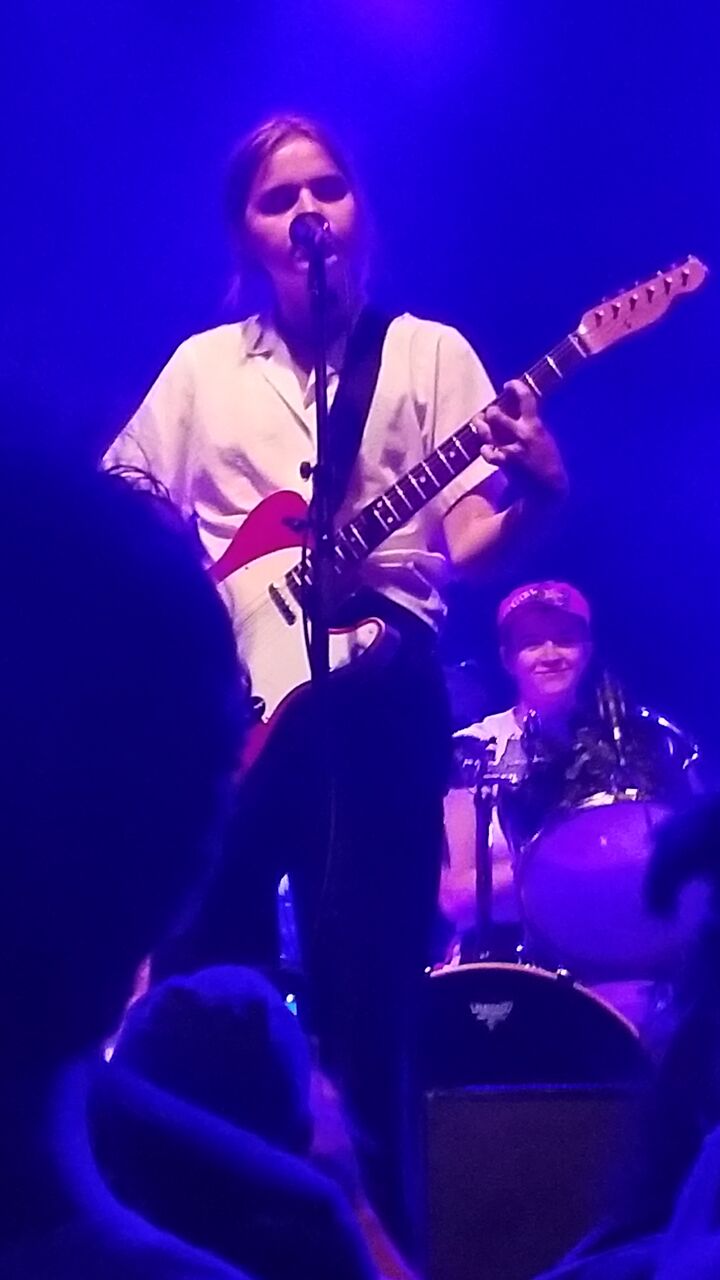
[ATTENDED: June 8, 2018] Goat Girl

Goat Girl are a massive buzz band in England.

Back in March, The Guardian had this to say:

Fearless, omnivorous Goat Girl (named in reference to Bill Hicks’s lusty alter ego, Goat Boy) found each other, and their sound, in Brixton indie venue the Windmill, signing to Rough Trade (over Domino and XL) two years ago before releasing anything. Taking their time and choosing the right home has served them well – their eponymous debut sounds self-assured: 19 songs crafted with care, in which dirty grunge riffs take strange left turns.

I was surprised that they were playing here so soon, evidently on a multi-date tour with Parquet Courts.  But they proved to be an excellent compaion band to parquet Courts since they have a punk, DIY aesthetic but don’t stick to one genre of music

I’ll let NME describe their album:

The four piece’s debut album is a grubby, clattering thing that takes its lead from 1980s LA punk trailblazers like X and The Gun Club, who took traditional country music and fed it moonshine until it fell down in a ditch, then scraped the mud off its jeans, handed it a microphone and a broken electric guitar and made it walk through broken glass to sing in a grotty toilet venue bar over a broken PA system. Goat Girl have mixed this scrappy sound with the gothic ennui of Nick Cave and the Bad Seeds and the doomy experimentalism of Tom Waits. The result is a late-night swagger through the murky underbelly of the town that Clottie Cream, Rosy Bones, Naima Jelly and L.E.D. – not, we assume, their birth names – call home, coming in at 19 swirling songs in 40 punchy minutes. It even includes a song that describes their very sound, the Pixies-esque belter ‘Country Sleaze’, thus rendering the past paragraph of me picking apart their sonics almost entirely pointless. Ah well.

Goat Girl was a lot of fun.  They played for about 40 minutes, presumably their whole album, although I didn’t know it. (more…)

Read Full Post »

[ATTENDED: June 8, 2018] Street Stains

Street Stains are from Washington D.C.  They are a duo consisting of guitar and drums.

Guitarist Chris Richards (who was in Q and Not U) plays a spare guitar and simple riffs.  It amused me that he never really took his hood off as he shouted the lyrics.

Drummer Sean McGuinness (who also plays in Pissed Jeans) played some really complex fills and kept the simple songs from growing dull.

He had some things to say about parties in Washington D.C. and how they suck (I assume as an introduction to “The Party.”

I also enjoyed that they have a song called “Street Stains” and one called “Somewhere Over the Chemtrails.” (more…)

Read Full Post »

SOUNDTRACK: CRASH TEST DUMMIES-Oooh La La! (2010).

Crash Test Dummies were once huge, then mocked and then silent.  They are still a band, although the band is really only singer Brad Roberts anymore.

In fat they were more or less broken up but then in 2010 Roberts began experimenting with toy instruments, the Optigan and Omnichord.

Those instruments were the inspiration for this music and yet the songs don’t sound like novelty or “toy” creations.  Both of the instruments were proto-samplers and they allowed Roberts to generates sounds on styles he didn’t normally play.  And so we get this interesting and fun release which features many contributions from fellow Dummy Ellen Ried, who still sounds amazing.

Roberts’ voice is still deep, but he really has his songwriting chops down well.  “Songbird” is a pretty folk song with a lovely chorus.

“You Said You’d Meet Me (In California)” was recorded as a Dummies song, although this version is more fun, with the way he sings it and the way he uses the instruments’ effects.

“And Its Beautiful” really is beautiful–it’s a very catchy song with pretty instrumentation and great backing vocals from Ellen Reid.  “Paralyzed” is a slow piano ballad while “In between Places” has some cool effects sprinkled on the song.

“Not Today Baby” is a goofy song.  Dummies have always been seen as a novelty band, and it’s songs like this that are why. But honestly, what’s wrong with having a sense of humor in your music.  This song isn’t ha ha funny but it should raise a smile.

“Heart of Stone” is the kind of sad song that Brad does so well.  Ellen Reid’s doo doo doo doo” are a lovely touch.

“Lake Bras d’Or” is a pretty ballad with minimal instrumentation, while “What I’m Famous For” is over the top.  This one has a kind of Western feel–a banjo-picking, fast-talking monstrosity.  And yet it’s a fun country ditty with some pretty funny lyrics.

Roberts talked about the big band sound of “Now You See Her” as something of an inspiration for the album–that this toy could make this kind of music and he wanted to see if he could wrote a song in that style   is a kind of big band.  It’s again, kind of a novelty, but I think he pulls it off really well.

The final song “Put a Face” is played with accordion and violin and is sung entirely by Ellen Reid.  It’s a beautiful song and a lovely ending to this unexpected disc.

[READ: January 20, 2017] “Two Men Arrive in a Village”

I usually love Zadie Smith stories–even when she writes things that are quite different from her usual style  But this one is simply odd.

The title is sort of a parable and the story reads like one as well.  It even starts as if the title is the first half of the sentence:

Sometimes on horseback, sometimes by foot, in a car or astride motorbikes, occasionally in a tank—having strayed far from the main phalanx—and every now and then from above, in helicopters. But if we look at the largest possible picture, the longest view, we must admit that it is by foot that they have mostly come…. Two men arrive in a village by foot, and always a village, never a town. If two men arrive in a town they will obviously arrive with more men, and far more in the way of supplies—that’s simple common sense.

After a fairly long setup of the things two men might carry, we find that these two men arrived in the narrator’s village at sunset. (more…)

Read Full Post »

SOUNDTRACK: GRACE VANDERWAAL-Tiny Desk Concert #751 (June 6, 2018). 

I had been listening to the All Songs Considered podcast when Bob Boilen told the below story about how he found Grave VanderWaal.  Since I don’t watch any show with anyone with talent of any kind, I had never heard of her either.

When 14-year-old Grace VanderWaal came to perform at the Tiny Desk I had to confess to her (and her mom) that, until my “accidental concert experience,” I had no idea who she was, nor did I know what America’s Got Talent was.

It all started this past February, when I went to the 9:30 Club, a 1,200 capacity music venue, to see what I thought was a show by rock guitarist Grace Vonderkuhn and her power trio from Delaware.

When I arrived for the unusually early 7:30pm show, I saw a long line of young teens wrapping around the block, mostly girls, and a fair smattering of adults who didn’t look like the regular concert goers who head to the 9:30 Club on a weekday evening. And as you’ve likely guessed by now, the show I was about to witness was not the riff-rock guitar player we’d recently featured on All Songs Considered but a very different sort of wunderkind who won the hearts of millions as the 11th winner of America’s Got Talentand, now, a Columbia recording artist.

Inside the club was a massively enthralled and enthused crowd and it didn’t take long for me, one of the few older guys in the club, to also be completely swept away by her performance. It was a dazzling show that felt fresh, sincere, bold but also simple, with Grace on ukulele singing songs such as “Moonlight,” a song about a friend dealing with mental health issues, which she also performs here at my desk.

“She always has a smile
From morning to the night
The perfect poster child
That was once in my life
A doll made out of glass
All her friends think that she’s great
But I can see through it all
And she’s about to break”

Despite what I feel is my broad love of music, I was reminded how easy it is to get comfortable in the musical confines we devise for ourselves. It’s easy to stereotype artists and perhaps be dismissive of something that falls outside our comfort zone. But Grace’s show and music reminds me to keep my thoughts and judgements open. So, if you’re about to pass on watching this one, figuring you’re not going to connect with a young teen and her music, stop. Take a deep breath, open up your heart and let Grace VanderWaal enchant you with her unique talent.

I was curious about this Grace after his story (and also wanted to make sure I didn’t make the same mistake when I saw that Grace Vonderkuhn was playing nearby in Philly ( I didn’t make that show).

So this Grace has a raspy voice, making her sound much older than 14.  But when you look at her she looks like a fragile child.  I’m not sure how poppy her recorded music is, but the ukulele-driven song “Moonlight” is fun and different, despite the very poppy overall feel.

She’s accompanied by “her beautiful beautiful guitarist” Melissa Dougherty.   Dougherty also sings great backing vocals.  Is she annoyed being the accompaniment for a 14 year old?

She says that “Darkness Keeps Chasing Me” has become her favorite–she was always told the song was too much of a downer.  Her voice is surprisingly deep in the beginning.  Indeed, she has a nice command of her voice–low and high notes.  The guitar melody is quite lovely, too.

“Clearly” is kind of a cover of Johnny Nash’s “I Can See Clearly Now.”  They thought that it was such a bright happy song and her producer thought it would be cool to add darker lyrics leading up to the happy chorus.  I don’t know the original verses I don’t think, but of course I know the song.  And listening to it now, it doesn’t need darker lyrics, but it’s fine that they’re added.

So this isn’t so much a cover as taking a really great idea and building a new song around it.

But don’t like the way the chorus has changed:

I can see clearly now, the rain has gone.
I accept all of the things I cannot change.

What did they put the AA slogan  in the voice of a 14 year old?

Plus I hate that they have modernized the delivery of the “bright bright sunshiney day.”  Part.  It sounds like  contemporary vocal melody and it’s just wrong.

So I’m mixed.  Glad I heard her.  But even more glad that I didn’t make the same mistake that Bob did.

[READ: January 12, 2017] “The Polish Rider”

This was an interesting story about an artist and Uber.

Sonia is a Polish artist–she grew up in Poland.  She is about to have a show at a gallery curated by Elena.  But she wakes in the night realizing that she has made a terrible mistake. She has allowed two of her paintings to be hung on the wall with paint on the edges.  The rest are “blank” or painted white and look clean, but these two–she is full of regrets that she allowed them to be hung as they were.

Her paintings are all variations of the same thing: the famous kiss between Erich Honecker, the leader of the German Democratic republic from 1971 until the fall of the Berlin Wall and Leonid Brezhnev, the head of the U.S.S.R. from 1964 to 1982  The iconic Socialist fraternal kiss took place in Berlin and was photographed by Régis Bossu in 1979.  The photo was ubiquitous in Kraków.

After The Berlin Wall came down, a Soviet artist Dmitri Vrubel painted the image on the East side of the wall with the caption: “God help me survive this deadly love affair.”  In March 2009 the artist spruced up the paining, which Sonia thought cheapened the whole thing.

Sonia’s canvasses all showed this kiss, meticulously done and very clean, But each canvas was done in a different style: cubist, chiaroscuro, etc. (more…)

Read Full Post »

SOUNDTRACK: DANIEL CAESAR-Tiny Desk Concert #750 (June 4, 2018).

Boy I did not like this Tiny Desk Concert at all.  I don;t like Caesar’s voice, I don’t like his lyrics and I don’t care for the backing singers.

This would be why his three most-streamed songs have a combined 249,000,000 plays on Spotify alone.  I just do not like this kind of music.

And of course it went on for nearly 17 minutes. So I’ll let the blurb say nice things

Daniel Caesar [real name Ashton Simmonds] and his band had a clear vision for their Tiny Desk performance. While already confined to a small space, they opted to congregate at the piano, where producer and music director Matthew Burnett sat to create what feels like a fly-on-the-wall moment. We’re presented a purity that’s nearly impossible to capture on an album.

The years of training in church, fused with natural talent, is on full display. Supporting vocalists Camille Harrison, Danah Martin and Nevon Sinclair are in tow for the whole ride, providing some of the richest harmonies we’ve heard at the Tiny Desk. I found myself fixated on the playful manner in which the band members interacted with each other.

I will agree with the intimate nature of the show.  He’s leaning on the piano, largely unaware of the surroundings.  And the piano sounds good. I also won’t leave out Adrian Bent on drums.

They play three songs.

“Japanese Denim”  I hate the opening lyrics: “I don’t stand in line / I don’t pay for clothes; fuck that yeas.  But I would for you.”  Good grief.

“Get You” I like the acoustic bass by Saya Gray on this track.

“Best Part (feat. H.E.R.)” H.E.R. (Gabriella Wilson) has a nice voice and they sing well together: “You’re my water when I’m, stuck in the desert / You’re the Tylenol I take when my head hurts.”

[READ: January 12, 2017] “Seven People Dancing”

Langston Hughes died in 1967.  This story was written in 1961.  It’s fascinating how a word can change in 50 years.

The story begins by telling us that “It was Marcel’s apartment and he was a fairy.”  Given my daughter’s age and the prevalence of magic-related stories out there, and the fact that no one uses that word anymore, I certainly never thought he meant that Marcel was gay.

Also telling about the fairy: “Nobody esle was unusual in that regard.”  Also, that he had inserted a “de la” in his named Marcel de la Smith as an indication of French Creole origin.  Although he had never be to new Orleans.

So it was Marcel’s apartment and seven people were dancing–three couples and Marcel.  Six of these people were colored and one was white.  “Marcel was colored, a muddy brown and not good-looking…. His dancing was too fanciful to be masculine and too grotesque to be feminine.  But everything he did was like that, so it was very easy to tell that he was a fairy.”

Marcel gave parties to mixed couples which many places would not do.  And why?  He was an old fairy who had lost interest in uniforms.  In fact, his interest now was money. That was why he gave parties primarily for people who did not touch his heart.

A few paragraphs in and a narrator enters the story who comments “the reason I say ‘perhaps’ about the white girls is that I do not know the ultimate why of anything.”  Her name was Joan and Claude had brought her.  He had introduced her to Harlem in the first place.

Hughes has a fascinating way with words.

The other couples laughed and the laughter bounced, like very hard rubber balls, around the room, not like tennis balls but like solid hard rubber balls, and Marcel laughed, too. Marcel’s laughter was like a painter’s ground cloth that protects the furniture and anything else under a ceiling being painted.

One of the men was a very dark, very handsome hard-rubber-ball man of indefinite age, maybe young, maybe fifty, but too dark to tell. (I know that he was thirty-eight). The woman with whom he was dancing was the color of green tea in an off-white cup.

But he also repeats information a lot:

Seven people were dancing, three couples and Marcel. Midnight.

It was Marcel’s apartment, and seven people were dancing. Six were colored and one was white. Marcel himself was colored, a muddy brown and not good-looking. It was he who danced alone.

Marcel’s laughter somehow cleared the air of evil and left only the music and the seven people dancing, including himself.

Otherwise, why did the laughter ring out again, louder than the music, and bounce, like a dozen hard rubber balls, around the room after 2 a.m.,

And why did Marcel’s laughter stop being a ground cloth and start bouncing like a rubber ball, too, and a very hard one at that?

The “Oh, but” identified her as having been around at least a little in Harlem, and therefore the laughter bounced like rubber balls.

This story nears its end with the dark man saying how much he wanted to dance with the white woman.  And then there’s this paragraph which I don’t understand at all.

It was a Dizzy Gillespie record, and what it said without words summed up the situation pretty well. It was not that room but the world in that room that was in the record. The music was uranium, and those seven people, had they been super-duper spies, could not have known more about atomic energy—that is, its reason for being a mighty way of dying, “Oh, but I do” being a component.

Being fifty years old and startlingly out of date, this story was hard for me to parse.  Surely the mixture of dark and white people and a gay man must speak to something–I love how progressive it is.  But why the repeated rubber balls and why keep telling us it was seven people?  This was a short piece and there was so much was repeated.

The ending was comical but serious and again, it seemed really spare.

I’m not really familiar with Hughes, so I can’t even say anything by comparison to his other work.

Read Full Post »
SOUNDTRACK: GUSTER-Live Acoustic (2013).

There was one more Live Guster release around the time of those three full album recordings.

This one is called Live Acoustic and it comes from a tour in 2012.  There’s no dates or locations assigned to the songs and indeed they are all done acoustically.

The most notable aspect of this disc is that none of the rockers are included.  This is good because it means they aren’t trying to strip those songs down.  But at the same time, it means that the disc never really takes off like a Guster show would.  It’s not all ballads, mind you–most of the songs from Easy Wonderful that are included are uptempo, and of course “Satellite” is a super fun single, but there’s nothing like “Fa Fa” or “Barrel of a Gun” or “Amsterdam.”  It speaks volumes to Guster’s songwriting skills that I didn’t even miss these favorites until I really looked at the track listing.

They include songs from all of their albums (except Parachute which was all acoustic) and a “deep B side” from the Satellite EP.

For the most part these songs sound great in an acoustic setting.  My only quibble is that some of the songs have really great orchestration which I miss (but that’s personal preference I suspect).  A bunch of the songs have strings which are a nice addition, especially on a song like “Either Way” and the amazing wild violin solo in “Satellite.”  This reminds me of when we saw them with Kishi Bashi and he played the violin on “Satellite”

The one really nice factor is that with everything stripped away, the guys’ voices sound really powerful.  And as I say, because the tone is somewhat mellow the song selection works to this and you don’t miss the bigger songs.  Plus any show that ends with “This Could All Be Yours” is a great one.

  • Backyard [KEEPIT]
  • Do You Love Me [EASYWON]
  • Long Way Down [KEEPIT]
  • That’s No Way to Get to Heaven [EASYWON]
  • What You Call Love [EASYWON]
  • Beginning of the End [GANGING]
  • Diane [KEEPIT]
  • Rocketship [GOLDFLY]
  • Empire State [GANGING]
  • Rise and Shine [SATELLITE EP]
  • Two Points for Honesty [LOSTANDGONE]
  • Either Way [LOSTANDGONE]
  • Satellite [GANGING]
  • Rainy Day [LOSTANDGONE]
  • Hang On [GANGING]
  • This Could All Be Yours [EASYWON]

[READ: January 19, 2017] “Maybe It Was the Distance”

I enjoyed this story so much, I could have read twice as much (and it was pretty long).

This is the story of a Jewish family: Irv and his 43-year-old son (Jacob) and 11-year-old grandson (Max).  It begins very amusingly with them heading to the Washington National Airport (they refuse to call it Reagan National).  Irv also hates NPR (which they were listening to) because of the flamboyantly precious out-of-no-closet sissiness and the fact that they had a balanced segment on new settlement construction in the West Bank.

The first half of the car ride devolves into an argument between the three of them about opinions and Jewishness.  Jacob is frustrated by his father and Max is both precocious and still a child–it’s all very funny.  Especially when they argue while the light is green.

They were heading to the airport to pick up their Israeli cousins.  They were picking up Tamir, who was Jacob’s age, and his son Barak.  Jacob and Tamir’s grandfathers were brothers in a Galician shtetl that was overlooked by the Nazis.

Issac (Irv and Jacob’s family) moved to America while Benny (Tamir’s family) moved to Israel.  They would visit every few years.  Isaac would show off his American lifestyle and then spend two weeks complaining about Benny after they’d left.  And then Isaac died (he had outlived cancer and Gentiles). Tamir surprised everyone by coming in for the funeral.

Jacob discussed Isaac with Tamir and said that basically he did exactly same thing every day (and the details are very funny, if not sad). (more…)

Read Full Post »

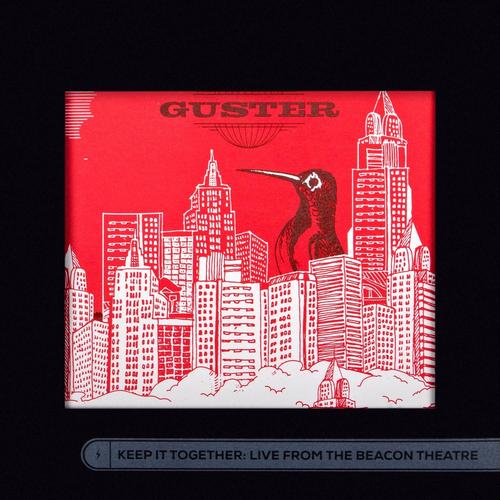
SOUNDTRACK: GUSTER-Keep It Together Live from The Beacon Theatre (2014).

In 2014, Guster released three CDs of them playing their early CDs live in their entirety (excluding for some reason their second disc Goldfly).  This is their fourth CD ‘Keep It Together’ recorded live in concert at The Beacon Theatre on November 30, 2013, ten years after its release.

As the disc opens, Ryan shouts, “Keep It Together starts now.”  This makes me think that they played other songs before it?  It would be great to hear an album in its entirety but not if that’s all they played.

After the first song, “Diane,” Ryan jokes,  “I guess there no real surprises in the setlist from here on out.”

Midway through the show, he comments that as an active band making new music, you want to be careful not to trade in nostalgia.  But he also knows that if one of his favorite bands played one of his favorite albums…it would be magical.

The band sounds great.  And, fortunately, it’s one of those shows where the live recording sounds at times even better than the original.

The only real divergence from the album is that after “Homecoming “King” they play “Chariots of Fire” on piano and strings.  I’m not sure why, but it’s fun.

One of the great moments of any Guster concert is when they play “Come Downstairs and Say Hello” and the Thundergod plays the bongos and smashes the cymbals with his hands.  It’s more fun to see it, but it’s great in this case to hear it.

“Red Oyster Cult” sounds great with the horns as an addition and Ben Kweller comes out and sings lead on the first verse of “I Hope Tomorrow is Like Today” (I had no idea he co-wrote it!).  They even leave a slight pause for the “hidden track” of “Two at a Time.”

This is a great version of this album, and well worth the listen.

[READ: June 2, 2018] “Fungus”

This is a story about carrying on after the unthinkable. But not just carrying on, carrying on with the mundane things that you can’t live without but remind you of exactly what happened.

The story opens with an insurance check and talk of geckos.  But the tone is not lighthearted like Geico commercials.  Andrew has access to Ingrid and Ron’s car, but really, he can only borrow it for so long.  It is time to buy a new one.

So Andrew and his daughter Willa go to the Subaru dealer.

These two scenes are simple enough, but they are fraught with meaning–with the undertone of what happened and how Andrew is allowed and allowing himself to deal with it.   There’s darkly funny thoughts (he’d like a homemade sign around his next that says “I don’t know”).  But the reality is that he has to go on for Willa’s sake, if not his own.

And then there’s this idea which is perfect for the story but works wonders in everyday life: (more…)

Read Full Post »

[ATTENDED: June 3, 2018] Japanese Breakfast

Japanese Breakfast is the creation of Philadelphia-based Michelle Zauner.  She sings pretty melodies and has a variety of tones when she sings–some high-pitched notes and some lower parts as well.

A lot of bands celebrate in some way when they play a home town.  Sometimes its an extra song or a guest.  I don’t really know how this show deviated from other in terms of set list, but Zauner had a lot to celebrate being back at Union Transfer.

[Quotes and quoted passages are from an article in The Key

“I fucking used to work coat check here,” Zauner told the audience as she gazed into the sold out crowd at UT.

She said this just after she’d sung her first song “Diving Woman.”  It was the first time she had headlined Union Transfer.  She said she felt a bit shy playing here because so many friends and family were in attendance.  And she talked a lot about her connections to the city.  She graduated from Bryn Mawr college and she recorded both Japanese Breakfast albums in Philly.   (more…)

Read Full Post »

[ATTENDED: June 3, 2018] LVL UP

I had two ideas of what LVL UP sounded like.  I thought they were either a punky crazy band or were a poppy band.

Turns out they were neither.  They’re more punk than pop, but there’s a kind of a DIY quality to their music more than anything polished.

I was also delighted to see that they have three singers (and I assume songwriters) as well.  For this show, they basically went around the horn with who sang lead.

Bassist Nick Corbo started off with “Angel From Space.”   He was followed by guitarist Mike Caridi with his more angular song “Blur.”  Then came second guitarist Dave Benton with his more chill sounding “Soft Power.”

The only one who didn’t sing was drummer Greg Rutkin.

Then they repeated the cycle.  Nick Corbo with his big old-fashioned looking bass played the slower “Five Men on the Ridge.”  Back to Caridi with a new song (all the others are, I believe on their new album.  It was followed by Benton’s “I Feel Extra Natural” which references the Silver Jews.

They went through the cycle of singers one more time and then played a couple more songs at the end.  It was cool that they kept things moving and all sounding pretty different while maintaining their overall vibe.



Read Full Post »

[ATTENDED: June 3, 2018] Radiator Hospital

Radiator Hospital is a Philly band led by Sam Cook-Parrott.

They write short, punky songs with Cook-Parrott singing most of them.

In an interview he said

Usually, I write simple songs so we can learn them quickly and then play shows. But then six months after we recorded it, we will look back at the recorded version and think we play [those songs] much better now after playing at shows all the time.

(more…)

Read Full Post »

« Newer Posts - Older Posts »