 SOUNDTRACK: LISA LEBLANC-Live at Massey Hall (June 6, 2015).
 I thought I didn’t know who Lisa LeBlanc was, but it turns out that I knew her song “5,748 km” from a NPR episode. How funny.
LeBlanc thanks Massey Hall for putting her on and for supporting new artists. It’s so legendary, she can’t imagine what’s going to happen right now.
The show, in which LeBlanc opens for Spirit of the West, opens with this formal introduction.
Welcome to Massey Hall. To get the night going when you have a band like Spirit of the West who is dynamic and fun, who else can you bring to match that kind of excitement? Please welcome to the stage Lisa LeBlanc.
She walks out on stage, grabs the banjo and plays a slow banjo melody. After a beat or two she starts whistling a forlorn melody–a perfect Western-sounding instrumental (her whistling is very impressive).
Her whistling is great.
Then she gets a sly look and starts playing her banjo a little faster. And then completely unexpectedly (to me anyway) her drummer (Maxime Gosselin) and baritone guitarist (Jean-Phillipe Hebert) start trashing like lunatics. “Gold Diggin’ Hoedown” is a song that perfectly meets what her style is called: “trash rock” It is crazy and fun.
She says she grew up in New Brunswick playing music in the “kitchen party” scene. She played with her uncles in the garage instead of going partying with the cool kids. “I was kind of a loser.”
The next song is in the same style, but it is sung in French. “Cerveau ramolli” which she translates as “My Brain is Mushy.” This song is totally rocking with great thumping floor toms.
I can’t find the names of all of the songs (usually the video names them, but not this time). There’s another song in French.
She switches banjos and then talks about “Katie Cruel,” a song that no one knows where it came from and it’s her favorite song of all time. There’s a quiet part in the middle with just banjo and then nearly a capella before rocketing back to life.
She gets a new banjo and sings quietly over gentle picking:
Don’t try to figure out what’s going on his head / he ain’t trying hard to see whats going on in yours…. I love these lyrics:
He’ll give you the shirt off his back but he wont give you his heart.
She tells the audience she’s from New Brunswick. Cheers from half the crowd. Then she says she’s from a town of 51 people. She was trying to date someone from Vancouver. Canada is really big. This is an introduction to “5.748 km” in which she plays guitar instead of banjo. It’s a spoken/sung song.
She says “Let’s talk about cowboys” and then sings a song in French called (I believe) “J’pas un cowboy.”
For the final song she says the title “You look like trouble but I guess I do too” is quite self-explanatory. After a few verses they take off. That baritone guitar is so low and rumbling. Things slow down in the middle where she plays a great banjo solo and then the sing thrashes to an end.
Over the credits she sings part of one more song this time with electric guitar.
LeBlanc is multi-talented and a lot of fun. She’d be an excellent opener for anyone.
[READ: June 2, 2018] “Mum’s the Word”
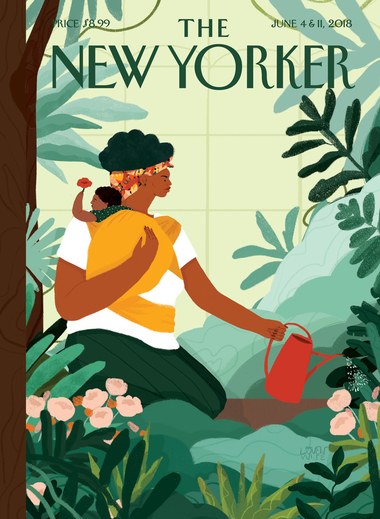
This issue of the New Yorker had a section entitled “Parenting.” Five authors tell a story about their own parents. Since each author had a very different upbringing the comparison and contrasting of the stories is really interesting.
This is a funny (sort of) essay about being a parent and how “as a parent I spend a good amount of time talking about things that don’T interest me like My Little Pony, or pasta, or death.”
The death part is funny because her four-year old daughter is suddenly obsessed with it. But in unusual ways: “When I die…I want to die in Egypt so that I can be a mummy.” After half paying attention, Rivka nods assent then her daughter says “Mummies make other mummies. With toilet paper.”
It’s only after a few seconds of processing that Galchen realizes what her daughter sais and corrects her. Hearing this correction her daughter say, “If I have to die, then I don’t even want to exist.”
Galchen says she was not preoccupied with death as a child preferring Threes Company. Even when her father died, no one in her family became preoccupied with it. “You won’t find a photograph of my dad on the wall at my brother’s apartment or at my mother’s. We excel at ignoring ghosts.”
But her daughter persists: “Do you know anyone who is died?” After a list of who is dead, there is a follow up. There is always a follow up . But this time:
“Laetizia says she can cut her own nails now.”
They go to visit Papa who is visiting an old friend who is bringing her new boyfriend. These two were brought together because they both had dead spouses. They mention a mutual friend who married someone whose children did not not know that her husband had a dead wife (or that he had children with the dead wife).
They all agree that you need someone who will let the ghost be in the room.
This brings back memories of her dad.
She wonders how we can learn things from our children when really, they know nothing.

 I Just Read About That...
Leave a comment