 SOUNDTRACK: THIRD COAST PERCUSSION-Tiny Desk Concert #747 (May 29, 2018).
 I have always been taken with percussion. I especially love vibes and marimba. But I love it even more when bands make music using unusual items. Third Coast Percussion does both of those. And the songs are beautiful as well.
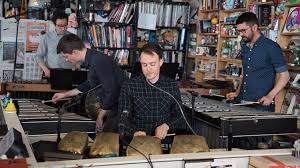
The quartet of gentlemen who form the Chicago-based Third Coast Percussion [will] play their sophisticated, modern marimbas and vibraphones, but be on the lookout for the subtleties of tuned cowbells and 3/4″ galvanized steel pipes, like those found at the local hardware store. Add to that a glockenspiel, a MIDI synth, a melodica, a drum kit, children’s deskbells, crotales, a Thai gong and a singing bowl, and you’ve got significant noise-making potential behind Bob Boilen’s desk.
They play three beautiful pieces. And the blurb sums them up quite well:
The mesmerizing opening number, “Niagara,” written by the group, is from the band’s latest album, the aqua-centric Paddle to the Sea. This water is fast-moving, with pulsing, repeating patterns in the vibraphone, punctuated by drum beats and a bed of low synth.
David Skidmore behind the drum kit is also playing the synth while Sean Connors has the main up and down melody on the marimba. The other two (Robert Dillon and Peter Martin) are playing the same glockenspiel until Rob starts with some drum hits (while David behind the kit plays accents of that main drum beat). There is just so much going on!
There’s a wonderful moment about half way in when the marimba starts playing a slightly different melody and it’s really quite enchanting. I am quite taken with the song.
The Third Coasters follow with another from the album, their own arrangement of a slowly rippling ode to the Amazon River by Philip Glass. Beginning with droplets on the glockenspiel and evocative bowing of both vibraphone and crotales (small bronze discs), the music flows softly, taking its time to fan out in all its quiet beauty.
The group busts out the children’s desk bells on the second song, a cover pf Philip Glass’ “Amazon River.” Sean plays them while also hitting the glockenspiel. David is bowing the crotales (which he later hits with mallets) while also playing a melodica. Rob plays a four mallet marimba while Peter plays a four mallet glockenspiel melody. Sean gets to hit the Thai gong before it almost stops and then he goes behind the marimba to join Rob with three mallets. Meanwhile for thee second half of the song, David is hitting some small bell-like instrument and Peter has the singing bowl. As the song ends, David gets to conclude with the Thai gong.
The final song is completely intense.
Torched and Wrecked is, as David Skidmore mentions, something that once happened to his band mate Sean Connors’ automobile. It’s also a butt-kicking ride that includes those steel conduit pipes, which the band cuts to specific lengths to get the desired pitches. Skidmore wrote the piece, but it’s Connors who appears to achieve a kind of cathartic glee pounding on the metal tubes.
There’s no funky instruments om this, but the song is great. David (2 mallets) goes behind the marimba with Rob (4 mallets). Peter is at the glockenspiel (4 mallets) and yes Sean has the metal tubes. The song is fast and intense and I get lost with just who is playing what sounds by the end. It’s really cool.
It’s also fun to see them all pop up at the end when they all finish at the same time.
[READ: January 14, 2018] “Six More Considerations”
Lydia Davis writes short, short pieces. Flash fiction, they call them. Sometimes I think they are great. Other times they just irritate me.
This group falls into the irritation camp.
Anyhow, the six stories are
“The Cornmeal”
Two sentences about condensation.
“Dinner”
This one is kind of funny. A dreamlike state about having to make dinner for friends–when your bed is in the kitchen.
“The Dog Hair”
This is a sweet, sad story about your dog being gone but finding dog hair all around. How much is there?
“The Language of the Telephone Company”
The trouble you reported recently is now working properly (that’s the whole thing).
“The Song”
I can’t decide if it’s genius or madness to start your story with “Something has happened, in a house, and then something else has happened, but they have been inconsequential things. Especially when that is 1/4 of the story. A singing man is silenced with two words.
“The Party”
This story is longer than the other five combined. And yet it might be more confusing than the rest. She drives to a windmill and goes in to find a carousel and horse-drawn carriages. I guess this is a dream diary of some sort?
The irritation for me comes that these pieces which are little more than diary entries are lauded so highly. And yes, they are called Considerations, but come on.

 I Just Read About That...
Leave a comment