 SOUNDTRACK: TED LEO-Tiny Desk Concert #680 (December 4, 2017).

Up until now, I have more or less missed Ted Leo and all of his phases. The blurb notes:
How you listen to Leo depends on when his work came into your life. If you’re a back-in-the-day type you might rep for Chisel, his ’90s punk outfit born on the Notre Dame campus and bred in Washington, D.C. If you’re just tuning in, you may have witnessed his understated comedy chops in arenas like The Best Show on WFMU and a highly enjoyable Twitter feed. At the center of this bell curve are those who found Leo at the dawn of the 2000s — when, at the helm of what’s most commonly called Ted Leo and the Pharmacists (shout-out to the typographical variants still mucking up iTunes libraries), he kicked off a run of five stellar albums in just under 10 years, each one urgently attuned to its political context and yet defiant in its ideas of what punk could sound like and whose stories it could aim to tell. Fans will tell you the songs about eating disorders and missing old ska bands felt just as vital to their moment as those that explicitly took on Sept. 11 and the Iraq War.
I know Ted Leo from when he played with Aimee Mann as The Both (they did a Tiny Desk show) and I am aware of Ted Leo + Pharmacists (the above mentioned typographical variant), but I somehow never really heard him/them. I didn’t even know he was a Jersey guy. (My friend Al is a big fan, I recently learned).
Recently, WXPN has been playing his new song “Can’t Go Back” which is wonderfully poppy and catchy and which I sing along to each morning. Leaning more about him (and how funny he is in the Tiny Desk show) makes me want to see what I’ve been missing.
I obviously had no idea about his punk past, so I was pretty surprised to hear the feedback and heavy guitar of the first song here “Moon Out of Phase.” Leo sings pretty hard on this song, too. It’s fairly simple musically, but there’s a bunch going on lyrically that’s fun to pick out.
[After] the bone-rattling slow burn “Moon Out of Phase,” he smiled and explained the song was perhaps “a little heavy for noon — but, practically speaking, it helps me get the cobwebs out.”
“Can’t Go Back” couldn’t be more different. It’s catchy and not at all heavy. It has backing vocals (provided by Leo himself) and just swings along.
It’s a bit faster than on record, and as the blurb notes:
By the time he hit the first chorus of “Can’t Go Back,” a danceable bop about accepting that the life you have isn’t quite the one you planned for, any remaining cobwebs had been scattered to the wind.
Interestingly for being such a guitar based guy, there;s no solos on the songs (and yet they’re not short either, the first and third songs are about 4 minutes long). Rather than a solo on “Can’t Get Back,” there’s a cool guitar chord progression.
He seems unsure of the quality of that song (not sure why–because he doesn’t hit those high notes perfectly?) But then says he’ll finish off with a request. “I’m a Ghost” is an old song that he doesn’t usually play solo, but figured he would because of the time of year (guess this was recorded around Halloween).
He tells an amusing story about someone asking about the first line: “I’m ghost and I wanted you to know its taking all of my strength to make this toast.” The person asked if the toast was “a toast” or a ghost pressing the lever down on a toaster and “the hand of the frosty apparition is just going through the thing.” He says it was originally “a toast” but now it is absolutely about the toaster, that’s the greatest metaphor for so many things.”
It’s really about “alienation from the political process.” It’s more rocking, like the first song, but with a catchy chorus like the second song. This is a fun set and a good, long-overdue introduction to Ted Leo.
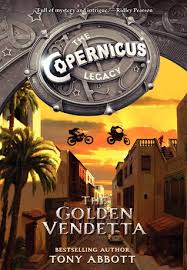
[READ: April 6, 2017] The Golden Vendetta
This is the third full-sized book in the Copernicus series. It follows the mini-book about Becca.
I enjoyed this book more than the second one. I enjoy the sections where they have some downtime and aren’t just running around. And there was more downtime in this book. I was also really intrigued by the way it began.
The families had been reunited and them separated. So Darrell and Wade and the adults Kaplans were living in a hotel under an assumed name. And Lily and Becca were also together under assumed names–but they were not allowed to contact the boys. This went on for two months.
In that time Galina Krause had been inactive. We learn that she had been in a coma, but the good guys never find that out, they’re just in the dark for months.
Until Galina wakes up and is on the move again. And then everyone is on the move.
The families travel under assumed names but are still followed relentlessly by the bad guys.
There was a pretty large amount of death in this book, which leads me to think it is geared to a slightly older audience. A man is killed on a train. He has a mark on his wrist which shows he is working for Ugo Branheta, a man who means trouble.
And then there’s the main nasty plot by Galina–it involves a sunken Russian nuclear ship, which can’t be good.
The family does some search for the next relic. This time they are in France. Then they are off to Monte Carlo where an auction is taking place. I enjoyed this section especially because the item up for auction is a pair of special glasses which Leonardo da Vinci made for Copernicus. The whole auction sequence has some of the things I like best about Abbott–humor and seriousness with educational aspects too.
Through a fairly confusing scene [actually, many of Abbott’s battle scenes are hard to follow], Becca winds up with the glasses. She is able to use them to read some strange silvery parts of Copernicus’ diary.
The family has some important connections, of course, and through them, they meet some of the best characters yet–British pilots named Bingo and Pinky–who are pretty funny and reckless and offer some much-needed comic relief (even amid the danger which follows them).
During all of the fleeing, Roald and Terrence Ackroyd go off to investigate something else. This of course means that they are danger and are utterly cut off from everyone else. Normally I don’t like this aspect of these mysteries, but since the family wasn’t looking for him, having two separate dangerous missions was cool.
So Sara and the kids are now in search of four keys to help open the lock where the next relic is hidden. They also wind up splitting up to each find one key. And then as the book draws to a close, once again Galina and her men are there to make it difficult for them.
This would make a fun movie because of all of the locations. I’d love to see the historical mosques and places that they go, although the book it feels too much like fly, flee, find, fly, flee, find.
One new thing in this book was with Lily. Lily’s parents are having marital issues back home. And she absolutely does not want to deal with that. But it is weighing on her mind, obviously. And it’s making her lose focus. She’s really distracted and feeling useless as a member of the group. As the book draws to and end she needs to decide if she is going to continue with the quest or go home with her parents as they move to Seattle to start anew.
And while the end of the book had a twist and a cliffhanger, those things weren’t that dramatic. However, there was an awesome revelation in the last few pages–of a colonel–that actually made me gasp out loud.
At this point in the series I have a few questions, some of which I’m sure will be answered in the final book.
What is up with Galina? I can’t wait to see what the revelation is about her–for a time I considered that she might be one of the children from when Becca went back to Copernicus’ time.
How does she keep finding them so easily? This is the most frustrating aspect of the story. She is either supernatural or we are meant to believe that her super spy network is powerful as she says.
Some questions that will likely be unanswered:
Why did Becca’s flashback/time travel cease?
And this one that’s bugged me now for a while. It seems pretty likely that if the family didn’t search for the relics, then Galina would never find them. She seems to be relying on them to find most of the pieces. So if they simply stopped finding them (and going through all of the clues that she could never figure out), wouldn’t it prevent her from getting them?
The fourth clue from the relic at the end of the book was so complicated that Galina would never have figured it out. And evidently it was rigged so that if anyone tried to get it by not using the proper method, it would self-destruct, or something. So shouldn’t they have just left it alone? Or destroyed the key knowing she could have never gotten it? It seems like putting things in utterly obscure and impossible to figure out hiding places is better than putting them in their pockets or even a bank vault.
Following that logic, I realize there would be no story there, but the number of times that they have just handed Galina things makes it seem like they’re doing more harm than good.
The final book is also massive. I am very interested to see how the series ends, but Ii need to take a rest and read some other things for a while.

 I Just Read About That...
Leave a comment