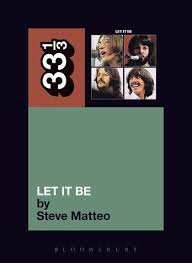
 SOUNDTRACK: THE BEATLES-Let It Be (1970).
 I wrote about this album back in 2015.
Of all the fascinating details about Beatles releases, I don’t think any are more fascinating than the details about Let It Be. I’m not even close to understanding everything that went on here. But in a nutshell, it seems that they went into the studio to record an album called Get Back. They were even going to film the whole things. It got scrapped. Some members quit the band then rejoined. And then they recorded Abbey Road.
And then the band did a concert on a rooftop (almost exactly 46 years ago!). And soon after they broke up. Then some producers decided to release Let It Be as a soundtrack to the documentary made about their recording. They used some of the material from Get Back and some from the rooftop concert and then Phil Spector got involved and put all kinds of strings on everything and then the album was released in the UK on my first birthday.
There’s lots of snippets of dialogue which seem designed to make it feel like a soundtrack (which it doesn’t). There’s really short snippets of songs, there’s raw live songs, there’s overproduced string laden songs. It’s kind of a mess. But in there are some good songs too.
“Two of Us” is a pretty folkie number that I like quite a lot although I first became familiar with it from a Guster cover (which is pretty fine). I never quite understood the title of “Dig a Pony,” but it’s a big weird sloppy song. It’s kind of fun to sing along to—especially the falsetto “Beeeecause.” This song was recorded from their rooftop concert and it feels rawer than some of the other songs.
“Across the Universe” is a lovely song. Evidently Lennon didn’t contribute much to Let It Be, so they threw this on to give him more content. I actually know this more from the Fiona Apple version (which I think is actually better than this processed version). I don’t really care for the strings and echoes feel on this version. “Dig It” is a short piece of nonsense. It was exerted from a lengthy jam but for some reason only this little snippet was included on the record–it sounds odd here.
“Let it Be” is quite a lovely song. I don’t really care for the Phil Spectorisms that were done to it—the strings and choruses seem a bit cheesy. At the same time, the guitar solo (which is quite good) sounds too raw and harsh for the song. “Maggie Mae” is a traditional song, another bit of fun nonsense. I like “I Me Mine,” it’s rather dark and the chorus just rocks out. “I’ve Got a Feeling”, was also recorded on the roof, so it feels raw. There’s some great guitars sounds on it. Evidently it was initially two songs, and Lennon’s part (the repeated “everybody” section) was added to it.
“One After 909” sounds so much like an early Beatles song–very traditional rock and roll (which means I don’t really like it). Although the version is raw sounding (it was also recorded from the rooftop) so that’s kind of cool. Huh, Wikipedia says “the song was written no later than spring 1960 and perhaps as early as 1957, and is one of the first Lennon–McCartney compositions.” “The Long and Winding Road” is where all the controversy comes from. McCartney hated what Phil Spector did to his song. He HATED it. And I have to agree. It sounds nothing like the Beatles–it sounds very treacly and almost muzaky. It feels endless. At the same time, I’m not even sure if the song is that good–it’s so hard to tell after all these years. I think it kind of rips off the transition in “Hey Jude” which was used to much better effect.
“For You Blue” is a simple blues. I like it better than most of the Beatles’ blues, perhaps because of John’s slide guitar (and the funny comments through the song–which makes it seem like the band actually liked each other). “Get Back” ends the disc as a fun rollicking romp. I really like this song, although I’m surprised at how short it seems–I thought there was a lengthy outro. The end of the song (and the disc) has John asking if they passed the audition–lots of fun going on in this contentious recording session.
So it’s not the best career ending disc, although I guess as a soundtrack it’s pretty good. I’ve never seen the film, and I’m kind of curious to after having walked through all of these Beatles albums.
[READ: September 1, 2016] Let It Be
After reading Colin Meloy’s take on The Replacements’ Let It Be, Steve Matteo’s take on The Beatles’ Let It Be is really different.
Matteo did a ton of research into the recording of this record. Indeed, this book feels really long (and it drags occasionally). I have to assume that anyone who is a big fan of The Beatles will know much of what he covers here. I didn’t, so this works as a pretty thorough introduction for me. And, as my review of the record above notes: I didn’t know much about the recording in the first place. So this filled in some gaps (more gaps than I cared about actually).
The book begins with the earth shattering announcement that in 2003 police had recovered more than 500 hours of stolen tapes from the Let It Be sessions (I hadn’t heard about that, so I guess it didn’t shatter the earth all that much).
Rather than talking about this record itself, Matteo talks all about what went into the creation of the record. And, admittedly, it is a fascinating mix of ego, talent, angst, friendship, overworked-ness and nearly everything else.
There is talk of weddings and breakups, of divorces (and Paul writing “Hey Jude” for John’s song Julian as his parents were getting divorced). There is talk of George getting married and coming to the recording with a big pile of quality songs. He had been pushed to the side by the Lennon-McCartney juggernaut. There’s also John and Yoko (and how they released Two Virgins just a few days after The White Album). The only one who seemed to give nobody any shit was Ringo.
There was also the problems of the business of Apple. A poorly run organization if ever there was.
To complicate everything–including the tension between the band members–when they started their recording sessions they were going to be filmed pretty much all day. Reality TV before such a thing existed. This was going to be used as a film or TV show or something (it eventually became the movie Let It Be).
Matteo is very thorough about all of this–detailing who was on the film crew, what kind of instruments the guys used, how the film was tracked and recorded. Several named are mentioned several dozen times. The only one that I found interesting was Alan Parsons. I didn’t know that he was a young worker at Abbey Road and was also there for the rooftop recording.
The early sessions at Apple weren’t great. The filming was fine (and I gather the band was nice to everyone) but mostly they just jammed a lot–they hadn’t played live in a couple of years and were finding their footing with each other).
At around this time the band was also looking to create its own studio–Abbey Road was very prim and proper–not to The Beatles’ liking. There’s a pretty fascinating section about how Abbey Road did not like to do loud bass–even though they had the technology–because it wasn’t suitable for hi-fi standards. People would bring American records with lots of low end and the Abbey Road looking for that sound, but the engineers balked at them–it wasn’t proper-sounding. So The Beatles hired someone to make a studio in Apple. But he botched it something fierce. So they had to use most of the Abbey Road equipment anyhow.
Those dates were filmed as well. The band worked on a few new songs and played more covers. They even did the rooftop show. Matteo gives a concise account of the rooftop show. I found it interesting and fascinating to read about–how exciting it must have been to be there walking to lunch and then The Beatles are playing in the town?
George quit during some of these sessions. Then he came back. The guys brought in Billy Preston to play keyboards on some of the sessions (including the rooftop concert, which I didn’t know). Preston is also credited on Get Back which was released as a single as “The Beatles with Billy Preston.”
The incredible thing really about all of this is that the band was in the studio at all. They were obviously unhappy with a lot of things (although they did seem to enjoy playing together, still). They had recorded so much output in such a short span of time and, even though they hadn’t played live together in some times, it’s not like they had been idle.
The band released Sgt Pepper in May 1967, Magical Mystery Tour in November 1967, The White Album in November 1968, Yellow Submarine in January 1969, Abbey Road in September 1969 and then Let It Be in May 1970. That’s six records in three years. No wonder they were cranky. There’s even a line in the book, and I can;t tell Matteo’s tone, but it seems like people were shocked by the delays from the band.
The single of “Get Back” with “Don’t Let Me Down” on the flip side, was released on April 11, 1969…it marked the first single released by the Beatles since August of 1968.
That is eight months without a single. Seriously guys, let up a bit. The end of the book talks about how even with bad press and poor reviews from England, Let It Be sold more pre-orders of any album ever. People wouldn’t have forgotten about The Beatles if they had taken a year off.
So the sessions that they recorded yielded songs for Abbey Road which was intended as one type of album. Get Back was supposed to be a more back to basics album. It eventually became Let It Be–a soundtrack to the film.
Through some interesting machinations, Phil Spector was brought in. He has recorded “Instant Karma” for John and John loved it So he encouraged Spector gto get involved with their recordings. Matteo loves Spector quite a lot (more than I do), but he also shares that Spector did some things to really piss off Paul.
But the album still managed to get released. And Paul emphatically stated that The Beatles would never record again.
Matteo talks about the break up using some people who were around all those years ago.
Don’t blame Yoko, although it seems that Yoko encouraged John to move on. John probably didn’t want to be a Beatle anymore but he didn’t have the impetus to leave. Matteo also says that Let It Be is not what broke up the Beatles, despite Paul hating “The Long and Winding Road.” Matteo posits that Alan Klein was most responsible for the breakup. He came in after their manager Brian Epstein died and his heavy-handed tactics pushed things along a clip that disintegrated the band.
The final chapter is all about the multitude of bootlegs surrounding the Get Back sessions, with a small diversion about Let It Be… Naked (which Matteo doesn’t seem to like, although I do).
So this proved to be very informative (sometimes too informative). There’s a lot about the recording sessions surround the album but not a ton about the album itself (even though they are clearly linked). I learned quite a bit. I did not know that it won awards as a soundtrack album which is fascinating in itself. It also helps to clarify their timeline a little bit, too. It also makes me wonder if I would enjoy Harrison’s solo output (I have simply never gotten over “I’ve Got My Mind Set on You”).
Although honestly I think it would be fascinating to see the Beatles’ full output (including solo stuff) plotted on a timeline. I’m sure such a thing exists. It’s amazing how much they accomplished in such a short period of time.

 I Just Read About That...
Leave a comment