 SOUNDTRACK: RHEOSTATICS-Calgary Folk Fest, Calgary, AB (July 1996).
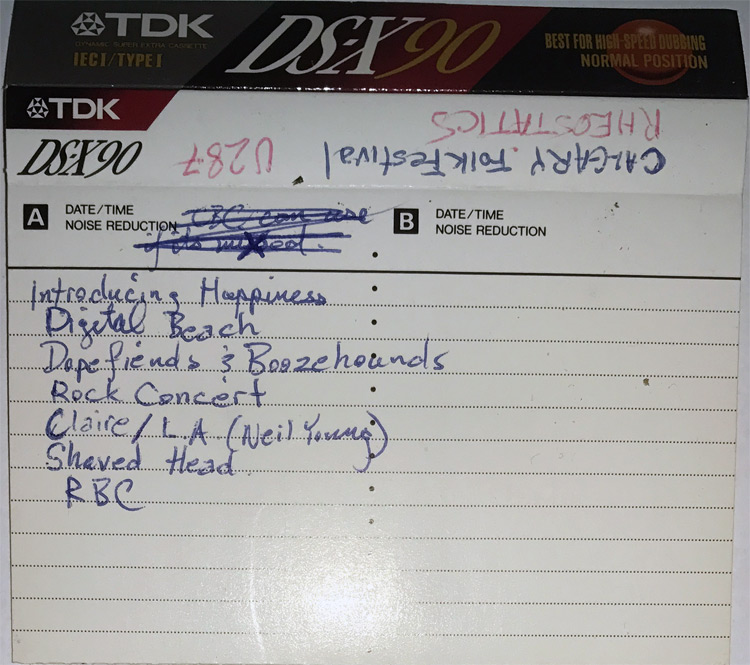 1996 is an interesting year for Rheostatics Live recordings. In addition to this Folk Festival show, there’s a show they do at their old high school. And then there are many shows with them supporting The Tragically Hip.
This is an acoustic set from July 1996 at the Calgary Folk Festival – don’t know exact date. It features Martin Tielli, Dave Bidini and Tim Vesely. There is no drummer though Tim does play a bit on My First Rock Concert. Dave Allen plays violin on Shaved Head and RBC and Dan X of the Rhinos and played drums on RBC. It’s available here.
The introduction is a nice one: “My favorite eastern band… the Rheostatics.” Dave jokes, playing like you’ve never seen them before.
Teh show (which is fairly short) sounds very different. It’s all acoustic and they seems to have created special arrangements for the songs.
For the first few songs it’s just Martin, Dave and Tim. They open with “Introducing Happiness.” There’s a few sloppy moments near the end but otherwise it’s a very interesting version. Tim says it’s “a song for my cats back home.”
Dave dedicates the second song (a delicate “Digital Beach”) to Graham James and his wife who drove out here “from somewhere in Saskatchewan to come and see us play and to take in the weekend and the festivities.” He asks, “any other people from Saskatchewan? We love that place. We love Melville.
There’s a long intro for a mellow “Dope Fiends” that features some really great harmonies. It’s very loose and fun with the guys shouting out lines. It feels like a real campfire version.
After the song Martin says, “It’s hard to sit down.”
Dave: “You like sitting down?”
Martin: “Not particularly.”
Dave: “Me neither”
Martin “I’m squirrely as hell.”
Dave: “We thought if we sat down for once it would be a whole new thing and catch on. But we plan to get up later for the show-stopping finale.”
Dave plays “My First Rock Show” (one of the earliest times I’ve heard it played live). He says, “This is a song about attending a rock festival. This is folk festival. The song is the first time I went to a rock festival. It was at the CNE (Canadian National Exhibition). As the song starts he says there’s a Janis Ian kind a feel happening.
After Dave sings the “Took away the car keys” he says, “Timmy, get on the drums there, brother.”
After the song Dave says that earlier today we saw a young fellow with a tattoo. A Rheostatics tattoo! It’s not real, it’s magic marker. But you gotta show it off! You rubbed it off? Aw!
“Clarie” goes out to James Meritetch (?) There’s a kind a classical opening and after the solo Martin segues the song into Neil Young’s “L.A.”
And then the guests start coming. Dave says “A friend of ours from Kingston Ontario, a noted member of the drinking band The Mahones, Dave Allen the doctor is in the house…. well …park. We haven’t played with Dave for four years–he was on Whale Music. He says they didn’t expect to see hm but he showed up at the festival and “they lassooed him, as you do.” They play great, moody acoustic “Shaved Head.”
Then Dan Michell, Dan X of The Rhinos from Guelph and Kitchener–everyone here from Ontario is on stage now. They play an interesting folkie “Record Body Count” with a violin. There’s an electric guitar solo. Interestingly, they end with an extra chorus. And then they are gone.
The announcer says, “The Rheostatics!” … “A drum stick!” … “The Rheostatics!”
It’s one of their more interesting shows and quite fun.
[READ: July 6, 2017] “Caring for Plants”
This was a rather dark story translated from the Korean by Sora Kim-Russell. At first I thought that there was no way this story could be as long as it was–it seemed almost over when it started. But then by the end, I wanted it to go on for many pages more.
The story opens with Oghi in the hospital. He has been there for 8 days since the car accident. His wife died in the accident and he was badly mangled. He cannot speak, he is in incredible pain and is clinging to life thanks to an IV drip. His face looks like a waffle stuck to the iron–that’s how his wife would have described it. And worst of all is that he accident was his fault.
It took six months before he could go home. His mother-in-law had been taking care of his wife’s garden (the only thing his wife loved taking care of). Since he cannot speak, his mother-in-law is more or less doing whatever she wants in the house–going through the jewelry and taking what she wants–things he doesn’t even recognize.
His wife’s parents were hostile to him before the wedding. His own parents died when he was young and her parents disapproved of an orphan as a son-in-law. His mother-in-law even told him not to think less of himself because he had no parents.
For a time after the accident, Oghi had a live-in-caregiver. She was unkind to him–rough, abusive, mocking, But he could do nothing to stop her.
His mother-in-law brought the pastor. Oghi did not go to church and did not believe in giving money to them either. He wanted nothing to do with the pastor but could not say so.
By the time Oghi finally saw himself in a mirror, he could do nothing but envy his wife. (And this is only 1/3 of the way through the story). Even worse, the doctor told him he could live for another twenty years.
There are more episodes of frustration and failure–Oghi’s inability to do anything either physically or because of his mother in law.
Then we learn that Oghi wasn’t the best husband, either. He was very busy, often staying out late. His wife was always in her room sitting at her desk. He believed that she went into her room when the headlights came in and then later slipped into bed with him when he was asleep.
Eventually, Oghi’s mother fired the caregiver for theft and drinking. In their fight they both referred to him as The Cripple. Then his mother-in-law moved in. They only had each other. And the physical therapist.
The therapist was kind and gentle and seemed to care about Oghi. He actually listened as Oghi tried to talk. But his mother-in-law got mad–he gets paid by the hour, that’s why he listens to you. She complained about money constantly and yet every time the pastor came she gave him money–Oghi’s money.
Then one day he noticed his mother-in-law modifying the garden. She seemed to be inspecting the plants carefully. Then she began digging a hole. It grew deeper and deeper then she covered it up when the pastor or therapist came.
As the story nears the end (and now I’m totally engrossed), she pushes the issue of money. She says that he should just sell his house its the only way to afford the bills.
The last two paragraphs, however, left me really puzzled. I felt like it alluded to something that we don’t know about: “His gut told him that his mother-in-law knew what happened that day in the car.” Was there something more that we don’t know about? There’s no details given that I could see.
I have some theories about what’s going on in the garden but the end doesn’t really lead us to any specific decision. And I wanted more–is this a cultural thing that I’m missing? are there details in the story that I’m missing? I even wondered if this was an excerpt (as he is the author of something called “The Hole”).
Ah, okay I see that this is an excerpt from The Hole so it makes sense that the ending was confusing.
At first I wasn’t interested in the story but I have become rather intrigued by it, I may have to check out the whole thing,

 I Just Read About That...
Leave a comment