 SOUNDTRACK: DIRTY DOZEN BRASS BAND-Tiny Desk Concert #601 (February 28, 2017).
I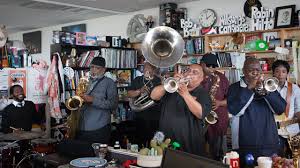 have, of course, heard of the Dirty Dozen Brass Band. I’ve probably even heard them on a record or two that I own. But I don’t really know much about them (in this Concert there are only 7 of them, I don’t know if they ever actually have a dozen members).
But nevermind, because man, do they swing. And they swing with a big chunk of funk.
“Use Your Brain” is catchy as anything–with a great funk sound. I love that the bass is all done by the sousaphone (Kirk Joseph). I love the squeaky trumpet solo that gets played at the end of the song by Gregory Davis. And I love everything in between. A cool thing is that there is a guitar (played by Takeshi Shimmura) in the song which you can barely hear except during the moment when the horns are quiet and then you hear it do a great little funky chord riff. It’s not prominent, but it is essential.
“Best of All” has a very different style (an almost Latin feel)–with Efrem Towns the “vocalist” doing r-r-r-r-r-r-r-r- vocal rolls. I’m intrigued that for most of these songs the saxophone Kevin Harris (tenor sax) and Roger Lewis (baritone sax) play the main riff most of the time and the trumpets are often silent (until they totally take the song higher). Like the great high note in the middle of the song. The guitar is playing lots of little riffs that you can hear every one in a while–rounding out the song very nicely. And the sousaphone makes some great rumbling sounds. This song has a drum solo and I love that the drummer (Julian Addison)is placed up at the front of the band so you can really see him–his playing is fluid and that solo is funky and not showoffy.
“Tomorrow” has a funky bass–all coming from the sousaphone–and a real ska feel (especially as the guys sing the chorus “Tomorrow yeah yeah yeah yeah”). There’s a great rollicking solo from the baritone sax. Whenever Towns sings, he’s barely audible over the music of the horns–which is fine because hearing his voice is fun even if you can’t really hear what he’s saying.
For the final song, “My Feet Can’t Fail Me Now” Davis says:
This is the song where you all participate –you all been a little bit stiff, not moving. (someone says , well it is NPR). For this song we want you to participle. Don’t just stand there and clap like that, you know… move. Put your back into it. Put your wiggle in the wiggle. Drop it like it’s hot. All that stuff you do behind closed doors do it now–well not all you do.
The song is super fun and dancey with a big chorus chant of “feet can’t fail me now, feet can’t fail me now.” There’s some great horn and a cool wah wah guitar throughout the song.
The Dirty Dozen Brass Band show just how much diversity you can get with “just a brass band.” This was a super fun concert.
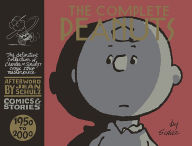
[READ: February 13, 2017] The Complete Peanuts Comics and Stories
This is the final book in the Complete Peanuts series from Fantagraphics. It took 13 years–2 books a year–and here is the odds and ends collection to tie the series up.
There is an introduction by the editors of the series who explain just what this volume is: The content has to be Peanuts, drawn by Schulz himself, and (when possible) with verification from Schulz’s widow, Jean. Material that had not been seen before or was not in print in the twenty-first century got preferential treatment (no Happiness is a Warm Puppy, which is frequently reprinted). So you’ll see dozens of strips not seen in any book and ones not printed in more than half a century. Six complete books are here– four story books, two volumes on life’s lessons. Seven comic book stories, lots of single panel gags and lot of ads!
Then there is a Designer’s Note by Seth. Seth has been behind all of these books (imagine dedicating 13 years of your life to something like this). He says that he wanted these books to look and feel dignified and maybe even a bit sad. He also wished to pay a personal tribute to Charles Schulz in his design.
He says that it was Schulz who first set him on the cartooning path. He was the first artist Seth ever noticed: “Who is this magical person who signs his name in the last box of Peanuts?” He never met the man and he’s not sorry about that–he has all he needs from the work itself. He wants to think of this compete set as a monument to Schulz.
He then talks about how he and cartoonist Joe Matt were friends in the early 1990s and they would talk Peanuts all the time–they knew the first thirty years practically by heart and would quiz each other on them.
And then the book begins.
Included here are some gag cartoons from The Saturday Evening Post (from 1948-1950). They are more Li’l Folks than Peanuts, but they are clearly forerunners to the main strip and I love seeing them. The jokes are good but the surprise is that there’s some with adults in them!
Next come Comic Books with this fascinating note: “the majority of the original Peanuts comic book stories of the 1950s and 1960s were drawn by other hands.” Huh. But there are seven here that were done by Schulz himself (1957-1959). What is unexpected about these is that the stories aren’t three or four panels, they are several pages. The pacing is so different.
There’s a baseball one, with a ball that falls apart and turns to string–a great punchline at the end
There’s a Snoopy sprinkler/birdbath one.
There’s one called “The Rainy Day” which involved Lucy and Linus and the library.
And then there’s one where Lucy yells at Linus about his blanket and we see the same kind of ghosts and monsters that we see in the animated Halloween special.
There’s also one called “Snoopy,” which is about Snoopy trying to determine when someone is going to fake him out when throwing a ball.
There’s another where Linus tells lies to everyone (how unlike him). He is told that his tongue will turn black if he keeps telling lies. And, amazingly, it does!
I really enjoyed the last one, where Lucy says that they should perform Beauty and the Beast. She will be beauty, Charlie will be the beast and then when he transforms into a handsome prince… Schroeder can take over.
Then there’s some advertising.
Most of us think of Peanuts as advertising Met Life. But back in the 1950s, there were strips and illustrations for Brownie cameras: The Brownie Book of Picture-Taking (1955). And from 1960-1964, the strip advertised the Ford Falcon. Between 1959 and 1963 Schulz also made one panel drawings for Dolly Madison Cakes and Butternut Bread.
The Brownie pieces are little strips (with Snoopy looking very old-school and more like a dog).
The Ford ones are more updated with Snoopy looking as he currently does. The Falcon ads are quite convincing and would certainly have encouraged me to buy one. There’s a dozen or so pages with so many strips and each character chiming in about how great the cars are on gas mileage (and affordability).
The Butternut Bead jokes are cute–simple drawings with speech bubbles touting the product
After these comes a one panel “recipe.” In 1983 the Women’s Sports Foundation released a cookbook. Schulz was on the Board of Trustees and provided a drawing with recipe for… Cold Cereal.
The next section is called Christmas:
It contains a strip from 1958 that first appeared in Better Homes and Gardens. There’s a story called Charlie Brown’s Christmas Stocking: which came as a booklet in the December 1963 issue of Good Housekeeping. It’s a series of one-panel jokes about where to put your stocking if you dont have a fireplace. And “A Christmas Story” was the cover feature for the December 1968 issue of Woman’s Day. It is basically Linus’ speech from the TV show. Then there’s Lucy talking about Santa Claus. Snoopy listens to both of these and ends with “I’m going to have to be careful…all this theology could ruin my Christmas.”
The Peanuts Storybook section includes four books by Schulz. I don’t quite understand how they were published. They seem very short, so maybe they were all printed in one book?
There’s “Snoopy and the Red Baron,” which is mostly similar jokes from the strip about the WWI Flying Ace
There’s “Snoopy and His Sopwith Camel,” which isn’t very different but it is broken into two parts (this one involves Lucy as a country lass who is too ugly for him to bring home).
Then there’s “Snoopy and It was a Dark an Stormy Night” which is mostly Snoopy’s typewriter gags. We see what he is typing at the top and then the conversation underneath (no speech bubbles). The big difference with this one is that his book is published! And then it is printed at the end of this section.
The final one is “I Never Promised You and Apple Orchard: The Collected Writings of Snoopy.” Again more typewriter gags, but these are some of my favorites–the terrible puns and wordplay. The end of the section contains “Toodle-oo, Caribou” A Tale of the Frozen North about Sally Snow, Joe Jacket and Joe Eskimo.
Things I Learned is a section of two books (again, how were these published if they are so short?)
Things I learned After it Was Too Late (and Other Minor Truths) from 1981 and
Things I’ve Had to Learn Over and Over and Over (plus a Few minor Discoveries ) (1985).
For some reason the later one is printed first. It contains a series of drawings with what amounts to bullet point observations. Most of them are funny and most of them are quite sound. “Chatter is not conversation ; A hug is better than all the technology in the world ; Candy bars are like years, we’re paying more but they’re getting shorter. You cant sulk in a dining room chair.”
The first one is more of the same: “Nothing echoes like an empty mailbox; Unfortunately it’s very hard to forget someone by drinking root beer ; There’s more to life than not watching TV ; a good education is the next best thing to a pushy mother ; never drop a bag of sequins in shag rug.”
Then there are some sports sections
Golf includes some single panel cartoons for the Bing Crosby Pro-Am gold tournament (Schulz played in it). He also published Snoopy’s Grand Slam in 1972 and a sequence about him playing in the Masters in 1968. The single panels are quite funny: Are you looking where you think it is or where you hope [the ball] is? Snoopy’s Grand Slam is a cute series of inside jokes for golf fans–it helps if you know a lot about golf and golf courses.
There’s a Tennis section as well. Snoopy’s Tennis Book published in 1979 with two other pieces Snoopy at Wimbledon (which shows him playing on grass) and Snoopy’s Tournament Tips, a series of 17 tips which are mildly amusing
Then final section is called Spot Drawings. These are drawings and doodles from throughout his career although for this book they have selected primarily drawings of Snoopy, There’s about 45 in all.
The book ends with a (surprisingly long) essay by Jean Schulz, Sparky’s widow. It is an incredibly sweet story about Schulz and their life together.
It talks about how they met (and the poem he wrote to her after they met). He was proud of her and all the charity work she did and often helped whenever he could. They played tennis together and ice skated together
There’s a section about home life. He was focused on his work when it was work time but was always happy for interruptions from her. And he loved jokes and practical jokes especially. She relates some cute romantic stories between them.
She argues that Schulz didn’t have depression so much as melancholy–like Garrison Keillor’s A Prairie Home Companion.
She loved going out to receptions with him because he was a great conversationalist and always asked questions that might have been considered prying but which were always warmly received because of his demeanor. He would often ask what did your father do? He once asked a business associate who was a Mormon, What do you thin of the fellow Joseph Smith–it genuinely made her think about a question she had never paid attention to .
He was charming with Jimmy Carter. Later when Schulz’s syndicate thanked Carter for never giving speech that preempted Peanuts said “I’ve done a lot of stupid thing in my life, but I not that stupid.”
She also talks about religion and how he was encouraged to read the Bible when his mother died–it helped to fill the void. He read it through three times (and could quote it like in the strips). But he was never dogmatic about it. He frequently said “Jesus’ message is love, but there’s no money in that.” She says it’s disturbing when someone tries to use Peanuts as a tool to push an agenda (The Gospel According to Peanuts), because Sparky never advocated a particular view, religious or otherwise.
She talks all about the development of the strip through the years and how the characters evolved. Originally everyone hates Charlie Brown but by the end he has two girls fighting over him. But I was particularly interested in her discussion of Rerun who really dominates the strip at the end. Rerun came about from Jean describing mishaps riding on the back of her mom’s bike but he moved beyond that and ultimately, “Rerun develops as the only ‘normal’ kid.” He tags along after the other kids; shadows and the only thing he wants is a dog, a bike, and to be able to get the ball in the basket.
Schulz bristled against people saying he should quit, and felt that his work was still solid right up to the end (and I agree).
Then she speaks of Snoopy and all the dogs that Schulz and the two of them had.
It is funny how long the essay is given how brief Schulz’ strips are, but she has a lot to say and it is all touching and sweet and a delight to read. In part for insight into the man’s ideas, but also to see that he was human after all.

 I Just Read About That...
Leave a comment