 SOUNDTRACK: LAURA GIBSON-Tiny Desk Concert #200 (March 5, 2012).
I’d published these posts without Soundtracks while I was reading the calendars. But I decided to add Tiny Desk Concerts to them when I realized that I’d love to post about all of the remaining 100 or shows and this was a good way to knock out 25 of them.
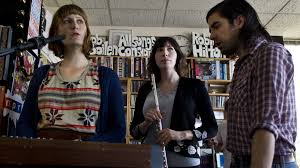 Laura Gibson performed the first Tiny Desk Concert in 2008. The whole enterprise was started because of her. Bob had seen her in a club and her quiet music was overpowered by the audience. So he invited her to play in his quiet office. And now, here it was 200 shows later and Gibson is back–the first person to headline twice.
Things have certainly changed since then. There was one camera on her face and another on her guitar. There was minimal editing and the sound was fine.
Since then they have stepped up the game–multiple cameras, professional lighting and, as Stephen Thomspon writes: Bob’s desk “permanently houses a microphone that’s worth more than my car. (Three hundred dollars!).”
2006 was the release year of her debut album. She had put out her third album in 2012. She was quite back in 2006 and is still quiet in 2012. But for this show she has brought along some help: Brian Perez – Vocals, Percussion; Matthew Berger – Drums; Johanna Kunin – Vocals, Piano, Flute; and Jill Coykendall – Clarinet.
The songs are very quiet. “Feather Lungs” begins with some lovely harmony vocals and then Gibson on keyboard. The flute and clarinet add layers of music which really fleshes out this quiet song. The thumping drum that opens “La Grande” really sets the tone of a much heavier song. This proves to be a romping song with Gibson on guitar and a lot of intensity behind her.
“Milk-Heavy, Pollen-Eyed” slows things down again, with quiet percussion and Gibson’s delicate guitar and vocals. She says that the last time she was there it was a Monday morning and there was not much enthusiasm to sing along with her. But since it’s a Friday afternoon, she invites eveyone to hum a long to “The Rushing Dark.” Of course, she has backing vocalists so it’s unclear if anyone else joins in, but this a capaella song sounds lovely.
[READ: December 6, 2016] “Bestiary”
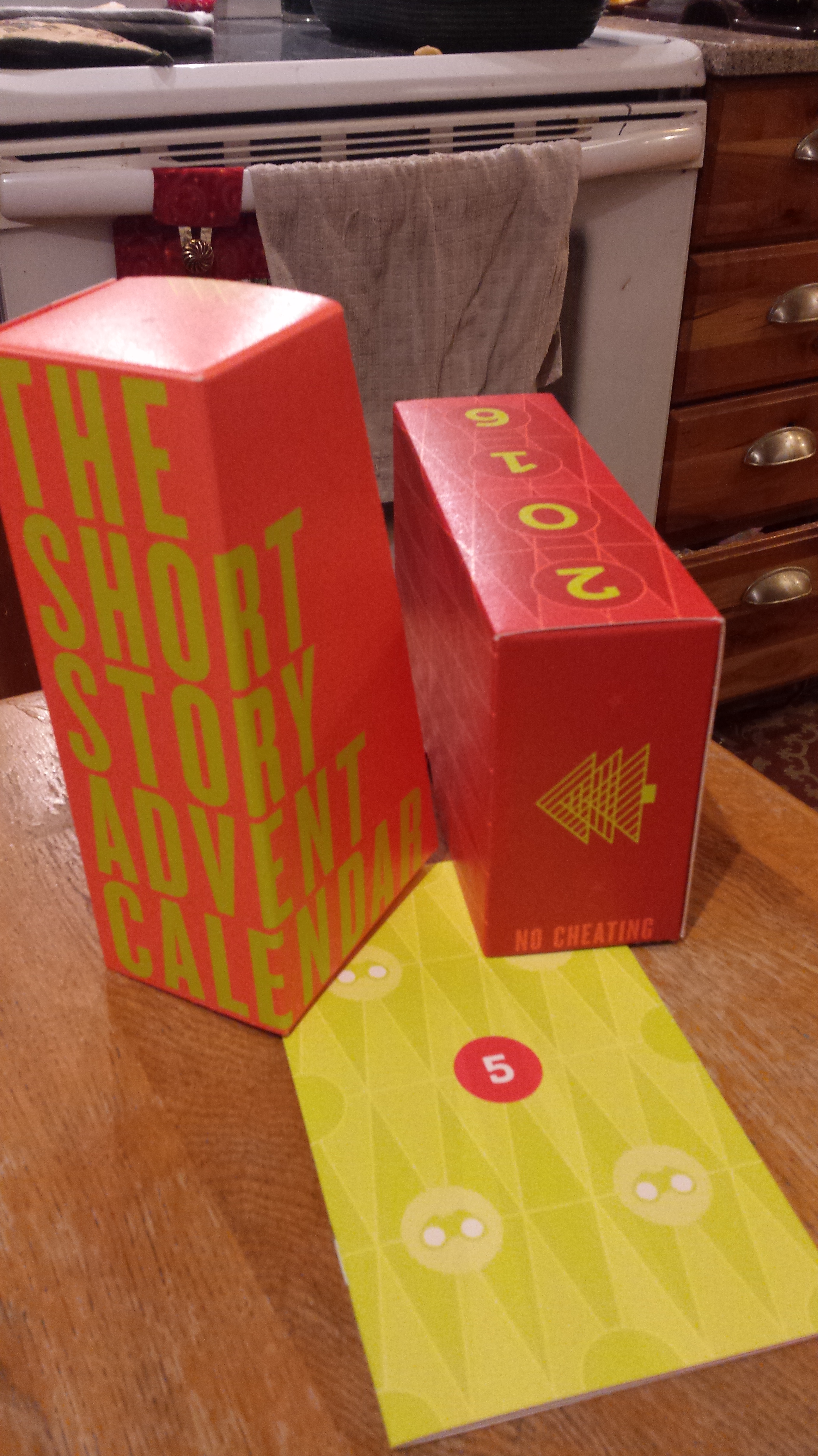
Near the end of November, I found out about The Short Story Advent Calendar. Which is what exactly? Well…
The Short Story Advent Calendar returns, not a moment too soon, to spice up your holidays with another collection of 24 stories that readers open one by one on the mornings leading up to Christmas. This year’s stories once again come from some of your favourite writers across the continent—plus a couple of new crushes you haven’t met yet. Most of the stories have never appeared in a book before. Some have never been published, period.
I already had plans for what to post about in December, but since this arrived (a few days late for advent, but that was my fault for ordering so late) I’ve decided to post about every story on each day.
“Bestiary” is an interesting “short story” because it is not exactly a short story. It’s not even exactly fiction. Rather, after an excellent epigram from Robert Kroetsch “We are the animals who talk the fables in which the animals talk. We are talking animals, claiming that animal’s don’t talk.” The piece consists mostly of factual stories about animal behavior.
Each one opens with a title that ties into the piece beneath it.
Courtship tells the story of Jule Dumont d’Urville, the man who named Adélie penguins (he named them after his beloved but maligned wife) on an Antarctic expedition. I love that it ends with the story that male penguins will bring a nesting pebble to the feet of his chosen female. However, unlike humans, “Female Adélie penguins do not keep or display the stone that says I desire you.”
Mind Control tells of a creepy parasite that a Malaysian fungus emits. It basically takes over the minds of ants and makes them succumb to the needs of the fungus.
Captivity discusses some animals at the Calgary Zoo which was flooded. A peacock tried to fly away to a tree but did not survive, and the tropical fish were killed when their water was polluted. “To summarize: the bird did not survive taking to the air and water killed the fish.”
Teaching Opportunity talks of bottle nose dolphins in Brazil who seem to be herding mullets to the shore so the fishermen can catch them. No one is sure why the dolphins do it or if they get anything out of it.
Deployment talks about the Chinese using monkeys to destroy birds’ nests so their planes don’t crash into the birds near the runway.
Contrivance looks at bonobos who have learned to use tools, including one ape who sharpened her stick to a point and then tried to stab one of the workers. Even though it never seemed angry.
As a Warning To Others tells of a horrible viral video of people beating a fox to death after a fox ran off with two infants, in the town.
Hesitation is the first piece that comes across more as fiction than as a factual story about animals. This one is about the author watching a spider build its web and marveling at the creature’s size and skill.
Brotherhood tells the story of Cecil the lion, the one who was shot by the American dentist. Most of the piece talks about the long and complex history of Cecil the lion before he was killed for sport (which makes it seem all the more horrible when you know the backstory).
Familiar relates the history of women who were deemed to be witches based on the testimony of one man who saw them communicate with an animal “familiar.”
Phobia is the second-hand story of a boy seeing a horse trapped in the basement foundation of a yet to be built house and the scar it left on him.
Interpretation ends the piece with the story of birds who were so confused by the especially loud and lengthy fireworks throughout Kentucky that it caused birds to fall from the sky for quite some time afterward–“many were convinced it was an omen, or a least of sign, though of what, exactly, none could agree.”
So these stories don’t really have a thematic link, but they were all interesting to read.

 I Just Read About That...
Leave a comment