 SOUNDTRACK: THE INTERNET-Tiny Desk Concert #474 (September 29, 2015).
 The Internet are an offshoot of Odd Future. This is an R&B group fronted by Syd the Kid, and the music is really delicate–almost easy-listening-sounding keys and a ropey bass line.
Syd’s voice is beautiful and soulful and she raps and sing delicately. Which is why it’s surprising that the first words of the first song are “now she wanna fuck with me / live a life of luxury.” But after the surprise of these lyrics the chill music is kind of soothing: “roll up an L and light it.” And I love her falsetto for the chorus”
“She blowin up my phone. All I hear is wha wha, wha wha (Band: wha wha).”
“Under Control” is a song dedicated to her band: she promises she’ll be there for all of them “when I’m a legend baby and we’re all rich”
Her confidence and casualness is totally infectious. And I love the the wah-wahs effects on the keys as the song nears the end.
The last song is called “Dontcha” which gets a “yes!” from the crowd when she says she’s going to play it. (That makes her very happy). She says she’s never done an acoustic version before. I gather it’s a single, although I enjoyed the other two songs a bit more.
The veering into R&B territory is not my thing, but it’s cool to hear her branch into different genres in one song.
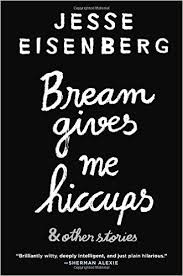
[READ: May 15, 2016] Bream Gives Me Hiccups and Other Stories.
I’ve really enjoyed the comic pieces that I’ve read by Eisenberg–he writes a lot for the New Yorker. In fact, I had recently decided that I would read and post about all of Eisenberg’s New Yorker pieces at some point in the future. Well, it turns out that nearly every one of those New Yorker pieces has turned up in this book (there’s three that didn’t). So that saved some time.
What that means is that most of these pieces are quite short. And that very few of them are stories in the conventional sense. They tend to be a few pages long, or sometimes longer pieces done as diary entries.
What is most interesting about Eisenberg’s writing is that most of these stories are funny–some are very funny–but there is also a lot of pathos and sadness in them. Many of the characters come from broken homes and many of the situations are rather bleak. And yet he manages to make them funny.
The first story is the longest (nearly 60 pages) and it is called “Bream Gives me Hiccups: Restaurant Reviews from a Privileged Nine-Year-Old.” I am embarrassed to admit I didn’t know what bream was (it’s a kind of fish). This piece is made of up of several restaurant reviews by this precocious nine-year-old (sometimes he seems too knowledgeable for a nine-year-old, but otherwise the tone is really good). But the trick to these reviews is that he is always going out to these restaurants with just his mom. And he talks about their evenings together (and the men she is dating).
The first few reviews are pretty funny (Sushi Zonzawa in particular) although in all of them I couldn’t fathom the star rating (16 out of 2000 stars). The next restaurant they got to is Iraqi. It is the coolest spot in town, but our reviewer can tell his mom doesn’t like the food: “Mom took a little bite of it, with the front of her teeth, and then flared her nostrils like she wanted to puke right there on the table. Then she said, ‘Sweetie, I think you’ll like this. Why don’t you try it.” As the entries progress, we learn more and more about the mother. The next entry is a the Whiskey Blue Bar at the W Hotel. Then there’s some lightheartedness at TCBY (which his snobby mom doesn’t like). The reviewer even talks about his school cafeteria–this one is especially funny because their principal has announced that starting today their menu will consist of Healthy Choices made by a famous chef. But my favorite review was of Organix, the vegan place in which “The guy said there was no dessert menu but that ‘Tonight’s desert is apples.’ That made me and Mom laugh a little bit and Mom said “Just apples?” And the guy explained that the apples were special and from the other side of the country. And he seemed so proud of his apples that I felt bad for laughing, but mom didn’t feel bad and she kept laughing.”
The next review ids called “Thanksgiving with Vegans,” and Sarah agreed that the funniest line was “Last night, Mom and I went to Thanksgiving dinner at a Vegan family’s house, which is kind of like going to temple for Christmas.” The section ends with some stories about the writer’s friend Matthew. The writer’s mom makes comments suggesting that the narrator and Matthew are destined to date, which seems really odd, especially coming from a mom. I enjoyed most of this, but the Matthew section confused me.
The second section of the book is titled Family
“My Little Sister Texts Me Her Problems” is a series of texts in which we get a lot of insight into both of them through their fragmented conversation.
“Separation Anxiety Sleepaway Camp” (in the New Yorker) shows the daily schedule of a camp in which everyone needs to call his mom fairly regularly.
“My Mother Explains the Ballet to Me” (in the New Yorker) is a very funny scene of embarrassment as the narrator’s mother is very vocal about the ballet, the usher, and gosh just about everything else.
“An Email Exchange With My First Girlfriend, Which at a Certain Point Is Taken Over by My Older Sister, a College Student Studying the Bosnian Genocide” is a lengthy story. The first part involves the man and his girlfriend talking about ebbing apart and the jealousy that arises between them. When his sister takes over, things go in another direction entirely when the sister compares their relationship to Bosnia (in very great detail, including footnotes!) The twist at the end is really funny.
“My Prescription Information Pamphlets as Written by My Father” This one made me laugh out loud. His father looks at all of the medicine he has been prescribed (the father is very critical of the doctor, too) and then puts in comments like “In Case of Overdose: Drink several ounces of water, which comes out of the faucet and could also be used to wash dishes.”
“My Nephew Has Some Questions” (in the New Yorker) shows just how much you can learn about a person by asking Why? It’s surprisingly well done for such a simple premise.
The third section of the book is titled History
“Men and Dancing” (in the New Yorker) shows just how reluctant men are to dance–whether it means providing rain for his people, protesting Vietnam or scoring a touchdown.
“Final Conversations at Pompeii” (in the New Yorker). Most of the stories in the New Yorker appear in the book in exactly the same way–some stylistic changes (numbers written out, ‘ok’ changed to ‘okay,’ that sort of thing). I browsed the article and the book to see if there was any difference, and I found this one big one. In the book there is an entire extra conversation added about a wife and husband. This overall story is what you’d think it is–amusing conversations just before the volcano erupts.
“Alexander Graham Bell’s First Five Phone Calls” In which Bell gets needier and needier and maybe even tries to use his new invention to pick up a lady.
“Marxist-Socialist Jokes” basically undermines all standard jokes by inserting Marxist Socialist into the question and gives a very formalized answer
The fourth part is the longest in the book. It’s called My Roommate Stole My Ramen: Letters from a Frustrated Freshman.
In this piece new freshman Harper Jablonski writes to her high school guidance counselor because she hates her roommate and school so much. Harper is a nasty piece of work, judgmental ans cruel. And as the letters go on, we learn quite a lot about her home life and also about how nice her roommate really is. And no matter how nice she is to Harper, Harper still calls her Slutnick instead of Slotnick. As the story goes on, Harper gets into all kinds of stupid trouble until finally by the end of November, Miss Rita (the guidance counselor) has to do something about it. This story was pretty funny, but also rather dark and sad.
The fifth section of the book is titled Dating
“A Post-Gender-Normative Man Tries to Pick Up a Woman at a Bar” appeared in McSweeneys and basically shows a very submissive man trying to pick up a woman at a bar.
“A Post-Gender-Normative Woman Tries to Pick Up a Man at a Bar” flips the story on its head with a very assertive woman trying the same thing.
“A Guy on Acid Tries to Pick Up a Woman at a Bar” This was the least successful of the bar stories. I wanted it to be even weirder
“A Lifelong Teetotaler, Embarrassed by His Own Sobriety, Tries to Pick Up a Woman at a Bar” You get the point here.
The sixth section of the book is titled Sports
“Marv Albert s My Therapist” (in the New Yorker). I really got a kick out of this piece, in which all of the lines from Marv Albert are basically things he would say while announcing a basketball game “Out of bounds! Rejected!” It’s well done.
“Carmelo Anthony and I Debrief Our Friends After a Pickup Game at the YMCA” (in the New Yorker) is a fun joke. We see the two conversations interspersed–reexamining what happened at the Y. The way this was set up in the book (Anthony’s conversation is indented) is more effective than in the magazine. You can hear a reading of this story here.
“A Marriage Counselor tries to Heckle at a Knicks Game” (in the New Yorker) Like the Marv Albert story, this one shows the disconnect between therapy and sports–the counselor is intent on things being fair for both sides.
The seventh section of the book is titled Self-Help
“Smiling Tricks Your Brain Into Thinking It’s Happy” goes on a bit too long with the titular premise, but the examples are pretty funny
“If She Ran Into Me Now” is also a bit long for what it is–imagining your ex- showing up when you look your best.
“A Bully Does His Research” (in the New Yorker) I really got a kick out of this one, in which a bully does in fact learn everything he can about the boy he picks on, and the teacher he insults and his principal and even himself. It ends in a very funny/dark way.
The eight section of the book is titled Language
“Nick Garret’s Review of Rachel Lowenstein’s New Book, Getting Away.” I didn’t understand the joke at first because I didn’t know if Nick Garret was a real person. But eventually the joke reveals itself and the story proves to be very funny indeed. He has certainly taken this book personally
“A Short Story written with Thought to Text Technology” (in the New Yorker). I actually imagined this going in a different direction, so I was amused that this was more about a writer being full of self-doubt and wondering about the barista in this shop where he’s writing. I liked the writer/painter jokes.
“If I was Fluent In…” (in the New Yorker) this was probably my favorite joke. It plays on the idea that is he was fluent in a language and overheard people speaking that language, he could surprise them. It starts with French, moves to Hindi , gets fairly dark with Portuguese and then has a great comeback with Aramaic.
“My Spam Plays Hard to Get” was also great. In each of his spam messages the message tries to get him to do something but then thinks better of it.
“Manageable Tongues Twisters” is much like the Marxist-Socialist twist on common jokes, but I found them all amusing. Like How much lumber could a woodchuck discard if a woodchuck could discard lumber?
The final one is called “We Only Have Time for One More” It gives a very detailed explanation of why a band can only play one more song (each member of the band has his own reason why one more song is all they can do).
So overall I enjoyed this book quite a bit. Some of the pieces are better than others, but there’s a lot of laughter to be had here.

 I Just Read About That...
Leave a comment