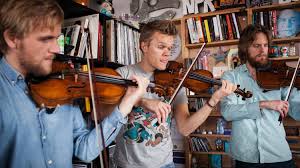
 SOUNDTRACK: DANISH STRING QUARTET-Tiny Desk Concert #399 (October 25, 2014).
 I always enjoy hearing a string quartet that I’m unlikely to hear anywhere other than a Tiny Desk Concert. It’s fun to listen to them before reading anything about them to try to imagine where they’re coming from musically. The opening notes of the first song made me think they were a modernist quartet playing music that was repetitive and mildly atonal.
But they quickly swing it around into what turns out to be the first of many traditional Danish wedding folk songs!
While the quartet does play classical pieces as well, for this Tiny Desk Concert, they focus only on songs from their then recent album Wood Works. The blurb says “the group recently took a musical detour that landed them in the foggy inlets of the Faroe Islands (a Danish outpost halfway between Norway and Iceland) and various Nordic hamlets where folk tunes are played and passed on.”
The first piece is actually three melodies: “Traditional: Ye Honest Bridal Couple — Sønderho Bridal Trilogy Parts I & II” The piece begins somewhat atonally, but about 2 and a half minutes in the somber tones give way to a spritely melody that sounds like a great lost Irish jig. But soon enough with the addition of the other strings it sounds very romantic indeed. In what I presume is part II, around 6 minutes, the cello plays a wonderfully upbeat and catchy rhythm. The violins play staccato notes that keep the rhythm going while the viola and cello continue the melody–it’s pretty awesome. Especially as the song fades and each of the strings plays the riff in succession.
The second piece is in fact two pieces: Traditional: Sekstur from Vendsyssel — The Peat Dance.” Once again the two melodies sound kind of like Irish dances (I guess it’s time to call them Danish dances). The second half of the first part sound great as the full quartet plays a wonderful melody. But when the second part of the set comes and the super fast fiddling begins, it s hard not to dance (you can even hear someone tapping his foot as he plays). The big difference between this and Irish dance is the rather formal sounding and lovely ending melody.
The final piece is the third part of the Bridal Trilogy from the first piece: “Traditional (arr. Nikolaj Busk): Sønderho Bridal Trilogy Part III.” He says that these melodies date back many 100 years and are still used today. It begins very slowly and almost somberly. It doesn’t feel very wedding-like to me and of the three this is my least favorite.
The quartet sounds amazing. The players are Violinists Rune Tonsgaard Sørensen and Frederik Øland, violist Asbjørn Nørgaard and cellist Fredrik Schøyen Sjölin. It’s also kind of funny since three of the four have beards–not something you typically see on a string quartet. They acknowledge this on their website: “We are simply your friendly neighborhood string quartet with above average amounts of beard.”
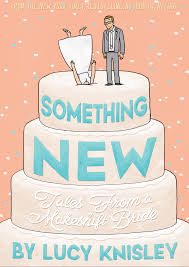
[READ: June 20, 2016] Something New
Knisley has made a rather successful career out of writing graphic novel memoirs. She has covered food and travel. And, in a somewhat surprising twist (if you have been following her books), she just got married.
This is surprising because the man she married is the man she broke up with in one of the previous books. The story basically tells how they were on an off sorta kinda for years until they finally tied the knot.
So this book is the story of their relationship and their engagement. But beyond that it is also an interesting and helpful guide-book for those who want to get married but who may not be totally on board with all of the conventions and trapping of the wedding industry.
In addition to Knisley’s winning illustrations (which seem even more confident, I believe) she includes some photos from the events (which are sweet). And beyond the basic “plot” of the book, she has a lot of interstitials that are very funny. Things like Popular Bridesmaids Hairstyles! (with amusing things like the Lia Simpson or the George Washington). And a very funny flowchart about if you should go to an upcoming wedding or not).
Some of these interstitials are delightfully anti-wedding-industry, like the section about The Ring (an average engagement ring costs $5,500 but some people go alternate routes–no ring at all, or earrings, or tattoos, or even an engagement boa(!). She also looks at the origins of wedding traditions that no one seems to question–like why a bride carries a bouquet or that in Korea they slap the feet of the groom to prepare him for married life.
She talks about the creepy garter toss thing (bride and groom were expected to consummate their marriage on the wedding night and guests would “assist” the bridge in removing her dress). Not seeing each other on the wedding day was put in place back when weddings were arranged and there was concern that marrying couples would chicken out if they saw each other before it was too late.
She even has a few amusing “crazy bride” stories, like when she stole a tiny plastic cat to use as a potential cake topper. And I very much enjoyed the “bridal marketing scheme” quiz of which one were real and which were fake.
There’s also a look at weddings according to famous movies (which include funny one-line summaries of famous movies).
The book begins with the story of how they first met–their first date was very sweet. It’s also apparent that Knisley has some boundary issues. The book then shows their breakup (complete with Lucy’s handy-dandy bad breakup kit–blanket burritos, actual burritos, a living thing you pour your excess love into (cat) and more). And then finally how they wound up getting back together and getting serious.
The middle of the book is taken up with wedding planning and all of the various stressors which that can induce. She says she understands but can’t forgive bridezillas, but is also appalled at how much everything costs “Why would people pay so much foe a yard of tulle?”
Knisley takes a good look at the feminist implications of marriage–is it right to marry when others can’t (this was before the supreme court ruling) or the patriarchal institutions of marriage. She also looks at the challenges to keeping or changing your name: “It’s the 21st century!”
I really enjoyed her bridal gown shopping story–and her ultimate solution is awesome. Hint–it involves pockets!
And then we learn the pros and cons of intense parental involvement. They decided to have the wedding at her mother’s house which has lots of acreage. But that free location comes with a huge price in autonomy.
Since Lucy is a foodie, the section of wedding food was great. They found a local restaurant that could do all of the yummy foods they wanted. Including–and this is a highlight–a big tray our poutine! (she even includes a recipe for the best poutine–which I will include here because I have to try it some day:
Potatoes:
Cut russet potatoes into strips and soak in water for an hour then pat dry. Pour enough peanut or canola oil to submerge fries and heat to 325. Fry potatoes until golden brown. Put on paper towel and add salt.Gravy:
Melt 4tsp on butter and stir in a quarter cup of flour. Add a minced garlic clove and shallot store for 2 min. Add 4 cups of beef stock 1tsp of malt vinegar and a squirt of ketchup.Then:
Combine fries and cheese curds warm in the oven to melt the curds a little and then pour gravy over the whole thing.
I also enjoyed the truth that poutine must be made with cheese curds: anything else is cheese fries. And that there should be no weird additions (no sausage gravy, no sautéed vegetables, no bacon, no ice cream–its fine to pile these on, but then you;re looking at Disco fires).
There was more parental fighting over the music. They wanted a playlist but her mom wanted live band. I wish she printed \her full playlist because it began with They Might Be Giants and The Smiths (including a cello version of “There is a Light that Never Goes Out” by The Vitamin String Quartet) to which they walked down the aisle. It also featured David Bowie and Adam and the Ants
The end of the book offers practical advice. Like how to make a lot of things yourself–this saves a ton of money but also takes up a lot of time. She made a photo booth backdrop and a very cool guest sketch book. She made her own veil and many favors and decorations. She also tells about things that failed (watch out for trying to do too much) and then things she had to buy or borrow, because as chapter 15 says, Weddings are Money.
Then it was the wedding week with parties and more parties and last-minute details and a sudden unexpected thunderstorm. And then there was the big day and it was quite a torching event–Knisley does a great job recreating the event.
Even if you may not care about Knisley’s particular wedding, the story is compelling and fun with just enough things going slightly wrong to make the story entertaining. And her wedding advice is probably great for anyone looking to do a wedding on a budget. Or for those of us who have already been there to see how the kids are doing it these days.
For ease of searching, I include: Rune Tonsgaard Sorensen, Frederik Oland, Asbjorn Norgaard, Fredrik Schoyen Sjolin.

 I Just Read About That...
Leave a comment