 SOUNDTRACK: WILCO-Tiny Desk Concert #509 (February 23, 2016).
 As far as I can tell, Wilco is the first band to be invited back for a Tiny Desk Concert (there was a stated rule that no one would come back twice, with some people skirting that by coming with another band). Laura Gibson was invited back since she was the very first attendee, but since Wilco’s newest album has been so successful, it seems somehow fitting that they get invited back.
And perhaps in honor of that, while their last performance was noisy and raucous, this one is decidedly more mellow—with all acoustic instruments. But that doesn’t mean it’s quiet and calm either.
For the first song “The Joke Explained” from Star Wars, they used banjo, acoustic bass, hollow bodies electric guitar (w/ slide), the ever-present melodica and muted drums (w/shakers). And it sounded great.
For the second song, the older “Misunderstood” everybody seemed to switch instruments. Tweedy switched guitars, the acoustic bass became an acoustic guitar, the hollow body became a slide guitar. Nels Cline’s slide guitar brings so much to the song by doing seemingly so little. I love how this simple, sweet song has a wild middle section–a crazy breakdown with noisy cymbals and drums–drummer Glenn Kotche is fantastic–and everyone else playing some crazy high-pitched notes until it all settles back down again.
Tweedy has another guitar for the third song “I’m Always In Love” and the melodica is back. There’s xylophone keeping the melody. And as with all of these songs, Tweedy sounds great and the backing vocals add wonderful harmonies. Cline plays a wonderful slide solo, too.
Before the final song and there’s another guitar change for Tweedy, and he says that after this song, “you guys need to get back to work solving this Trump problem. Figure it out! Its weird!” They play “Shot in the Arm,” another great old song.
The band sounds excellent—a wonderfully full sound even without amplification. I am really excited to see them his summer.
There’s also a nifty video showing “Misunderstood” with two 360 degree cameras so you can see what goes on in the audience during a Tiny Desk Concert. Check it out.
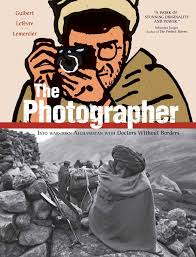
[READ: February 7, 2016] The Photographer
I loved Guibert’s book Alan’s War, in which he took the words of Alan Cope and put them to an amazing graphic novel. Well, he is back again doing the same thing with the words of famed photograph Didier Lefèvre.
Didier Lefèvre died in 2008, but before he died he left a legacy of amazing photojournalism. That includes this trip to Afghanistan which he took with the team from Doctors without Borders.
Alexis Siegel translated this book again, and he offers an excellent introduction which not only explains Lefèvre’s life, it also gives context for everything tat these men and women were up against in that war-torn region.
As mentioned Guibert draws out the story that Lefèvre told him. But this book is different from Alan’s War in that it also uses the photos that Lefèvre took. Guibert fills in the gaps where Lefèvre, didn’t or couldn’t, shoot. And there was a lot he couldn’t shoot.
Lefèvre flew from Paris to Karachi and met with the doctors who he would accompany. Juliette, the head of the mission (her story alone is fascinating that she could be a professional in charge of a mission while being female in the Middle East). John, a surgeon, Robert a doctor, Regis a nurse and Mahmad an interpreter. As they prepare to go, Lefèvre is outfitted in local clothes and tries to ride a horse (he is given the nickname Chapndoz (the horseman) because of his poor riding skills.
And finally they head off. Things are very different in the Middle East (there are dead horses all over this book–beware and the way that one of the men gets a donkey to move forward is horrifying). The terrain is brutal–they tell Didier that he will lose a lot of weight and be in great shape by the time he is done–the altitude will increase his red blood cells and he’ll be able to walk these hills with no trouble in a couple months. This proves to be true–except that it took a huge toll on his life as well.
The Doctors without Borders people know all the dangers, none of this is new to them, but Didier has to learn the hard way. Like that a circling helicopter could bring instant death if they’re looking for fugitives. And that things will get pretty gruesome.
The second part shows them establishing their hospital. We learn that the Russians turn a blind eye to their being there. They would rather them not be there but in case of an emergency they can be counted on for assistance (maybe). But before the doctors can even finish establishing their location, patients start coming. From small children who have been hurt at home (hand in a fire) to casualties of war–spine cut by shrapnel). To fighters who have been severely injured –losing an eye, losing a foot–it’s awful.
Didier takes a ton of pictures (some are horrifying) and they are all really powerful. I never understood why some have a big X through them. But by the end of chapter 2 he is ready to go home. And so is the team, however, Juliette has plans to take a detour. This will add a week to their return and Didier doesn’t want to wait. He decides to get help with some others and says his goodbyes.
Unfortunately for him, this probes to be a terrible mistake and his terrifying journey takes up chapter 3. His guides wind up abandoning him in the middle of nowhere. He is sure he will die. He gets help from locals who know they can extort all his money. He even winds up in jail at one point. This decision proved to be so bad for him that it nearly killed him. It certainly made him lose most of his teeth and maybe even hastened his death.
It is only through the help of an old an unexpected friend, that he is able to get himself on the right path to head home. I’ll spare the crushing irony that occurs.
This story was really amazing. It is not diary entries from Didier. Rather it is his recollection of events some years later, while he is looking through the photos.
In addition to being quite long, the book is huge and very heavy. It is a lovely package altogether.
If I had one gripe it is that some of the pictures are quite small (they show many in a row like a roll of film). It’s not the end of the world obviously, but it’s hard to see some of the details. But aside from that I was totally engrossed in this story. Both the work that Doctors without Borders did and the experience that Didier had there. Not to mention Guibert’s amazing drawings.
The end of the book offers an epilogue of what everyone has been up to since the events of the book (1986). And it’s also explains what happened to Didier and what a loss his death was.
This is an amazing piece of history. Thanks again, Mr. Guibert and thanks to First Second for bringing it to the States. #10yearsof01.
Incidentally, since February was supposed to be the big anniversary month for First Second, I’m going to take a break from posting about their books for a while. But the rest of the books will get their due over the next few months.
For ease of searching, include Didier Lefevre.

 I Just Read About That...
Leave a comment