Feeds:
Posts
Comments

Archive for February, 2016

photoSOUNDTRACK: WILCO-Tiny Desk Concert #509 (February 23, 2016).

wilcoAs far as I can tell, Wilco is the first band to be invited back for a Tiny Desk Concert (there was a stated rule that no one would come back twice, with some people skirting that by coming with another band).  Laura Gibson was invited back since she was the very first attendee, but since Wilco’s newest album has been so successful, it seems somehow fitting that they get invited back.

And perhaps in honor of that, while their last performance was noisy and raucous, this one is decidedly more mellow—with all acoustic instruments.  But that doesn’t mean it’s quiet and calm either.

For the first song “The Joke Explained” from Star Wars, they used banjo, acoustic bass, hollow bodies electric guitar (w/ slide), the ever-present melodica and muted drums (w/shakers).  And it sounded great.

For the second song, the older “Misunderstood” everybody seemed to switch instruments.  Tweedy switched guitars, the acoustic bass became an acoustic guitar, the hollow body became a slide guitar.  Nels Cline’s slide guitar brings so much to the song by doing seemingly so little.  I love how this simple, sweet song has a wild middle section–a crazy breakdown with noisy cymbals and drums–drummer Glenn Kotche is fantastic–and everyone else playing some crazy high-pitched notes until it all settles back down again.

Tweedy has another guitar for the third song “I’m Always In Love” and the melodica is back.  There’s xylophone keeping the melody.  And as with all of these songs, Tweedy sounds great and the backing vocals add wonderful harmonies.  Cline plays a wonderful slide solo, too.

Before the final song and there’s another guitar change for Tweedy, and he says that after this song, “you guys need to get back to work solving this Trump problem. Figure it out! Its weird!”  They play “Shot in the Arm,” another great old song.

The band sounds excellent—a wonderfully full sound even without amplification. I am really excited to see them his summer.

There’s also a nifty video showing “Misunderstood” with two 360 degree cameras so you can see what goes on in the audience during a Tiny Desk Concert.  Check it out.

[READ: February 7, 2016] The Photographer

I loved Guibert’s book Alan’s War, in which he took the words of Alan Cope and put them to an amazing graphic novel.  Well, he is back again doing the same thing with the words of famed photograph Didier Lefèvre.

Didier Lefèvre died in 2008, but before he died he left a legacy of amazing photojournalism.  That includes this trip to Afghanistan which he took with the team from Doctors without Borders.

Alexis Siegel translated this book again, and he offers an excellent introduction which not only explains Lefèvre’s life, it also gives context for everything tat these men and women were up against in that war-torn region.

As mentioned Guibert draws out the story that Lefèvre told him.  But this book is different from Alan’s War in that it also uses the photos that Lefèvre took.  Guibert fills in the gaps where Lefèvre, didn’t or couldn’t, shoot.  And there was a lot he couldn’t shoot. (more…)

Read Full Post »

SlewisOUNDTRACK: BEN FOLDS-Tiny Desk Concert #508 (February 16, 2016).

benfolds I’ve liked Ben Folds for many many years.  He’s funny, he’s amazing live and he plays a mighty good song or two.  He’s the kind of artist you say, Has he really not done a Tiny Desk Concert before? (He did an episode of Live from Daryl’s House after all).  But he’s finally here to bang the hell out of their piano and curse up a storm.

He plays several songs from his new album So There, which is  a collaboration with the sextet yMusic.  I haven’t actually listened to the record much because I gave it to Sarah and haven’t grabbed it from her pile yet.  Since there’s no strings for this Tiny Desk, these songs sound just like normal Ben Folds songs–clever lyrics, fun piano and unexpected twists.

The first song is “Phone in a Pool,” one of his rollicking stompers.  It’s catchy and fun to sing a long to and after one listen, you’re right there with him in New Orleans throwing a phone in a pool.  Midway through the song, he forgets the words and just starts laughing: “In a world where you get applause for fucking up.”  And then he makes up a verse about forgetting the words.

“Not a Fan” is a slower song with a beautiful piano melody and biting, funny lyrics (get your T-shirt signed, fangirl).

“Capable of Anything” is a fast, romping song.  He says on the record the vocals are very quiet, so he’ll see what he can do.  After a run through a verse he stops and realizes that he has knocked the piano out of tune.   And when he bangs on the keys at the end, its easy to see how.  There’s some really fast piano work (and you can hear him stomping along).

he says he’ll play some old songs.  He asks for a song and someone shouts “Emeline,” which he immediately starts playing.  And then about a verse in, he gives some story behind the song.  He says that when he was a kid 8 or 9, he wrote earnest songs, but when he was a teenager he wrote “cool”s songs like “Having Two Dicks is Cool.”

And then he started using songwriter vernacular, words you only use in pop songs, “why’d you make me cry, girl?”  Why do people do that? When he was 18 or 19 he started to write songs that were more natural, like Emeline, the first song he was proud of–using the word “stupid” or a money analogy–and which he still loves playing.

He’s willing to do more songs and asks for requests saying which ones he can or can’t do.  And then Bob points out that he’s going to miss his plane if he does more than one song.  So he chooses for everyone and plays an amazing version of “One Angry Dwarf And 200 Solemn Faces.”  he says it can probably be done and will put the rest of the piano out of tune.  And he’s not kidding.  He really pounds the heck out of that thing–how does his own piano manage?

The song is bouncy and fun and he even jokes with the lyrics near the end.

It’s an amazing, invigorating set and has me really excited to see him this summer.

[READ: February 28, 2016] Lewis and Clark

In 2014, Bertozzi made the excellent Shackleton graphic novel.  But three years earlier he had created another historical graphic novel, this one about Lewis and Clark.

Like Shackleton, it aims to be truthful but not comprehensive.  Bertozzi himself explains that it is not meant to be a replacement for the scholarly recounting of the journey.  Rather, he hopes to show the “experience” of the journey.

The book doesn’t really include any historical context, so in a brief summary:

Shortly after the Louisiana Purchase in 1803, President Jefferson commissioned a group of U.S. Army volunteers under the command of Captain Meriwether Lewis and his close friend, Second Lieutenant William Clark to explore the territory.  Their journey lasted from May 1804 to September 1806. The primary objective was to explore and map the newly acquired territory, find a practical route across the Western half of the continent, and establish an American presence in this territory before Britain and other European powers tried to claim it.The campaign’s secondary objectives were scientific and economic: to study the area’s plants, animal life, and geography, and establish trade with local Native American tribes.

(more…)

Read Full Post »

SOUNDTRACK: mohawk CHELSEA WOLFE-Tiny Desk Concert #507(February 12, 2016).

chelseaI know Chelsea Wolfe from my fiends Liz and Eleanor who are fans of her. I have her album Pain is Beauty, which is atmospheric and gothic and reminds me of Siouxsie and the Banshees.

For this Tiny Desk, she strips away all of the band and noise and plays just her electric guitar (with some major fuzz) and sings (with some looping as necessary). I’m especially intrigued that one of her strings seems to be ever so slightly out of tune, which brings a really interesting tone to her echoed guitar playing.

Her voice is really pretty.  On the record I’d been trying to think who she reminded me of.  I hears Some Siouxsie Sioux, but in this set it’s someone else and I just can’t quite place it.

“Maw” really showcases her voice as she sings a lot of lines that soar, ever so briefly, and her voice sounds really powerful.  There’s a whole goth kind of tone going on with her low guitar and her echoed voice.  I especially like the end of the song where she wordlessly sings as her guitar echoes to a close.

She doesn’t talk between songs.  And immediately she begins “Crazy Love.”  This song has a beautiful melody and great singing but with a  very dark overarching feel.  I saw that her music was described as “doom folk” which certainly makes sense.

I like “Iron Moon” best.  The slow riff in the beginning and the way her voice seems to want to crack but never does, it’s really powerful.  And the way she always sounds great while she hits those big notes.  It’s a great set and a rather unique sound for her.

It’s also nice to hear her talk at the end, just to know that she actually spoke to the people there.

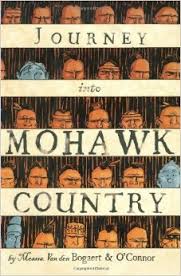
[READ: February 27, 2016] Journey into Mohawk Country

Harmen Meyndertsz van den Bogaert was only twenty-three in 1634 when he ventured into Mohawk territory in search of the answers to a pressing question: where were all the beaver skins that the Indians should have been shipping down the river?  And he wrote a journal of his experience of traveling into the future-New York State in the dead of winter accompanied by the delegates from the Mohawk tribe.

George O’Connor has taken van den Bogaert‘s diary and used it word for word (after being translated by Charles T. Gehring and William A. Starna in 1988) to create a visual representation of this journey.  I know O’Connor mostly because he is the editor of First Second’s Fables and Fairy Tales collections.  I gather he is also an illustrator, although this is my first exposure to him. (more…)

Read Full Post »

kokoSOUNDTRACK: CAR SEAT HEADREST-Tiny Desk Concert #506 (February 8, 2016).

carseatI only know of Car Seat Headrest from NPR.  They have really liked some of his previous songs and both Bob and Robin raved about his new song “Vincent” (which is really good).

For this Tiny Desk Concert, Will Toledo (who is kind of the only guy in the band, although not currently if you know what I mean) plays acoustic guitar on a tall stool.  Accompanying him are two friends from Leesburg, Va, who don’t actually do anything, and his two band mates who also don’t do anything (well, the drummer plays a toy “desktop” drum set for the song “The Drum”).  And yes, they all sing along during the sing along at the end of song three.

It’s worth mentioning that Toledo has released some 12 albums under the name Car Seat Headrest since 2010 (and Toledo is only 23).  Find them at bandcamp.  Unlike someone like Robert Pollard who has written hundreds of songs that are about 30 seconds long.  Most of Toledo’s songs are really quite long, with multiple parts.  And amazingly, all the parts are pretty catchy,

He plays three songs in this set.  His voice is a little creaky and high-pitched, but it is really-spot on for the kind of songs he writes.  By contrast,. it’s funny to hear how deep his speaking voice is.

“The Drum” opens with a riff that is almost out of tune seeming (like his voice).  The melody lines in the verses are simple but often unexpected.  And lyrically, the song is quite interesting (“the drum reads James Joyce,” “the drum’s in debt”).  And just when it seems like the song could end, it switches to a slower middle section, after which it all comes back to that catchy chorus.  By the end of the song it’s totally grabbed you.

For “Drunk Drivers/Killer Whales,” he pushes his falsetto pretty high.  The  song starts out rather slow but once the verses start properly it picks up.  I love the way in the drunk drivers part he adds vocal melodies that are not in the music to make the song even fuller.   And then unexpectedly, the song shifts gears from the melancholy drunk driver section to the powerfully sung (and I’m not exactly sure how it’s related) “Killer Whales” part. It runs to 6 minutes and is constantly shifting and always stays interesting.

“Sober To Death” is also about 6 minutes long. There’s some great lyrics in here as well “every conversation ends with you screaming.  Not even words just ah ah ahhhhh” (with his voice breaking during the ahhs).   The sing along part at the end has a neat intro where the first guitar line is plucked slowly and the second line picks up speed.  And when everyone sings along it really elevates the song.

After just two listens to this show I was totally hooked and I’m really looking forward to hearing his last album, which is reworking of his earlier songs for Matador Records, and his soon to be released new album with “Vincent” on it.

[READ: February 25, 2016] Koko Be Good

I absolutely adored the art in this book.  I really thought it was outstanding and it has made me search out more of Wang’s stuff (she has a number of online comics at her website).  I also didn’t realize that she drew In Real Life–with Cory Doctorow–her style is similar there but a but less wild as it is here.  And the story is pretty great too.

So this is the story of two main protagonists and a third character who plays a smaller but pivotal role.  Koko is a wild Chinese girl who is carefree and careless.  Jon Wilgur is a tightly wound young man who is planning to change his life pretty drastically.

koko2The story opens with Jon–he is drawn so perfectly, I can’t get over it–a great combination of realism and cartoon style.  He is listening to an audiotape sent by his girlfriend (I love that he is listening to an audio cassette).  He and his girlfriend are planning to move to Peru together very soon. She is currently there and he is about to pack up and head down there himself. (more…)

Read Full Post »

redSOUNDTRACK: LE FLY PAN AM-fpamCeux qui inventent n’ont jamais vécu (?) [CST019] (2002).

After their previous EP, Le Fly Pan am (note the addition of the Le) come back with an album that can be described as funky.  True, it’s weird funky that gets dismantled while its going along, but it’s still pretty funky.

They wouldn’t be them if there weren’t some crazy noises.  And so the first song (parenthetical translations are from Wikipedia), “Jeunesse sonique, tu dors (en cage)” (“Sonic Youth, You Sleep (In a Cage)”) is just noise and static for 90 seconds before leading to the first song proper:

“Rompre l’indifférence de l’inexitable avant que l’on vienne rompre le sommeil de l’inanimé” (“Break the Indifference of the Inevitable Before We Come to Break the Sleep of the Inanimate”) which kicks in with a really funky bass guitar and drum section. It’s really catchy and almost danceable. But throughout the song’s ten minutes there are elements of destruction going on. There’s screeches that sound like a dentist’s drill. About a minute in, the guitars just seems to stop playing riffs and just tart going crazy–playing loosened strings and just random notes like a beginner (even though the original rhythm is still there).  That funkiness stays for about 5 minutes until the songs shifts gear into a loping melody with a big bass and simple repetitive guitar lines. And then it kind of falls apart all together with some sounds like broken strings and lots of chatter (in French).  At 7 and a half minute it resumes at breakneck speed with the drums and bass pounding away and all kinds of effects splashing on top. The song ends with low rumbling noise before jumping into….

“Partially sabotaged distraction partiellement sabotée” (“Partially Sabotaged Distraction Partially Sabotaged”) This song opens with a four-note, slightly off-key guitar and then loping bass riff that reminds me of SST Records bass guitar of the 80s. It switches between this and a slightly funkier sounding section. But the destruction is apparent from the get go as early in the song, the sound just completely drops out on a couple occasions, making you think the disc is broken (it isn’t).  The song starts to get more intense as the notes seem to get faster and more insistent (those repetitive notes and ringing guitars just seem to scream tension).

“Univoque/Équivoque” (“Univocal / Equivocal”) opens with static and then a very funky bass line.  There a music box playing over the top and some quiet guitars. About half way through the bass ends but the music box (tiny and distorted) continues.  At 3:30 a new bass line, similar to the previous but with a new section added pops up.  It’s a simple song showcasing their groove and their noise.

“Arcades-Pamelor” starts with low distorted noises.  Like the first “song” this is mostly sound effects and things slowed down. Until a screaming noisy static takes over about half way through.  It’s really quite unpleasant.

“Sound-support surface noises reaching out to you” opens with another funky bass and drums and some simple guitar notes. About a minute in a sound emerges that sounds like a skipping CD (but it’s not your CD).   And then a new, different bass pattern emerges with lots of noisy percussion(sounds like people banging things). The skipping sounds seems to work as a segue between section, with some great funky parts and and then the final section which opens with what sounds like a mildly out of tune guitar ran and more great bass. This really enjoyable section winds up glitching to a halt with the  sound of a skipping record player.

“Erreur, errance: interdits de par leurs nouvelles possibilités” (“Wandering Error: Prohibited by Their Opportunities”) has the sounds of sticks clacking together and silverware dropping and mechanical sounds.  And they all seem to somehow settle into a rhythm of piano notes. Unlike the other tracks this one is pretty consistent—strange noises and a simple piano motif.  It’s also probably the least interesting of the bunch.

The disc ends with “La vie se doit d’être vécue ou commençons a vivre” (“Life Must Be Lived or Begun to Be Lived”) another great, funky bass and piano line, with some interesting guitar sounds round the corners. This song is so catchy, it’s wonderful.  After about 2 minutes there’s another breakdown. The music all stops except for the guitars which sound like they are getting strangled.   The second half of the song has the same funky bass but very different guitars and lots of squeals and feedback. After a couple more glitches at 6 minutes in, the bass takes off playing fast rocking riff as the guitar tries to keep up. It’s such a satisfying ending that it’s hugely disappointing that it only last 45 seconds before the album ends.

While it was always obvious that Fly Pan Am were going to play weird experimental stuff, it wasn’t clear before just how funky and dancey they could be too.  If you can handle some noise in your dance, this is a great album.

[READ:January 10, 2016] Red Handed

I absolutely loved this graphic novel.

I had never heard of Kindt before and I didn’t really know what to expect from the book, but I certainly didn’t expect the complicated and super clever plot and structure that this book had.

It opens with a newspaper story that tells us about Detective Gould’s ten years on the force.  Since his arrival there have been no unsolved murders.  He credits the rise in technology for his success.  (continued on A12) and then it moves into the graphic format.  It is headed Detective Gould (in black and white).  Then it shows some mug shots of suspects in color.  And it turns out that these people’s stories will comprise the bulk of the book.

The next chapter opens with a woman fleeing a diner with a stool.  She worked there and is told the stool is coming out of her paycheck,.   We learn that stealing chairs is kind of her thing.  And then we see what her next acquisition after this stool is.

The next chapter is called the Jigsaw and it involves a man who is an art dealer.  As the story opens he steals a giant painting form a woman he has picked up at a bar. And then we learn what he did with it and how he made his reputation.

After he is caught, the story shifts to a series of dialogue boxes on a black background in which Sgt Gould is speaking to a woman who Sgt Gould assumes is connected to all of the cases in the book.  She is playing innocent and has explanations for everything.

After this there is another black and white section designed to look like newspaper stories of The Detective’s Wife  (in which the two are sweet together) and then Tess’s True Heart in which we learn that Tess (whoever that is) is a very smart girl.

The next chapter is The Ant in which an artist wants to tell a story told from the point of view of an ant.  But since the ant cannot write, it must collect letters from the newspaper.  This turns into an art installation in which the author’s editor begins finding the words all over town and using them to tell the story (it’s much more convoluted than that and really clever).  Then we learn that Tess is the author’s editor–the first connection is built.

And after that short piece, we see more black and white stories from Detective Gould and Tess’ True Heart.

The next chapter is The Forgotten about a sleight of hand magician who has stopped doing magic and has become a pickpocket.

The Repair Man is about an elevator repair man who takes pictures up women’s skirts when they are stuck between floors.  And then he begins selling them to a smut dealer.  The way these pictures connect to the rest of the story is amazing.

The next section is The Performance Artist in which a woman is set up to look like she is cheating on her husband (elaborate ruse once again).

The Escape Artist tells the story of a car thief and how so many thieves think they are going to stop but they are afraid of losing the rush.  Well, this guy retired for real.  Until he ran into Tess.  He knows from long ago.  And she brings him back to the city.

Finally, The Fire Starter is about a guy who gets paid to start fights with the intention of a payout coming somewhere down the line.

The last fifty or so pages show how all these crimes, all these cases solved by Detective Gould, are tied together.  And the way it is told just gets more and more interesting.

This was an outstanding book.  I loved the art and design–the various ways that the medium was used to tell the story.  I loved that it was confusing but not too confusing and that it unraveled in the way it did.   I really can’t say enough about this book.  This was another big win for First Second in their #10yearsof01 celebration.

Read Full Post »

americusSOUNDTRACK: FLY PAN AM-Sédatif en fréquences et sillons EP [CST011] (2000).

330px-SedatifsEnFrequencesCover This is an EP that works as a kind of remixes and deconstructs further the debut. There are three songs, the first is fourteen minutes, the second is 11 and the final is 4.  As the Constellation site describes the disc:

This 3-song EP of fractured, tape-infested experiments is an intransigent slab of self-referential auto-criticism. The band was sticking to its agenda of acutely self-conscious musical manipulations, re-working its own materials and assumptions to yield new compositions of uncompromising formalism. Side A is a medley of sorts, consisting of phrases and fragments reconfigured and replayed from their self-titled debut (Fly Pan Am). Various melodies are reassembled and played off of one another, creating an extended live remix with blissful passages of layered guitars, drones, sampled backing vocal lines, and the requisite incidental noise break in the middle of the piece. The result is something like a ‘Stars On 45’-style musical encapsulation of the entire debut record.

“De cercle en cercle, ressasser et se perdre dans l’illusion née de la production de distractions et multiplier la statique environnante!” (“From Circle to Circle, Rehash and Get Lost in the Illusion Born of Production and Increase the Static Distractions Surrounding!”) opens with the sounds of machinery rumbling and then slowing to a stop. The song proper opens with a rapid bass line and squalls of feedback.   Some beautiful guitars play over the noise. More guitars come in along with all kinds of crazy noises—scrapes and scratches, radios and distortion.

The propulsive music stops around 3 and half minutes in and the noise takes over. There’s loud noises and static and all kinds of things. Then the noise shifts to what sounds like someone emptying a bag of ball bearings onto a metal table.  And then maybe making microwave popcorn.  About five minutes later (seriously) a drum starts playing in the background and then a guitar line that references the debut album starts up.  It sounds a bit like the two note guitar from “Dans ses cheveux soixante circuits” with the voices from “Nice est en feu!” thrown on top.  And then at 11:20 that two note half-tone thing from “Dans ses cheveux soixante circuits” resumes, but it’s only for 20 or so seconds before different sounds come to take away the repetitiveness (although the guitars do continue that until the end of the song).  It seems like the band wanted to revisit their debut but also wanted to make sure that it was properly buried under chaos as well.

The second song “Éfférant/Afférant” (“Unrelated / Related”) (11 minutes long) is described as “somnambulist clockwork repetition.” The bass and drums are kinda funky with some simple guitar chords playing in the background. While things do change somewhat throughout song (including notes that seem inappropriate at times), the main source of change is the weird electronic sounds that play over the top. The noise starts to grow louder and louder around 9 minutes and just when it gets unbearable it fades out to the end of the song.

“Micro Sillons” (“LPs”) is only 4 minutes long and it opens with static and noises—different ones in each ear.  After about three minutes of that, the noise mutates into a kind of machine-like hum.

This is definitely a challenging listen.  There are rewards to be had, and it s amazing what good songwriters these guys are, if they’d ever let their songs stay unmolested.

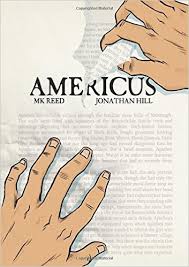
[READ: December 17, 2015] Americus

I didn’t really have any idea what this book was about–the title Americus evokes many different things.

So imagine my surprise to find out that this First Second graphic novel [go First Second!, #10yearof01] tackles the idea of banning books in schools.  It looks at religion, freedom of speech and middle school.

The story is about Neil Barton, an unpopular kid who loves fantasy and books, especially the Apathea Ravenchilde series (such a great name). Neil and his friend Danny race to library after school because the latest volume is out.  Neil is bummed that his library could only afford one copy of the book (budget cuts!) and Danny gets it first.  And as he starts reading, the artistic style switches to the Ravenchilde world (I loved that).

Then we meet Neil’s and Danny’s families.  Neil’s parents are divorced.  He lives with his mom who is harried and exhausted.  Danny’s family is an intact nuclear family, with two younger siblings.  And we learn soon enough that his mother (and father to a degree) are very Christian. (more…)

Read Full Post »

flypanam templarSOUNDTRACK: FLY PAN AM-Fly Pan Am [CST008] (1999).

In the Constellation canon, there were four originators: Godspeed You Black Emperor were orchestral, Do Make Say Think were jazzy, and A Silver Mt Zion had vocals.  But Fly Pan Am was the weirdest one—the played with noise, they broke up their songs, they deconstructed their own work and, especially novel to me, everything was in French on the discs.

Roger Tellier-Craig, the main force behind FPA was in GYBE as well.  So he knows post-rock.

Their debut album is a long affair–an hour’s worth of music (in all of 5 songs) taken from two different recording sessions.  (All translated titles are taken from Wikipedia).

“L’espace au sol est redessiné par d’immenses panneaux bleus…” (“The Floorspace Is Redesigned by Huge Blue Signs…”) is a 13 minute song.   There’s ringing noises as a simple melody is plucked out.  The full instrumentation kicks in adding a repetitive guitar line that seems to fall into the background behind the opening notes that are still playing out.  The guitar lines slowly gets longer and longer, almost like a game of Simon.  By around 6 minutes the song has built up a serious head of steam with the bass and drums moving quickly and the guitar getting really complex. By 7 minutes that pretty guitar has turned into a ringing feedback skronking solo which carries on for a minute or so before fading back. At around 9 minutes the song seems to retreat on itself again. The guitars fade away and the bass seems to get a bit louder with the guitars ringing out. The last minute or so resumes a kind of noisy static sound that tells you the song is over.  That’s a heck of an introduction.

“…Et aussi l’éclairage de plastique au centre de tout ces compartiments latéraux” (“…And Also the Lighting of Plastic in the Center of All Its Lateral Compartments”) is a 9 minute song that opens with more scorching guitars and rumbling bass.  The guitar switches back and forth between a two note melody and a chord (dissonant, of course). The other guitar then plays a different three note melody.  About 2:30 in some noisy feedback and samples start taking over the song.  All the music drops away except for the bass.  By 3:15, all the music had dropped out and its just noisy effects and feedback and then outer space sounds.  After about 4 minutes of that (yes, indeed) the bass comes back in playing a kind of discoey rhythm with the guitar supplying a dancey counterpoint which runs to the end of the song.  It’s their first song where something really catchy is utterly dismantled by noise.

“Dans ses cheveux soixante circuits” (“In Her Hair Are Sixty Circuits”) is 17 minutes long (!) and is one of the most abrasive songs I can recall. The song opens with both guitars each playing a two-note melody which rotates through a round. They sound lovely together as the bass and drums play a slow rhythm. The melody changes a few times and then by around 3 and a half minutes the main guitar line grows faster (6 notes instead of 2) and the background feels a bit more tense.   And then at 5:46, the whole song seems to get stuck on repeat. The bass plays a 2 note rhythm, the drums play the same pattern and the two guitars each play one note over and over.  And over.  Evidently it’s “a half-tone interval.”  And this goes on for 12 minutes.  TWELVE!  The only differences through this whole section come from the digitalia of guest electronic musician Alexandre St-Onge, but they are the most unobtrusive electronics I’ve ever heard and just seem to bubble and prickle gently onto the repetition.  It’s maddening and then trance-like and then maddening all over again.  How can they play the same thing for twelve minutes—and their rhythm remains perfect?

“Bibi à nice, 1921” (“Bibi Nice, 1921”) opens with noises and feedback (which is a nice break from the 12 minutes of repetitiveness. But you soon realize that that’s all you’re getting (aside from some distant rumbling noise in the background). It’s a very silent song. For four minutes (out of ten) and then the full band kicks in for a really rocking section—great guitar lines and propulsive bass and drums. But after two minutes, the sound drops out entirely—pure silence (enough to make you assume the disc froze). It slowly returns after 20 seconds–they are messing with us again.  At 7 minutes a new guitar line comes in—slow and pretty with a slow drum beat.  A solo plays over the top—it is primarily electronic, and sounds pretty cool.   The guitars start playing louder and the song feels like it’s going to build up into something huge, but it soon ends and turns into….

“Nice est en feu!” (“Nice Is on Fire!”) seems like it should be connected to the previous song, but it starts off very different with big bass notes playing a very slow riff.  The guitar starts playing a nice accompanying riff. At 3 minutes in, voices come in singing Ahhs in a nice melody. The liner notes say that Kara Lacy and Norsola Johnson do vocals on “Bibi à nice, 1921” and “Nice est en feu!” but I didn’t hear any vocals on “Bibi.”  At 4:30 the guitar line turns to something else and there’s suddenly a whole bunch of noise flooding the track—sounds of water rushing, maybe—but that goes away and a new melody (slightly dissonant) resumes.  With about a minute left the voices resume—angelic and soaring over the rumbling song.  It ends this weird disc on a very pretty note.

I love the crazy stuff that Fly Pan Am creates, even if some of it is hard to listen to.

[READ: February 23, 2016] Templar

I had actually started to read this graphic novel before Prince of Persia.  But when I saw in the introduction that Mechner talks about Prince of Persia, I decided to grab that one and read it first.  The two have nothing to do with each other, but sometimes it’s nice to get things on order.

Who doesn’t love stories about the Templar knights?  The whole premise of the National Treasure is predicated on them after all.  Not to mention, The Da Vinci Code and the book that he says far surpasses all Templar stories: Foucault’s Pendulum [RIP Umberto Eco].

So Jordan Mechner has done a lot of research (there’s a sizable bibliography at the end of the book) to create the story about a couple of Knights Templar.  He says that “much nonsense has been written about the Knights Templar over the years. I’m proud to say that this book has added to that sum.”  He explains that thousands of knights were indeed killed.  Some knights did escape, but the main plot he constructed probably never happened.   One of the histories he read said that “figures of no importance” did escape, and so that was the basis for Martin, Bernard, Isabelle and their gang–inconsequential Templars and their own story.

He also says (in the preface) that all of the movies about the Knights focus on the treasure, but the Knights’ actual story–their rise and shocking downfall– is even more interesting.  He gives a brief backstory.  Formed during the crusades, the Templars gained fame as the noblest and bravest knights in Christendom.  Their legend grew which increased their numbers.   “They were the Jedi of their time.”  They peaked in the 13th century under the protection of the Catholic Church and The Pope.  Then in October 1307 the king of France ordered the mass arrest of All Templars in his kingdom (15,000 of them).  They were brought before the Inquisition and accused of witchcraft, heresy and sodomy.  Guillaume de Nogaret the king’s chef minister staged a huge show trail.  Prisoners who denied the charges were tortured until they confessed, which made everyone who refused to confess seem like a liar. Despite knowing the truth, the Pope bowed to pressure and Templars were destroyed.  Wow. (more…)

Read Full Post »

persiaSOUNDTRACK: SALTLAND-I Thought It Was Us But It Was All Of Us [CST094] (2013).

Piles of salt mined by local residents sit on the surface of the world's largest salt flats, the Salar de Uyuni, near the village of Colchani November 20, 2007. Bolivian airlines Aerosur and the Canedos family inaugurated this week the first regular flights of its renovated Douglas DC-3S, or Super DC-3, to bring tourists to the Salar, one of the world's natural wonders, in a project that the airline considers a "trip back in time." Picture taken November 20, 2007. REUTERS/David Mercado (BOLIVIA)Becky Foon, who is one of the main creators of Esmerine has another band on Constellation called Saltland.  The big difference with this band is that she sings as well.  And that this album is much more mellow–full of droning sections and a slow, deep bass that keeps the songs moving along.

This disc is very mellow, with lots of slow beats and electronica sprinkled around it.  When Foon sings, she sings in a deliciously slow voice.  So this album is a good one for chilling out.

The disc opens with “Golden Alley” which has some big slow bass notes and strings urging the song along.   When she begins singing, he voice is deep and hushed–an almost whispered sound that feels practically percussive.  There are words, but her voice also works as part of the music.  A bit of a shift in the music occurs near the end that makes it seem like it’s going to be a long song–especially when Colin Stetson starts blowing some saxophone notes–but it actually just signals the end.

“I Thought It Was Us” is an instrumental which features harmonium and cello.  It also has some interesting noises from Stetson.  About a minute and a half in, it shifts to a really catchy melody that runs through much of the rest of the song while the saxophone solo takes off.  It’s a highlight.

“Treehouse Schemes” really stands out as something familiar.  I don’t know if it sounds like something else or if Foon’s voice is so much more distinctive.  But I really like this track a lot.  It has a slow bass line and some stretched out guitars and then Foon sings a simple and lovely melody line.

“Unholy” is a bit more droney with some well used kalimba and Foon’s voice providing mostly wordless notes.  I really like the way at about a minute and a half, fast drums come in and seem to push the song faster, although the tempo never actually changes.  Theres some great tension and then a nice denouement.

“But It Was All of Us” is another slow droning instrumental, with some wordless vocals and some occasional bass notes. It feels almost like Western movie but with a Middle Eastern feel, a Middle Eastern Western?

“Colour the Night Sky” has some quiet, heavily distorted vocals that swirl with the pulsing beat of the drums and bass.   And then about midway through there’s a clean section where the vocals shine through the din, with the words “I have a fairy tale that I read when I’m feeling down.”

“ICA” has some quiet cello swirls and low voices.  And the album ends on a highlight with “Hearts Mind.”  It’s another one with a prominent bass while swirls of sounds float around Foon’s vocals.   It’s the last-minute or so Foon’s multitracked voices create some lovely ascending ooohss.

This album feel s a lot longer than its 38 minutes, possibly because most of the songs are quite long.  It’s definitely a mood creating album, although not as despairing as the album cover hints at.

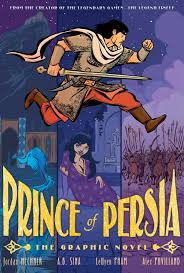
[READ:February 21, 2016] Prince of Persia

The evolution of this graphic novel is pretty fascinating.  And it is one I was completely unfamiliar with since I’m not a gamer.

Back in the 1980s Jordan Mechner created a video game called Prince of Persia.  It was popular and there was a sequel.  And then it kind of went away for a while, but people always loved it so then it came back again as a new series of games.  And a film (released in 2010).  Finally in, 2004 First Second (shoutout to #10yearsof01) contacted Mechner about making a story (not the same story as his games) into a graphic novel.  Mechner has always wanted to make a comic book (he had all the gear before he switches over to video games.  And here it is.

From what I gather, Mechner didn’t really write this story so much as inspire it (and I’m sure he had editorial control or whatever).  The book was written by A.B. Sina.  And it is a new story based on the nebulous ideas of the universe that Mechner had created.

I had actually not even heard of the video game (or the movie) so this was all lost on me. But that’s fine and is not necessary for enjoyment of the book.  Although I admit I found the story a little confusing (not because of not knowing the games), although by the end the way the stories linked up was pretty cool.

This story is set in two different eras (the 9th century and another prince in the 13th century) and has two stories paralleling each other.  The two men of the story are linked by a prophecy.  The story opens with Guiv, a (9th century) prince who had attempted to kill his brother Layth, fleeing the city of Marv after escaping death from Layth’s guards. The story then jumps to a young (13th century) woman, Shirin, who flees the city of Marv in an attempt to escape her father. She soon meets up with Ferdos,

Since Guiv was nearly killed by his brother he leaves the city.  He walks into the mountain where he is accompanied by a spirit animal (a peacock) and is able to fend off lions and boars until he encounters a door.  But inside is a pit made of human skeletons.

I was more interested in the story of Shirin.  She is a rebellious woman who would rather do gymnastic dances than hip shaking ones.  So she cuts her hair and leaves her palace behind.  Frankly her story of learning how rough things are outside of the palace was more interesting than the story of the men.   I guess it is also kind of that we follow her for many pages before she meets Ferdos and then his story takes over.  Not to mention, he seems like he’s just crazy for a while.

Ferdos is full of stories about Layth and Guiv and he imagines that he and Shirin will reprise the roles of these past rulers (Shirin will be Guian, the sister/lover–I’m a little unclear about that).

Eventually we learn that Ferdos has ties to the city of Marv, and that his story is linked to the past in unexpected ways.

The end o the story goes very fast with intense pacing and crossing of stories.  It definitely demands careful reading and maybe even a second reading, to see how the stories line up.

Th one great thing about the book is the way the two story lines are never visually confused–the color palates change depending on the century and the main characters all look different enough (especially Shrin, who looks incredibly sexy with her short hair and different colored eyes).

It’s a really clever and intricate story.   I wonder what fans of the game thought of it.

Read Full Post »

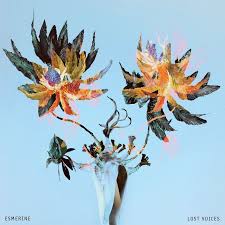
dirkSOUNDTRACK: ESMERINE-Lost Voices [CST116] (2015).

esmerine 2Esmerine’s previous album was recorded in Istanbul and featured a lot of Middle Eastern instruments.  This album was recorded in France and has an incredibly different tone than the previous one.   It doesn’t really have any unusual instruments.  Well, except for the darbuka (a drum) and the riq (a kind of tambouine), both of which appear on the track “Funambule.”  And these interesting items: the ekonting (a West African lute) and the sarod (an Indian lute).

This album has moments that rock a lot harder and louder than anything they’ve done before, but it also has some lengthy mellow moments too.

“The Neighbourhoods Rise” opens the disc with staccato strings and bass.  Then the cello and violin come in.  The song builds and grows more dynamic as drums enter the song, but at 3:30 the song bursts forth with big chords and loud drums.  There’s a great violin melody running through the exuberance.  Then the music all falls away leaving a lovely, sad cello and violin melody to take the song out.

“A River Runs Through This Town” opens with the most conventional sound of an Esmerine record–simple (loud) drumming and an acoustic guitar melody.  More instruments come in, adding complexity. I love that each instrument that comes in–marimba, cello–adds a new layer of notes to the mix until about 3 minutes in when it switches over to big chords.   The song works back and forth between these two styles and rocks much harder than any of their other songs.

“Pas Trop Pas Tropes” is a song of quiet marimba and lots of strings–the cello and violin are once again rather mournful, but very cinematic.  It doesn’t travel very far in its four minutes but it’s beautiful while its there.

“19/14” (can that be a reference to the time signature?) opens with marimba and drums and a deep upright bass (and I believe plucked cello).  When the staccato guitar (or is that the cello?) starts picking out notes the song gets even more interesting.  And then at 3 minutes an electric guitar solo bursts through the melody.  It’s probably the loudest thing the band has recorded yet.  Until the end of the song which gets even louder with pounding drums.  It’s fantastic.

After that, the album mellows out somewhat.

“A Trick of the Light” is but 2 and a half minutes.  It’s washes of keyboards and quiet cello/violin parts.  And then comes–a first for Esmerine, I believe–piano (played by Becky Foon).  The piano is simple but it stands out so dramatically on this track that it sounds amazing.

“My Mamma Pinned a Rose on Me” opens with a cool marimba melody and some ominous keyboard chords.  Some of the middle eastern instruments mentioned come out on this song.  It plays with variations on that simple marimba pattern with different instruments taking turns playing simple chords the top of it.  Somewhere round 5 minutes the song gets so mesmerizing that it nearly puts me in a trance.

“Funambule (Deux Pas de Serein)” opens with some thumping bass and rocks drums along with the Middle Eastern drum playing some cool accompaniment.   And then the nearly 8 minute song is off.   This song revisits the Middle Eastern sounds of the previous record, but with a difference–the drums make the song feel bigger and more intense until about 2 minutes in when the song shifts to a kind of screeching solo.  And then the song resumes with a much faster rhythm.  By 4 minutes the whole song is thudding away, powerful drums and a wall of sound.  When the wall wears itself out, the song’s denouement is more layers of cello and violin–beautiful intertwining melodies.

The final two songs are short.  “Our Love We Sing” is 3 and half minutes of synths and slow cello.  This song also features Becky Foon’s voice, singing wordless passages.  It builds and builds but has no grand climax.   The disc ends with “Lullaby for Nola” a simple piano twinkling and then strings accompany the lovely voice to create this slow, beautiful lullaby.

This album is not as cohesive as the previous one, but it really lets the band explore lots of different avenues.  I’m certainly looking forward to whatever they come up with next.

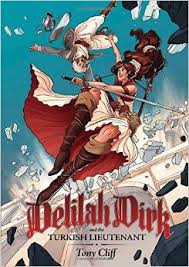
[READ: February 2, 2016] Delilah Dirk and the Turkish Lieutenant

I enjoyed this story quite a lot.  Cliff’s animation which was peculiar but ultimately very satisfying.  And more importantly, he tells a great story.

It opens in Constantinople in 1807.  The King has just begun a game in which the strongest men fight for as much gold and riches as they can grab

Then Chapter 1 shows us Delilah Dirk in prison.  And the guard Selim is reading off the extravagant list of charges against her.  These include–marksman, acrobat, swordsman, world traveler (alone!) and a woman with the ability to fly.  As we flashback to her meeting Selim in prison, we see her being quite cross at getting caught and just about to tell him.  Until she tastes his tea.  Then she reappraises him.

Turns out that Selim’s quite the man with a pot of spices.

As he relates Delilah’s exploits to the king, the king bursts out laughing–primarily because Delilah is a woman.  He doesn’t even think twice that she might try to escape until (and wee see this behind the scenes) she bursts through the wall to her rescue.  And takes Selim with her. (more…)

Read Full Post »

sculptorSOUNDTRACK: ESMERINE-Dalmak [CST096] (2013).

dalmakI really enjoyed Esmerine’s previous record–it was a delightful surprise from a band I didn’t know.  Since then, they have put out two albums.  Dalmak is a Turkish verb with many connotations: to contemplate, to be absorbed in, to dive into, to bathe in, to rush into, to plummet.

The album was recorded in Istanbul and after laying down the basic tracks, they added local musicians who contributed some great sounding Middle eastern and Turkish instruments–bendir (a drum), darbuka (another kind of drum), erbane, meh, barama and saz (a stringed instrument)–on tracks 2, 3, 4, 6, and 7.

“Learning to Crawl” opens the disc and consists of 3 minutes of beautiful swirling cellos and violins that create a wonderful atmosphere.  “Lost River Blues Pt 1” comes in next and it changes the whole tenor of the album with the first of the Turkish instruments.  The marimba keeps a musical rhythm as the other droning instruments play layers of music–creating an unexpected tension.  The repetitions of the rhythm is a wonderful undercurrent to the lovely cello and violin that play washes of music over the top.  Their melody adds a great deal of drama.  It is a 7 minute song and once it’s over it jumps right into “Lost River Blues Pt 2.”

Part 2 opens with some stringed instruments playing a great middle eastern melody alternating with some loud choruses of instruments.   The song grows quiet in the middle and the flute like instrument (the meh?) plays a melody before all of the drums kick in again (there are so many drums) the song grows more intense.

“Barn Board Fire” opens with some Middle Eastern strings again (the saz, I gather) and a simple two note bass to back in up. When the drums kick in the song really feels full.  There’s a cello solo that runs throughout the song and it’s quite lovely.  When the cello matches the rest of the music, there’s few measures that play with loud and soft and it’s quite cool.  It builds to a raucous ending before echoing out

“Hayale Dalmak” opens with some waves of keyboards, almost like a new age song.  it works as something of an intermission before the intense cello melody of “Translator’s Clos Pt 1.”  This time the first part is the shorter one, as the drums and cello play a great melody and rhythm together.  Again, it’s so scenic and evocative.  It builds to a great closure before switching to Pt 2 which opens with a great percussion intro (I need to know how they made those popping sounds).  This part is a little slower than the first, although the drums are still pretty intense.  In fact, even though there is a lot of cello in this song, the drums are really the highlight with all kinds of awesome percussion going on.  The middle of the song introduces the first vocals on the record–I assume they are in Turkish or Persian.

“White Pine” sounds like a western melody played on an Eastern instrument and a mournful violin played over the top.  It’s a neat twist. The final track “Yavri Yavri” opens with glockenspiel and strings.  The song swirls around before vocals come in again.  It stays like this for five or so minutes–always remaining somewhat mellow but never easy.

I really enjoyed this album.  And it gets better with each listen–the combination of Western and Eastern instruments works so well in these songs.  And of course, Becky Foon and Bruce Cawdron write some amazing melodies as well.

[READ: February 20, 2016] Sculptor

I know Scott McCloud from his excellent Understanding Comics, which does a great job in explaining how comics work to novices but also shows keen insight for fanboys as well.

I never really considered that he had created his own comics (even though the above book is also full of his drawings).  He had created a series called Zot!, but really not all that much more.

The premise of this book is fairly simple, but the details and twists and the psychological depth are really staggering.  As is the beauty of McCloud’s drawing. (more…)

Read Full Post »

Older Posts »