 SOUNDTRACK: LUISA MAITA-Tiny Desk Concert #100 (December 26, 2010).
 I’ve not heard of Maita. The NPR write up speaks about the electronic flourishes and deep grooves of her songs. Felix Contreras worried that their stripped down ensemble (only guitar, bass and fascinating bongos) would have a hard time creating that sound.
And in one way they do. Except that it’s clear they didn’t even try. Rather, they play a simple, but engaging kind of mellow Brazilian dance music. In the first song, “Ai Vem Ele,” the guitar and bass play the same grooves except when they each take some meandering moments. The percussion keeps a quiet but steady rhythm and Maita sings vocals and accent notes all over the place to keep the song interesting. I really enjoyed at the end of the song when the bassist played exactly the vamping solo that she was singing.
“Alento” is a much faster song, with quickly sung lyrics. It allows for rapid guitar playing and more uptempo feel.
They only play two songs (about 8 minutes long), but it really shows the kind of range she is capable of.
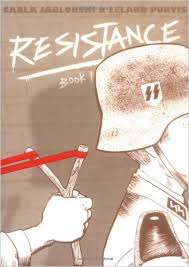
[READ: December 1, 2015] Resistance
This First Second graphic novel is about the Nazi occupation of France. It’s not exactly light reading and yet Jablonski has taken this incredibly dark story and found an excellent and compelling narrative about one family who works as part of the resistance to fight back against their oppressors.
This is the first book in a trilogy and I am curious to see what the next two books bring as this story was nicely wrapped up but there are so many more stories which could be told.
Jablonski also helpfully sets up the situation in the introduction. She explains how France was split in two as a result of the armistice agreement. She gives a very brief but powerful explanation for why they would agree to splitting their country in half. Paris and the upper portion of France became Occupied while Vichy and the southern part of France were “Free” (but still with a large Nazi presence).
This story is about an average family. Paul Tessier and his parents and little sister live in the free part of France. Paul is an artist, and I love the way Purvis juxtaposes Paul’s art with what is actually happening (placing Paul’s “drawing” in the middle of the action so we know he is observing everything.
As the story pens we see that Paul is friends with Henri, the son of a Jewish family who owns the hotel in town. Henri and Paul are both annoyed by Paul’s sister Marie who is nothing if not aggressively helpful. The Germans have already attacked France and taken prisoners (Paul’s father was one of them) and the kids in town are growing suspicious of Jewish families because of Nazi propaganda.
And then soon enough, Henri’s parents are missing from their hotel and we see a notice of German occupation on the wall. The kids can’t be kept safe from what is happening.
Paul and Marie stash Henri in the wine cellar. Then Paul meets an older boy who is working for the resistance. He is sabotaging German plans where ever he can. Paul and Marie want to help and after questioning their abilities, the boy says that little kids can be useful in situations like this.
Marie helps decipher a code in a library book and Paul draws pictures of whatever he sees. And that’s how they learn that Henri’s parents are still alive and are with the resistance.
Paul’s family plans to get Henri to his parents. But how can they possibly do that? And how can kids fight against the Nazis?
I never knew all that much about the French resistance, and I am delighted by how much I learned about this aspect of WWII. Sometimes a graphic novel can give you just enough understanding to make you want to learn more. It helped that this was a compelling and exciting story.
I’m really looking forward to Part 2, which is not something I would normally say about a story about Nazis.

 I Just Read About That...
Leave a comment