 SOUNDTRACK: NICK BUZZ-A Quiet Evening at Home (2013).
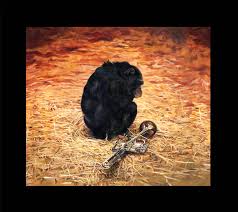 It seemed like Martin Tielli was done making music after his (so far) final solo album in 2009. He has been focusing on (gorgeous) visual arts since then. But then in 2013, Tielli along with Jonathan Goldsmith, Hugh Marsh and Rob Piltch recorded another Nick Buzz album (cover painting by Tielli)–possibly their last as well, but who knows.
This album is almost entirely mellow, with beautiful slow pieces and delicate singing and instrumentation–with some exceptions. The biggest exception is the first song and single (with video) “The Hens Lay Everyday.” It is unlike anything else on the album. It is a weird, electronic fast song with pulsing beats and funny lyrics (and a crazy video). It’s kind of a shame that it’s on this album because I want more music like that. But the rest of the album is also wonderful in a very different way. This song just doesn’t fit.
Beginning with the second song, the album is a beautiful album of wonderful ballads.
“This is Not My World” is a delicate guitar song with simple keyboard washes. Martin’s voice even sounds different on the song–I almost didn’t recognize him until the last few verses. “Milchig” opens with a buzzy violin (that sounds almost like a fly). Tielli did this song with The Art of Time Ensemble (it was called “Moglich”). It has a gentle guitar and Tielli’s keening voice and spoken word–“he had given me ‘the relax.'” There’s several sections in this song, and I especially like the slowly lurching middle section.
“Sea Monkeys” opens with some delicate chimes and underwatery sounds. And once again, Tielli’s voice sounds different. I love this peculiar song about ordering and “growing” sea monkeys. He says he only wanted plankton or krill but during that evening, the sea monkeys started building their city, and after 4 and a half minutes, the song turns somewhat more sinister with a section about the Crustacean Monkey Queen. The delicate music grows harsher and more mechanical sounding. It’s pretty intense. And it coincidentally relates to the book below.
“If You Go Away” has a vaguely Spanish guitar feel to it. It’s a very delicate, slow ballad (I should have realized it was an old song written by Jacques Brel) with strummed guitar and gentle percussion. It has a lounge feel as well (the romantic lyrics aid in that style). It was recorded live with audience clapping at the end.
The mood picks up a little with the next song, “The Happy Matador.” It’s played on acoustic guitar with flamenco-esque runs. It’s a delightful song even if lyrically it’s a little dark. “Eliza” is a darkly comic song with a kind of circusy feel. It opens with accordion, adds a violin and basically makes fun of a woman named Eliza, with the great last line: “The only incredible thing about Eliza is the terrible terrible music she inspires.”
“A Quiet Evening at Home” opens with some strange noises like Circo did, but this is an older, more mellow album and they quickly give way to some pretty, delicate guitar chords. About two and a half minutes of gentle chords are disrupted by a noisy saxophone and some manipulated spoken words. This process repeats itself for about six minutes of mellow, slightly weird, but really enjoyable music.
“Uncle Bumbo’s Christmas” continues in that delicate vein, but this time with actual words. It has gentle echoed guitar and some occasional strings. It’s not exactly a Christmas song although the lyric “I love everything about Christmas, except Christmas” is decidedly ambiguous. There’s beautiful overlays of vocals and guitar for the middle two minutes of the song before it resumes with a slightly more uptempo and much more catchy end section. This song gets better with each listen.
“The House with the Laughing Windows” opens with a tinkling piano melody. It hovers between ominous and dreamy. I like the way the song gently, almost imperceptibly, builds over the course of its 4 and a half minutes. And I love the way the guitars start playing louder as if the song is going to build to something bigger but it never quite does. John Tielli plays theremin on this track.
“Aluminum Flies” is a slightly louder song which is much more meandering and ends with what I believe is the sound of windshield wipers. The final song is the lovely “Birds of Lanark County.” It opens with chickadees chirping and a beautiful delicate acoustic guitar melody from Martin. Michele Williams sings lovely backing vocals.
It’s amazing how different this album is from Circo–same band members but an entirely different style, and a simply gorgeous collection of songs.
[READ: November 25, 2015] Blue on Blue
I had never heard of Quentin S. Crisp before (he’s not to be confused with Quentin Crisp, the British raconteur who died in 1999). Except that I knew he contributed lyrics to the most recent Kodagain album. But I received an advance copy of this book with Brendan Connell’s latest book (its publication date is December 15 (from Snuggly Books)).
This story was fantastic (in both senses of the word).
The story is told in 5 parts. And what I loved about it was that the central part of the story is a fairly conventional story about love and loss, and yet the other four parts frame the story with an other-worldliness that is almost familiar, but not quite.
The story begins with the statement “I am a citizen of the ASAF, the Alternative State of the American Fifties.” There’s a footnote attached which explains that the ASAF “ia an artificial history zone ‘reclaimed’ from sunken parallel time.” This is a potentially worrisome beginning to a book to be sure, and yet the book does not go through any rabbit- or worm- hole, this is simply the set up for the story.
The writer of this main body of the book is Victor Winton, a largely unsuccessful cartoonist and animator. And in that first section he explains that while he always thought his favorite color was green but he has recently learned that blue is the more significant color for him.
The world that Winton inhabits is fairly similar to our own except for little details like: “the wonders of the ASAF would become more explicit: virtuosos of the pogo-stick would demonstrate the loopholes and limitations on gravity’s law by soaring over heads to veer and swerve and pick through the moving weave of bodies.”
But the central item that really showcases the difference in this world is the Sea Monkey Kingdom. And he explains that he was possibly instrumental in the founding of the Sea Monkey Kingdom, for he wrote the initial advertising copy for Sea Monkeys. His ad copy was eventually replaced with some less peculiar, but people still speak of it fondly.
Then we get to the first forward motion of the story. Winton describes how he was inspired to create a new character, a beautiful woman whom he would call Lara Lovelily. After creating Lara Lovelily, Victor submits the character and story to his editor.
As the chapter closes, there’s one more footnote which says “it’s possible that Victor Winton in confused here…” So clearly, there is another “author” working with this text as well.
Victor then sees an advertisement for Buena Vista, a company that has mastered “the teleportation of both inanimate objects and living beings” and they are looking for volunteers. Victor decides to try out but is rejected.
Victor returns to the museum and that’s when he sees a woman who reminds him of….Lara. She’s not exactly the same but there is something very similar–she’s like an inferior copy of Lara. While in the Museum, he drew a picture of Lara and then presented it to the woman. She is delighted and then tells him her name is Jenny Mills.
And that’s when the story turns rather conventional and mostly non-otherworldly. Victor and Jenny become very close, going to dinner, holding hands. And after dozens of pages of a relationship building, they visit Sea Monkey Kingdom. And it is a magical Kingdom–I won’t spoil any of the amazing details that Crisp includes, but it includes periphonic helmets, an anemone garden and squidoodles.
Later they visit the grounds of Buena Visit castle–another magical place in which distance is what makes things so magical. And it is this magic that brings them even closer–until he crosses a line.
The rest of the book talks about how he was able to cope (or not) with the results of his action. The success of Lara Lovelilly had to compete for his attention–but somehow Lara began to feel inferior to Jenny.
The final section, Coda, is written from the person who wrote the footnotes (he is revealed, but I won’t say who it is). He reveals how most of the above threads come together in a completely fascinating way.
One of perhaps the most interesting things about this book is the inclusion of quotes from a book series called Magic Daoism. These books comes from a different place and who knows how Winton has them. One entry is dated with the non-ASAF year of 9th Jan, 2013, and the author of that volume talks about listening to the songs “Lovely Tree” and “Palm Deathtop” by Momus which he describes as “an evocation of losing everything, stripping naked metaphysically.” I love that Winton will never be able to hear these songs, and even wonders if they are real.
This is a wonderful book, with amazing insights into love and loss as well as talk about a parallel universe. Not too many books can do all of that so well. I’m really looking forward to reading more from Crisp (who is also editor for Chômu Press)
Tacked on to the end of the book is a remembrance called “The Cover Artist” by Jack Raglin. This two page piece is a remembrance of the artist Enoch Bolles, who is responsible for some of the most famous cover model paintings. I hadn’t heard his name before, but his covers are very familiar.
 He did hundreds of covers for Film Fun magazine, one of which you can see here.
There is no explicit connection between these two pieces, although it seems evident that Crisp was inspired by Bolles’ work to make this story.
Naturally, the Momus songs would have been the soundtrack to include with this post except that the Nick Buzz album has a song about Sea Monkeys, and I had decided to use that long before I had gotten to the Momus section.

 I Just Read About That...
Leave a comment