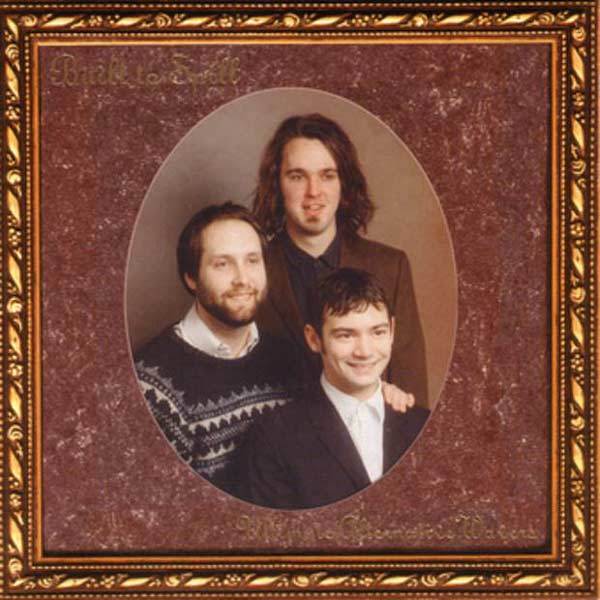
 SOUNDTRACK: BUILT TO SPILL-Ultimate Alternative Wavers (1993).
 I am going to see Built to Spill this Friday. I was supposed to see them back in 2001, but then some bad things happened in New York City and their show was cancelled (or I opted not to go–I see on Setlist that they did play that night). Since then, I have enjoyed each new album more than the previous one, so I am really excited to see them.
I thought it would be interesting to revisit their earlier records. In reading about the band I learned that Doug Martsch was in Treepeople (which I didn’t know and who I don’t really know at all). I also learned that his plan for BtS was to have just him with a different line up for each album. That didn’t quite work out, but there has been a bit of change over the years.
Their debut album is surprisingly cohesive and right in line with their newer material. It’s not to say that they haven’t changed or grown, but there’s a few songs on here that with a little better production could easily appear on a newer album. Martsch’s voice sounds more or less the same, and the catchiness is already present (even if it sometimes buried under all kinds of things). And of course, Marstch’s guitar skill is apparent throughout. The album (released on the tiny C/Z label) also plays around a lot with experimental sounds and multitracking. When listening closely, it gives the album a kind of lurching quality, with backing vocals and guitars at different levels of volume throughout the disc.
But “The First Song” sounds like a fully formed BtS song–the voice and guitar and catchy chorus are all there.. The only real difference is the presence of the organ in the background. “Three Years Ago Today” feels a bit more slackery–it sounds very 90s (like the irony of the cover), which isn’t a bad thing. The song switches between slow and fast and a completely new section later in the song. “Revolution” opens with acoustic guitars and then an occasional really heavy electric guitar riff that seems to come from nowhere. The end of the song is experimental with weird sounds and doubled voices and even a cough used as a kind of percussion.
“Shameful Dread” is an 8 minute song. There’s a slow section, a fast section, a big noisy section and a coda that features the guys singing “la la la la la”. Of course the most fun is that the song ends and then Nelson from The Simpsons says “ha ha” and a distorted kind of acoustic outro completes the last two minutes.
“Nowhere Nuthin’ Fuckup” is one of my favorite songs on the record. There’s a sound in the background that is probably guitar but sounds like harbor seals barking. I recently learned that the lyrics are an interpretation of the Velvet Underground’s “Oh! Sweet Nuthin.” They aren’t exactly the same but are very close for some verses. The rest of the music is not VU at all. In fact the chorus gets really loud and angular. I love the way the guitars build and then stop dramatically.
“Get a Life” opens with a wild riff that reminds me of Modest Mouse (who cite BtS as an influence), but the song quickly settles down (with more multitracked voices). I love how at around 4 minutes a big swath of noise takes over and it is resolved with a really catchy noisy end section. “Built to Spill” starts out slow and quiet, and grows louder with a catchy chorus. In the background there’s all kinds of noisy guitars and superfuzzed bass.
“Lie for a Lie” is pretty much a simple song with s constant riff running throughout. The verses are catchy, but the middle section is just crazy–with snippets of guitars, out of tune piano, a cowbell and random guitar squawking and even shouts and screams throughout the “solo” section. “Hazy” is a slow song with many a lot of soloing. The disc ends with the nine minute “Built Too Long, Pts 1,2 and 3” Part 1 is a slow rumbling take on a riff (with slide guitar and piano). It last about 90 seconds before Part 2 comes in. It has a big fuzzy bass (with a similar if not identical riff) and wailing guitar solos. Over the course of its five or so minutes it get twisted and morphed in various bizarre ways. With about 30 seconds left, Chuck D shouts “Bring that beat back” and the song returns, sort of, to the opening acoustic section.
While the album definitely has a lot of “immature” moments (and why shouldn’t the band have fun?) there’s a lot of really great stuff here.

[READ: September 26, 2015] Critical Insights: David Foster Wallace
It’s unlikely that a non-academic would read a book of critical insights about an author. Of course, if you really like an author you might be persuaded to read some dry academic prose about that author’s work. But as it turns out, this book is not dry at all. In fact, I found it really enjoyable (well, all but one or two articles).
One of the things that makes a book like this enjoyable (and perhaps questionable in terms of honest scholarship) is that everyone who writes essays for this collection is basically a fan of DFW’s work. (Who wants to spend years thoroughly researching an author only to say means things about him or her anyway?). So while there are certainly criticisms, it’s not going to be a book that bashes the author. This is of course good for the fan of DFW and brings a pleasant tone to the book overall.
For the most part the authors of this collection were good writers who avoided a lot of jargon and made compelling arguments about either the book in question or about how it connected to something else. I didn’t realize until after I looked at the biographies of the authors that nearly everyone writing in this book was from England or Ireland. I don’t think that makes any difference to anything but it was unexpected to have such an Anglocentric collection about such an American writer (although one of the essays in this book is about how DFW writes globally).
Philip Coleman is the editor and he write three more or less introductory pieces. Then there are two primary sections: Critical Insights and Critical Essays.
PHILIP COLEMAN-“About This Volume,” “On David Foster Wallace,” “Biography of David Foster Wallace,”
Coleman was the editor of this volume, and his three introductory texts are great for positioning the reader (novice or otherwise) into the word of DFW. He has keen insight into the works and an excellent sense of his biography as well.
The most useful of these three is the “On David Foster Wallace” essay in which he talks about DFW as a poet. Not a conventional poet mind you but a writer who respected poetry and was a keen reader of it. In particular, I liked learning that he used a line of poetry from John Ashberry as a line of dialogue but never brought attention to that fact. In the story “Little Expressionless Animals” one of the characters says “Your own face, moving into expression. A wave breaking on a rock, giving up its shape in a gesture that expresses that shape. See?” Ashberry’s poems reads “like a wave breaking on a rock, giving up / its shape in a gesture which expresses that shape.” Wallace was interested in poetry and wrote of it often, especially in his review of a book or prose poems, wherein he wonders if certain short stories aren’t actually prose poems.
I love little insights like this. It’s practically like an Easter Egg for a favorite book.
The first section of the book is called Critical Contexts. Four essays that give a kind of overview of DFW’s work.
KIKI BENZON-“David Foster Wallace and Millennial America”
Benzon opens with this quote from Wallace: “there are things about the contemporary U.S. that make it distinctly hard to be a real human being.” She talks about Wallace’s connection to the crises of late 20th century America. He was born in in 1962, the year of the Cuban Missile crisis She talks bout Infinite Jest as being a satirical extrapolation of 1990s America. And his social commentary continued on through The Pale King, which is a critique of neoliberal principles (being the belief that ” human well-being can best be advanced by … strong private property rights, free markets and free trade.” The book is full of talk of civic responsibility. Benzon argues persuasively that the focus on boredom is also crucial. She argues that America is “steeped in (sometimes dull) information that the reader must nevertheless become proficient in processing.” Careful attention is the antidote to an anesthetized consumer culture.
ADAM KELLY-“David Foster Wallace: The Critical Reception”
Kelly looks at how Wallace was received by critics throughout his career. Originally he was seen as a postmodernist. Then there was the focus on his essay “E Unibus Pluram.” He talks about the opening of the archives at the Ransom Center as being a huge boon to scholars. And how the third wave of scholarship as released his connection to postmodernism.
CLARE HAYES-BRADY-“‘Personally I’m neutral on the menstruation point’: David Foster Wallace and Gender”
I enjoyed this article a lot. Hayes-Brady discusses Wallace’s female characters (or lack thereof). DFW was always aware of gender issues, consistently using the pronoun “she” when referring to his reader. Hayes-Brady also goes back to his essay on rap and how he says loved the music, but wondered if the wholes system was closed and could never communicate to him, since he was a white male. Or how he speaks of “Cross-writing” as a male trying to write a female character. It seems that Wallace felt it was inauthentic for him to write female characters. His female characters seem to be in a struggle to tell their own stories,. From Lenore Beadman in Broom of the System who is not even sure if she is real, to the central character of Brief Interviews who does not even have a voice (she is simple listed as Q and all of her questions are implied) and even into Infinite Jest, where the P.G.O.A.T. is mostly seen on-screen or heard on radio.
MARK SHERIDAN-“INTERPRET-ME? Or, Fictional Pasts and Fictional Futures: The Predecessors and Contemporaries of “David Foster Wallace and Millennial America””
Look at some of the influences on DFW: Thomas Pynchon, John Barth, Don DeLillo and a host of others including poets and short stories writers. Focusing on Pynchon, Sheridan (and other critics) discuss how Broom of the System is uncannily similar to the Crying of Lot 49. Readers know that Wallace liked Barth, and that his novella Westward was a kind of homage, but it was also a kind of moving past him. This is a great essay for conceptualizing Wallace’s work.
CRITICAL READINGS
AISLING O’GARA-“An Understanding of One’s Place in the System: An Introduction to The Broom of the System”
O’Gara explores DFW’s first novel and how it approaches Wittgenstein. And also the books concern with Self vs Other. All of the characters suffer an inability to adequately distinguish their self in some way.
STEVE GRONERT ELLERHOFF-“Proteus Bound: Pinning Girl with the Curious Hair under Short Story Theory”
I really enjoyed this essay which looks at Girl with Curious Hair, DFW’s short story collection, not as a collection of short stories but as a thematically connected book. He says that people understandably emphasize the novella at the end of the book, but that they miss the links that run through the stories. It begins with the (real) opening legal disclaimer (written because of his use of so many “real” people (Alex Trebek, David Letterman, Merv Griffin, Pat Sajak, Paul Shaffer, the entrepreneur of McDonalds, even Lyndon Johnson). He says that the protagonists of the first nine stories each experience the subjective tension of distance between themselves and others “struggling to ascertain the nearness that intimacy demands.” I really enjoyed the way he went through each story analyzing it in this context,
DAVID HERING-“Form as Strategy in Infinite Jest”
Once again referencing Pynchon, Gaddis, DeLillo and William Gass, Hering speaks of the “encyclopedic nature” of Infinite Jest. But Hering focuses in on the structures inherent in the book–from the architecture of the building to the fragmented and recursive nature of the novel itself.
ALEXANDER RESAR-“”Signifying Everything: Mapping the Subject in Infinite Jest”
This was probably my least favorite essay in the book. Once Resar started getting into Semiotics I has a hard time even following the sentences. And that’s no fun. This essay looks at Hal’s inability to communicate in the beginning of IJ as a way of transcending the self. He then goes on to look at Eschaton and semiotics. And he finished with the The Entertainment, the Death Drive and the Symbolic Structuring of the Semiotic. I used to like philosopher Julia Kristeva’s books, but I am too far removed from philosophy classes to get involved in this kid of essay.
DAVID COUGHLAN-“‘Sappy or no, it’s true’: Affect and Expression in Brief Interviews with Hideous Men”
I haven’t read many essays about BIwHM, so I really enjoyed the way this one looked ta he book as a whole. At how some stories share the same title (which is obviously a connection) and yet there also appears to be many stories in the sequence “missing.” Similar to the easy about GwCH, this essay shows how interconnected these stories are. If not literally, then at least thematically.
CHARLES NIXON-“Attention, Retention and Extension in Oblivion: Stories”
Similarly, I have not read much in the way of criticism about Oblivion (In fact I have only read Oblivion once…note to self: tackle that book again in the new year). In this collection the “central organizing theme is Attention.” “Each story replicates or mediates on an altered, unconventional or extreme mental state.” Nixon cites critics misreading of the collection (James Wood is singled out) and how they initially dismissed this collection without understanding all that was going on.
RON CALLAN-‘E Pluribus Unum’: David Foster Wallace’s A Supposedly Fun Thing I’ll Never Do Again: Essays and Arguments”
This essay looks at Wallace essays. Although Callan says that William Gass argued that essays have limited value (they do not create anything new), Callan argues that Ralph Waldo Emerson’s essays were transformative and so are Wallace’s.
IRA NADEL-“The Nature of the Fun’: The Late Essays of David Foster Wallace”
The titular essay was about writing. Nadel looks at the fun that DFW had with his later essays. From graphic tinkering (the various fun ways he employed footnotes in his magazine layouts) to the way he tends to write from the abstract to the detailed which includes all readers, regardless of familiarity with the subject. This and many other stylistic choice make his articles enjoyable for anyone.
TIM GROENLAND-“A King of Shred and Patches: Assembling Wallace’s Final Novel”
This essay looks at (with a critical eye) the way that The Pale King was assembled. He is not critical of editor Michael Pietsch’s job exactly, but he wants readers to know that the undertaking of assembling the works of a deceased author is inherently flawed–it can’t help but be. Groenland, having looked at the work in the Ransom archives notes the things that Pietsch left out and (more alarming for him) the things that Pietsch changed. Pietsch says he changed things to make the story more clear, but what if he was wrong! To me the most fascinating thing to come from this essay is that the audio book differs from the printed book. I had no idea. Evidently the audio book was read and then changes were made to the print edition. It sounds like most of them were minor changes, and I wonder if I would even noticed (or how anyone did).
JORGE ARAYA-“Why the Whiteness? Race in The Pale King”
Araya looks at the lack of diversity in Wallace’s fiction, specially The Pale King. He applauds Wallace for his of diverse characters in Infinite Jest, even if some are problematic. But in The Pale King, the book is as pale as the title–the Hispanic characters are largely stereotypes and the only Asian character is a woman who believes she needs to perform sexual acts. As with Wallace’s use of gender pronouns in his writing about readers he was clearly aware of racial sensitivity. He wrote about “Nonstandard English” in his essay “Authority and American Usage.” He ends by wondering if the book is intentionally pale–that the whiteness is part of the story. There is also the possibility (in my opinion) that since the book was unfinished, we have no idea what other characters were going to be added.
ÁINE MAHON-“Difficulties of Reality in Cora Diamond and David Foster Wallace”
I found this essay unusual for this book because while it is about DFW, it is actually more about how he and philosopher Cora Diamond (of whom I’d never heard) read Wittgenstein in a similar way. While the information was interesting, it didn’t really resonate with me.
AENGUS WOODS-“Early-Morning Uncertainties: Anxieties, Abstraction and Infinity in Everything and More: A Compact History of ∞”
I rather enjoyed this essay which looks at the anxiety produced by infinity. I liked first that it acknowledges how much people dismissed Wallace’s book on infinity when it came out (too much for the unfamiliar, but nowhere good enough for the scholar). But Woods looks at the book in context of Wallace’s other books and how anxiety is such an important theme in the book. Beginning with the Wallace’s talk of the fear of stepping on the floor and moving back through history to the way Infinity has frightened philosophers from Aristotle to the Catholic church (who more or less made the search for infinity impossible for decades). This was a great essay.
So yes, I enjoyed this collection quite a bit. I also learned from the chronology in the back of the book that t here have been nearly a dozen books of essays about Wallace already. And I should look into them.
- Consider David Foster Wallace
- Conversations with David Foster Wallace
- Legacy of David Foster Wallace
- Every Story is a Love Story
- Companion to David Foster Wallace Studies
- Nature’s Nightmare
- Analyzing David Foster Wallace Oblivion
- Elegant Complexity
- Gesturing Toward Reality
- David Foster Wallace and the Long Thing
- Critical Insights

 I Just Read About That...
Leave a comment