 SOUNDTRACK: DEVO-“Satisfaction” (1977).
 This has to be the most audacious cover of its time. Devo took one of The Rolling Stones’ more beloved song and turned it into a weird, angular piece of art.
The original has a simple riff, a surprisingly slow pace an a slinky, sexy groove. Devo has sped it up and, most importantly, made it angular and complete unsexy. I have been listening to this song over and over trying to figure out what is going on.
The drums are consistent but there’s all kinds of interesting sounds in the drums. The guitar and bass are doing one or two repetitive riffs that don’t quite make sense individually, but work well together. The bass line itself is just fascinating–how did anyone think of that?
Lyrically, the song is the same, but instead of sounding like a guy who is trying to score, he sounds insane. And the babybabybabybabybabybaby section is hilarious and weird. Then they throw in a modified “Satisfaction” riff loud on the guitar at the end with the band chanting “Satisfaction.” Talk about deconstruction.
No Devo song would be complete without the visual element. All five of them wearing their plastic hazmat suits, moving in stiff/jerky motions, more robot than human. And of course, Mothersbaugh himself looks crazy with swim goggles on and mussy hair. Then they show his modified guitar–the first item in close up. There’s duct tape all over it, and extra knobs and some kind of square bottom section. It seems impossible that it is making the sounds that he is shown playing on it since the strings (or is it just one string?) seem so loose.
There’s the guy doing flips (Wikipedia tells me he is dancer Craig Allen Rothwell, known as Spazz Attack, whose signature dance move was a forward flip onto his back). And of course, there’s an appearance by Booji Boy sticking a fork in a toaster.
What on earth did Mick and the boys think of this?
This cover was done in 1977 and it is still remarkable today.
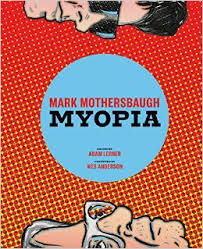
[READ: September 1, 2015] Myopia
We saw Mothersbaugh’s Myopia show at the Museum of Contemporary Art Denver. In retrospect I would have loved to spend more time there (although the kids probably wouldn’t have). So when I saw that there was a book for the show, it seemed like a worthwhile investment.
And this book is a fascinating and comprehensive look at Mothersbaugh’s life and output as a visual artist and a founder of Devo.
Mark was a quiet kid and he was legally blind when he was born. It wasn’t until he was around 5 that he got a pair of glasses which totally changed his world. He was always artistic and rebelled against convention. His world was greatly expanded when he went to college. But he was at Kent State when the four students were killed by the National Guard. This affected him profoundly and send him investigating the world of devolution.
Of course most people know of Mothersbaugh from Devo–who were huge in their own way in the 1980s. I was a young lad at the time and while I liked “Whip It,” I never thought they were cool (if only I knew). But before creating Devo, Mothersbaugh was creating all kinds of visual arts. He was doing print making at college, he was doing postcard mailers to people. It was only when he realized how much cheaper it would be to make music than to constantly be making print items that he devote some energy to Devo instead.
Devo was always part of his visual identity–they were considered a visual project along with his art. That’s why there were the energy dome hats, and the booji boy mask, the yellow suits and everything else.
In fact, the Booji Boy mask predates Devo by a number of years. He has photos of him wearing it in the early 1970s. He used to wear the mask all the time (which he admits now would likely get him shot if he went into a gas station wearing that creepy-ass mask).
And Devo was an important band in terms of subculture, with even Neil Young embracing them and putting them in his movie Human Highway (where Booji Boy is wearing a diaper that says Rust Never Sleeps).
Mothersbaugh has always had a fascination with mutation and with modifying the natural world without losing its ultimate organicness. And that’s why his music has moments of organic noise but is also quite robotic in time signature and style.
On the visual front, he has always kept a journal and has always drawn (I was really really impressed with how good his drawings are). And as any point in this book will tell you, he has made some 30,000 postcard sized art pieces–at least one a day–for years. They were visible at the gallery (in binders!) and small sample are available in the book.
In the early years, Booji Boy even wrote a book call My Struggle. Pages are excerpted in the book and it is bizarre–weird pictures, some manipulated–with impenetrable text. It is dada in the extreme. Some of the art from that book eventually appeared on Devo covers.
The most successful period for Devo was 1978-1984, when he did more work in music than visual arts (except of course that the band was very visual was well). By the early 1980s he had started doing the postcards
The middle of the book contains plenty of postcard sized photos as well as a collection of ages from his Beautiful Mutants series–in which he created mirror images of primarily found old photos. And then there’s the RoliPolis, ceramic sculptures of little fat guys often on a piece of AstroTurf. And of course, there are rugs. Yes, Mothersbaugh began his rug series in 1994. He had made an entry mat for his studio using one of his drawings. He eventually created many rugs from his postcard series. He liked that you had functionality with a piece of art. “They are much more pleasant to lie on, walk on, play on than pieces of paper.” And the fact that it was a traditionally “female” art also appealed to him.
And then, finally, there are his orchestrations–gigantic contraptions which are automated music machines. One of which is created with nothing but bird calls, all orchestrated to play from automated gusts of air. (This was really neat to be in the room for).
Speaking of orchestration, it is amazing the number of film scores he has created. For Pee-Wee’s Playhouse, to many Wes Anderson films, and even The Lego Movie. At the show, there were portable turntables with many of scores on 45 RPM records.
The book includes essays by Adam Lerner, Wes Anderson, Maria Elena Buszek (hers was very academic and a little dull, although she theorizes about artistic movements that clearly influenced Mothersbaugh), Shepard Fairey (talks about Mark as an influence), Cary Levine (talks about Mark’s rug collection as a way of mixing the masculine and feminine) and Steven Wolf talks about the distributing images that appear in Mark’s art–dealing with sex and body morphing.
You will come away from this exhibit or book with your mind reeling at the prolific artistry and the quality of work that MM has done. And you’ll certainly think of him as more than the guy from Devo.

 I Just Read About That...
Leave a comment