 SOUNDTRACK: ZUILL BAILEY-Tiny Desk Concert #63 (June 4, 2010).
 Zuill Bailey plays a cello. Well, actually, that’s not right. The cello he plays is old “very old — but it’s also special, built by the renowned Venetian maker Matteo Goffriller in 1693. That means Johann Sebastian Bach was all of 8 years old when Goffriller slapped on the final layer of shellac. The instrument is unusually large, with a tawny orange hue, and one of only two Goffrillers which can boast an intricately carved Rosette under the fingerboard [see below]. And its sound? A full, round, burnished tone that pours forth with remarkable volume.”
Bailey plays three pieces from three of Bach’s suites (he had just released an album of six suites). And they sound amazing. The first piece is instantly recognizable and sounds incredible on this instrument.
But beyond playing a gorgeous cello, Bailey is a great storyteller. He describes how when Bach started writing suites for cello, the instrument was considered a church bass–basically a piece of furniture and not something to write gorgeous suites on. He also says that people have asked him if he has named his cello and he says that he calls it J.Lo. because it is “robust in the bass tones.”
Introducing the second piece he says that the sarabande was banned from polite society because it was considered too slow and sensuous in those times (which is why he’s going to play it now).
 And then he describes the feeling of the sound that comes from that cello–it resonates through the maple in the instrument and vibrates his body. It is clear how much he loves this instrument.
Obviously the pieces are beautiful, but his renditions are really stunning.
J.S. Bach: Solo Cello Suite No. 1 – “Prelude”
J.S. Bach: Solo Cello Suite No. 2 – “Sarabande”
J.S. Bach: Solo Cello Suite No. 3 – “Prelude”
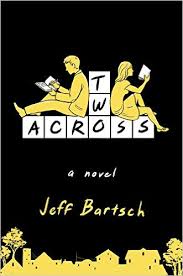
[READ: September 13, 2015] Two Across
Sarah brought this book home and loved it. She thought I’d enjoy it, too. And why not? The main character, Stanley, is a crossword puzzle maker (Sarah finished it on the day that puzzler Merle Reagle died, sad to say). The other main character, Vera, is a math genius who also becomes a puzzle maker. The fact that I just finished the Felicia Day book in which she (a real person) is a math genius, gave me strange parallels between Felicia and Vera.
If those character traits interest you, there is so much to like about this book. We first meet Stanley and Vera as they are competing for the national spelling bee in Washington D.C. They are both certain that they will win (we get alternating perspectives from each of them). And we see their minds as they hate the other one who is trying to take the title from them. When the bee ends, they are both rewarded for their efforts. And they form a strange bond, because they both have a lot in common even though their lives are entirely different.
Stanley lives in a hotel. His grandfather was a chef there and his father died in WWII, so the hotel has offered them their cheapest (crappiest) suite for the rent of $1 a month. Stanley’s mother never leaves the room… ever. She had never recovered from Stanley’s father’s death. The hotel staff is like Stanley’s family, and he is well looked after. But his mother pushes Stanley very hard, insisting that he go to Harvard. And Stanley is clearly a genius–he used to memorize the encyclopedia, and he has all kinds of facts at his disposal. But he is also deeply wounded by never knowing his father.
Vera, on the other hand, is pretty much transient. Her mother is working her butt off to become an IBM sales rep and so they travel everywhere. Vera is also a genius, finishing her school work in a few days and then spending the rest of her time reading or doing challenging math.
They are both quite likable, even if neither one has any social skills at all.After the spelling bee, they meet annually at future spelling bees. And even though they don’t really communicate between those dates, they grow attached to each other–two misfits with a gift. And then on the third visit, Stanley concocts a plan.
Stanley is meant to go to Harvard and could certainly get in, but he doesn’t want to. He is sick of studying and obeying his mother’s rules. Vera on the other hand can’t wait to go to college just to be by herself. But Stanley suggests that the two of them get fake married. Then, they will amass all kinds of gifts and can sell them and use the money for themselves. It’s a tidy little scam (since Stanley knows so many senators who come to the hotel, he figures to make a killing). Vera, always looking for adventure, agrees.
And thus begins a strange togetherness, in which they are married–but not really (the way they signed the certificate is genius), and in which they are together, but not. For they both head off to Cambridge, Mass, but they lead very different lives.
Stanley does become quite good at making and selling crossword puzzles, but it’s not exactly lucrative. Meanwhile, Vera was accepted at Radcliffe, and was blowing people away at school (except when she was spending her time worrying about Stanley). They were living in the same city and were married, but never saw each other. Literally. She didn’t even know where he was living.
Then she had an idea. She made a crossword. puzzle. Knowing that Stanley did all of the puzzles, she knew he would do this one. It was accepted to the Globe and the answers gave Stanley a location to meet her. And he did. And that sets in motion their primary method of communicating to each other. Which I loved. Indeed everything about this communication was awesome–from watching them make the puzzles, to imagining them in print, was wonderful.
But what I did not love is that each one of them is so awkward and stubborn–consistently doing stupid things and not communicating with each other, that I wanted to smack both of them. Stanley concocts another plan which works until it backfires and causes collateral damage. They separate and then reunite (through puzzles) and separate and reunite. But they are so hopeless together that I was angered by them. At one point when Stanley starts dating another woman–who is fun and vibrant and a real joy–I hoped he would stay with her. Even though the whole point of this book is that Stanley and Vera are meant to be together.
At one point, she becomes so dismissive of him that I thought, yes, she is better without him. And even though he pines for her, what had she ever really done to make him happy? Neither she nor Stanley ever actually says they love each other. It is so frustrating. And because of this it took me a really long time to read this book. It’s fairly short but I kept dragging it out because I couldn’t stand what was happening in it.
But here’s the kicker. The ending is magnificent.
Anyone who reads a lot knows that most great books have mediocre endings. Everything you love about the book has to end eventually, so the ending never lives up to the story. And that’s fine. Most books that you love you can’t really remember the ending anyhow–it’s the story that hooks you. Well, in this book, which I found frustrating and irritating much of the time, the ending blew me away. I can’t recall an ending that I found so well constructed and put together and so moving. And not just the last few pages–which were great–but the last fifty or so, which I couldn’t put down.
Perhaps it was his intention to make the middle so frustrating. I hope so, even if that is a mean thing to do. But the payoff was great. And I’m really happy to have read it.
And I wonder if the puzzles that Stanley and Vera made would actually work (a spinoff book of puzzles perhaps?).

 I Just Read About That...
Leave a comment