 SOUNDTRACK: VILLAGERS-Tiny Desk Concert #69 (July 19, 2010).
 Villagers is the work of Conor O’Brien. On their debut album he played all the instruments and created the cover art. Live, he has a full band, but in this Tiny Desk show it’s just him and his guitar.
He looks incredibly young (that haircut), but when he sings, he sounds sophisticated and mature. And his guitar playing is equally sophisticated (with some really interesting chords on the high notes of his strings).
His playing is crisp and clean and his voice is really lovely. He doesn’t do anything fancy, he just sings and plays, but he has a lot of power and honesty in what he does.
And lyrically, he is quite clever. He surpasses many singer-songwriters.
His three songs “Ship of Promises,” “Becoming a Jackal” and “Twenty Seven Strangers” are all on his debut album Becoming a Jackal. He hits an amazing series of high notes in “Ship of Promises,” and the way the song takes some unexpected (albeit brief) pauses is quite dramatic.
I like the way he slowly and confidently states the title “Becoming a Jackal.” This song is a bt faster and more dramatic, especially the quiet ending.
“Twenty Seven Strangers” is a story song about taking the bus. It is an unexpected perspective and quite an interesting look at a mundane event.
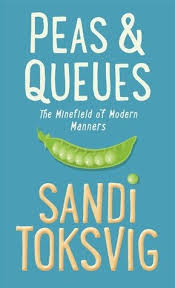
[READ: August 2, 2015] Peas & Queues
I was disappointed with the previous etiquette book, which was supposed to be funny and I think wasn’t all that serious. But this one, which is indeed serious, was also really funny, and was a real delight to read.
According to her bio on the book, Sandi Toksvig is “a well-known broadcaster for both television and radio.” But I’d never heard of her. It seems that she is big in Britain, but I believe is unknown here. Nevertheless she has written over twenty books, including fiction, non-fiction and children’s. So maybe I’m just out of touch.
Anyhow, I grabbed this book because it sounded interesting (and I liked the jokey spelling of the title).
Toksvig explains in her introduction that in 1520 when Erasmus wrote his book on manners it was dedicated to an 11 year old boy (a son of a prince). This book is dedicated to “a delightful child in my life” called Mary who is currently 8. But it is not a book for children, it is meant for Mary as she grows up. And you can tell right from the start that Sandi is pretty funny as she says “I hope it will prove useful to anyone not planning to live as a hermit. [Unlike Erasmus] I have made it easier for her (and you) by not using Latin (very much).”
And then Toksvig explores good manners from birth through death. She even starts with “Why do we need good manners” (a question my kids currently ask). The first thing to say is that basic manners apply no matter where you are or what you are doing. They are even a good idea when no one is watching. Having a code of behaviour will help you know how to react to the unexpected.
But it’s also important to know that rules about manners are not laws or rules, they are suggestions–propositions for behaviour to help grease the wheel of the great social machine.
She sums the top Cs of manners: consideration, common sense, context and comfort (to make as many people feel as comfortable as possible).
Then she begins at Home: be respectful to each other, even while children should respect adults, adults should also respect your children. She speaks of living with friends and sharing, and of overnight guests (what’s fun about them, how to get rid of the bad ones, and how to be a good one).
Table Manners are a big thing at our house, and she lays it out in pretty basic terms: hygiene, preventing murder and stopping us from being greedy. There is also this gem: “One of the worst things you can say about somebody is that they are not a pleasure to eat with.”
Some basic table rules: don’t speak of the bathroom at the table, don’t put elbows on the table (for space reasons), don’t start before everyone is served, sit up, make an effort chew with mouth closed, don’t pick your teeth, don’t pick your nose and avoid all expellations of wind (including don’t blow on your food)–instead, wait a bit, have some restraint: “Don’t blow a mistral of bad breath over the table in an effort to cool your food.”
There’s a lengthy section about dining out–both being a guest and having guests. Also while at the table: don’t have the TV on, don’t use your phone, don’t whisper, avoid arguments and let everyone speak.
Then she talks about communicating: think before you speak, help the conversation along (don’t shut down the avenue of chat with negative responses. If the person you are talking to says “Have you read any good books lately?”the answer should be anything other than “No.” Wait your turn and don’t correct others. Of course there is a also a lot about writing, including email and phone.
She even covers travel: public transportation manners, driving manners and what to do when traveling (like meeting and greeting people).
There’s a section on work (school and jobs) including workplace romance. Which leads to romance in general. She talks about your presentation and even gets into osculation (kissing).
Do: brush your teeth, take it slowly, breathe, be sensitive, smile when you are done.
Don’t: Wipe your hand across your mouth, be weird, kiss someone without warning (James Bond movies teach men that if they are good looking any woman will welcome their advances without warning. This is not true.)
This talk leads to sex, commitment and cohabitation. And of course to Pregnancy (Mary is only 8 but she is going to learn a lot here).
There is a ton of advice for new parents about manners with your children. I fear many people don’t follow them (including us), but just as many people don’t seem to care anyway. Nevertheless, this is a good book to look at when it comes to being considerate to others.
She even talks about how to break up with people (either casually or in the big Divorce). And finally she speaks of death–not your own, but how to deal with the death of others.
In the end of the book, she even brings up the downside to manners: when following the rules tips over into bad manners.
And don’t forget: Don’t keep saying sorry all the time. There is a difference between being appropriately apologetic and turning into a doormat. Don’t stay quiet if something needs saying and don’t be too stoic.
This is a wonderfully comprehensive and completely readable book. Toksvig’s writing is funny, charming and sweet. Even when the topics that could be dull and or awkward, she throws in some good humor. And most importantly, she is not a nag. She is trying to make things better for everyone. And even though some of these things take work to do, many of them can become second nature pretty quickly.

 I Just Read About That...
Leave a comment