 SOUNDTRACK: THE MYNABIRDS-Tiny Desk Concert #64 (June 21, 2010).
 I wish I liked The Mynabirds a bit more than I do, especially after hearing the origin story of the band’s name. Laura Burhenn says she wanted to create a band that was sort of like Neil Young playing Motown. She toyed with the name Myna and came up with The Mynabirds and then found out that in the 1960s Neil Young and Rick James had made music together for Motown under the name The Mynah Birds. Cool.
Burnhenn has a sultry kind of voice, which is nice. But I don’t really like Motown, so the “ooh la la” in the verses and the whole sound of the chorus of “Numbers Don’t Lie” is not my thing.
I prefer the second song “Let the Record Go” which is a bit faster and more rocking (and I like the oh’s at the end of each verse much more). The final song is by request from Bob. It’s the lead off track from the album “What We Gained in the Fire.” It’s a slow broody opener with interesting lyrics. It has a R&B feel and is a fine song.
It’s possible that I am confusing them with someone else, but I thought the band was more folky, so this was a little disappointing to me (although they are clearly very good).
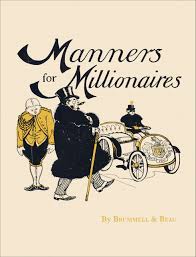
[READ: June 19, 2015] Manners for Millionaires
I saw this book at work and thought it sounded really funny. A 1900 British book about millionaires? With that obvious pseudonym?
The opening prefatory note says that “the coloured plates specially prepared for this volume had at the last moment to be omitted owing to the unfortunate indisposition of the Academician employed, but rather than disappoint the Public we have inserted instead a few specimen woodcuts from a forthcoming treatise on British Fishes.”
Great, so, silly, nonsensical fun, right?
Well, the problem for me with this book is that it supposes you know a lot about wealth and the aristocracy of England circa 1900. Gah. I’m not even exactly sure who the intended audience was for this book.
The book describes people as being in the Pauper, Practically Pauper, Comparatively Pauper strata of society (with less than 5000 £ a year and fewer than seventeen spare bedrooms). Well ostensibly this book is for these people. It tells them how to become rich. Chapter two describes very quickly how to make your fortune (in hilariously vague terms).
The opening chapter talks about their previous book Deportment for Dukes (which is real). And has some good questions, such as ‘Should one wear whiskers? I only saw three sets in the Park last Sunday, and one was pro-Boer!’
By Chapter IV, they assume you have made your fortune and so the manners and comportment portion begins. “Am I justified in exchanging Perdonella for a larger poodle, and what should you advise about keeping a landaulette?” (which is a sort of limousine).
Although I did enjoy questions like “Would Multum in Parvo do for a motto and what does it mean?” It means “a great deal in a small space.” They say that quid pro quo would be better.
At some point they talk about how to spend and gift your fortune (in £ s d).
The final chapter throws a cynical eye towards America with a question like whether “is a Rococo Rotunda in the style of the Renaissance or a Castellated Wigwam modeled on the Parthenon the most appropriate residence for a citizen of the greatest Nation on Earth?”
Their reply, “We can only recommend the citizens of the greatest Nation on Earth to settle it by spinning a quarter.”
The book is only 46 pages, but for me, anyhow, it was not a quick read. This may have been a very funny book in 1900 (or maybe it wasn’t, how would I know), in 2015, in the greatest nation on earth I found the book amusing, but mostly confusing. Mores the pity.

 I Just Read About That...
Leave a comment