 SOUNDTRACK: MARY MARGARET O’HARA-Christmas E.P. (1991)
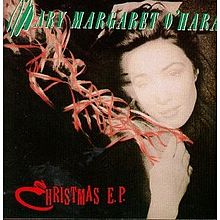 Mary Margaret O’Hara is a fascinating recluse. She released a cool, weird album in 1988 then did nothing for three years when she released this Christmas EP. Since then she hasn’t really released anything (except for a soundtrack).
O’Hara’s voice is her most notable feature (she warbles and swoons and is almost otherworldly–sometimes crazily so). She is the backing shrieker in Morrissey’s “November Spawned a Monster.” So one expects a pretty weird Christmas album from her.
But it’s actually fairly conventional and I have to admit a bit dull. “Blue Christmas” is just too slow for me. O Hara’s voice doesn’t have any oomph here. The cheesy violin solo doesn’t help either. “Silent Night” is, I feel, too pretty of a song for O’Hara’s voice which wobbles in weird ways for this track. “What Are You Doing New Years Eve?” suffers from the same as everything else on this disc–it’s too slow and languid. I know this song can be wistful, but I need this to be faster. “Christmas Evermore” fares the best on this disc because it isn’t familiar (to me). The music is a bit more uptempo (if still eccentric). And you don’t have other version to compare it to.
So, overall this proves to be a somewhat disappointing EP.
[READ: December 5, 2014] McSweeney’s 47
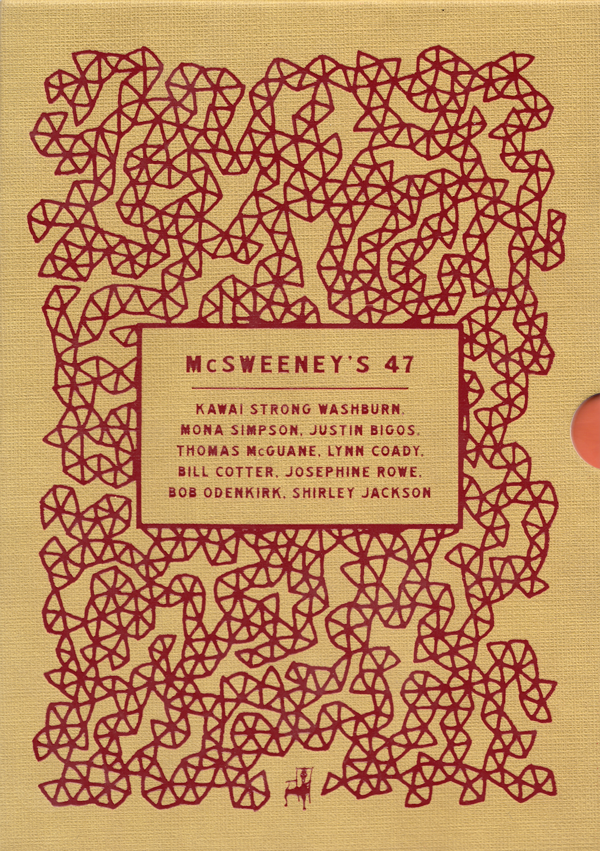
I love McSweeney’s issues that come in boxes with lots of little booklets. It somehow makes it more fun to read the stories when they are in little booklets with individual covers. In this instance, all of the booklets look basically the same–ten different cool pencil (and red) drawings on the cover done by Carson Murdach and a red back cover. The outer slipcase art is by Jason Polan.
There are ten booklets. One has a few letters and the rest are short stories. There’s even a surprise in here–the very exciting discovery of two lost Shirley Jackson stories. But there’s also the slightly disappointing realization that two of the books contain excerpts from McSweeney’s books (which I already own).
LETTERS:
JASON D. POLAN
Writes to Johnson & Johnson to say that their baby shampoo not only causes tears but feels like “pure water with lemon juice and salt in it.” I found this very funny.
ALEX RYAN BAUER
Discovers a search warrant in his apartment and his roommate missing. Sadly he finds no evidence of drug paraphernalia or anything else incriminating. But worse yet, the roommate never paid for anything despite clearly having a ton of cash.
KATHRYN DAVIS
Davis relates her time in the hospital when she was younger. She compares it to being on a plane where you aren’t anywhere.
BEN GREENMAN
Imagines a life story about the woman sitting across from him on the subway. He bases this on clues he is observing from watching her read and then put down her book.
JOSÉ LUÍS PEIXOTO
Is in Beijing and believes a woman is hitting on him until he realizes that what she is saying is actually “sex massage?” Damn.
BOOKLETS:
KAWAI STRONG WASHBURN-“What the Ocean Eats”
This is the story of Pomai, a Hawaiian girl on the verge of leaving her homeland. She decides to go surfing one last time. Unfortunately, she runs into he father at the ocean. Her father has been absent for much of her life, and she really doesn’t want to see him now. But he is happy to see her and talks about how he taught her to surf. She refuses to accept this and tries to show off by riding the biggest waves she’s ever done. You know something bad has to happen, but Washburn makes it so that several terrible things could possibly happen, and the resolution is ambiguous but still satisfying.
MONA SIMPSON-“Steps”
This is a very interesting and enjoyable story about step-siblings (I love the dual nature of the title). The woman of the story is contacted by the son of her former step father to say that her former step father is dying. This step father was her mother’s second husband. They were married briefly. The narrator has a sense that her stepfather abused her but can’t remember anything specific. She has memories that are damning but nothing concrete. In essence she doesn’t care about he man who is dying. But evidently he wanted to see her. She debates going all the way out there, but eventually decides to go. She seeks closure with the man, but instead, she winds up opening up friendship with her step father’s son from his next marriage–technically not even her step brother. I really enjoyed this story.
JUSTIN BIGOS-“Fingerprints”
This is a strange story told in fragments. There are pieces about a father and his children (he is only allowed to see them through a window); there is a story of a father seen begging for change. A stepfather who steals a delivery truck (and is caught shortly after). There is also a robbery, in which the thief made a messy sandwich and left fingerprints of mayo all over the house. The final section begins: “Another story: this one true.” I’m not sure what to believe and I didn’t care enough about any of it to try to figure it out.
THOMAS MCGUANE-“My Character”
This is fictionalized interview between an actor and an NPR reporter. I felt it was rather clichéd with the anticipated highs and lows and fakeness that such encounters bring about. Despite his harassment she “wins” in the end, I guess.
LYNN COADY-“Mr. Hope”
This was a great story about a girl in school and her principal Mr Hope. Mr Hope was their substitute teacher from time to time and it seemed that every time he came in he would do something utterly inappropriate. He brought in a boy whose eyes was knocked out of the socket on the playground by a thrown rock. He yelled at the class until they could tell him what love was. And then asked if he would ever be loved. (None of this would ever happen now, so I don’t know if we’re supposed to believe this really could have happened then). The protagonist fears him but also feels something for him and she ultimately winds up becoming a sort of friend to him. They have an unusual in joke in which he calls her the wrong name on purpose all the time. Things change when he moves with them to their high school where he becomes their full time teacher–not fair (and not believable either). She decides it’s time to rebel and begins to act up, much to hist disappointment (and expectation). I really enjoyed the weird way this played out. And I would certainly read more from her.
BILL COTTER-“The Sea nd The Glass”
This is an excerpt from Cotter’ Parallel Apartments. It is a sad tale about Murphy, a young boy who is a misfit. A neighboring girl finds him weird but interesting and they begin hanging around a lot. Until the very boy whom he used to hang around with comes into the picture again and she immediately dumps Murphy for this other boy (he sees them playing a game of strip Intellivision). Murphy becomes even more violent (his own stupid violence caused him great injury earlier) and starts taking it out on the local toads. As the excerpt comes to a close we see that Murphy has just gotten out of juvie. I’m now torn about whether or not I want to read this whole thing. Murphy is such a reprehensible character, but Cotter is such a good writer, it could be worth it.
JOSEPHINE ROWE-“Eight Stories”
Rowe writes flash fiction (I suppose) These stories are very short, but none are so short that they are “almost poetry” as I feel much flash fiction turns into. I didn’t love these, although I did enjoy reading about down Australia. I found a lot of them were not specific enough to my frame of reference for me to fully understand.
“Swan Dive” (about drinking and drinking), “Brisbane” (a story of fleeing) “House” (all houses are the same house in her mind) “Adeline” (the roof caved in) “Ern Kiley’s House” (the house that remained when they flooded the valley–this was my favorite) “Fire Fable” (the fire stars small) “Grandfather Bait” (a surreal story of mangoes and grandfathers) “In the Morning We Would Sometimes Hear Him Singing” (this story is over three pages and mentions Nick Cave;’s “Red Right Hand”!)
BOB ODENKIRK-“Selected Hooey”
Since I just read A Bunch of Hooey, I knew these pieces already:
“Martin Luther King Jr.’s Worst Speech Ever” (a favorite); “Politician’s Promise” (a good one), “Hitler Dinner Party: A Play” (pretty funny). “My Manifesto” (a good ending).
SHIRLEY JACKSON-Two Stories
These two stories were discovered in Jackson’s archives and have not been published before this. I had no idea that Jackson was quite so prolific (hundreds of stories) as I only really know “The Lottery.” That is of course a high bar to set other stories up to, so I just enjoyed reading these on their own. These stories are printed in their original typed style (including hand written corrections). It’s hard to imagine that she had so many stories juts lying around.
“The Sorcerer’s Apprentice” is about Miss Matt a proper lady who lives a quiet life. She has never really interacted with her neighbors in her apartment. Then one day a girl knocks on her door and says that Marian said she was allowed to use Miss Matt’s record player. Marian is the girl’s mother, whom Miss Matt doesn’t know (and doesn’t know how the woman knows she owns a record player). The record Marian wants to play is of her daddy who is “over killing Japs now.” She plays the record every day but their record player is broken, so she needs Miss Matt’s. Miss Matt lets her play the record, but the story turns ugly very quickly when the girl grabs one of Miss Matt’s dolls and threatens to keep it. It’s a strange ending, and more than a little unsettling.
“The Lie” is a story of expectations. A woman tells her husband that she is ready to return home for the first time in ten years to make amends for a lie. She drives all the way to her home town, sees sights of old, meets her old neighbor (who doesn’t really remember her) and finally finds the woman to whom she wants to make amends. But the twist is that the woman doesn’t remember the incident. In fact, even when the protagonist explains it in detail, she still doesn’t remember. It’s a strange story in which things simple don’t line up they way they are supposed to.
I enjoyed them both (even if they were both rather odd) and am curious to read more from Jackson.

 I Just Read About That...
Leave a comment