 SOUNDTRACK: BRASS BED-Tiny Desk Concert #339 (February 24, 2014).
 I expected Brass Bed to be a goofy band because of the snapshot image of them singing into toy microphones. I was initially disappointed by how normal they were, but I was soon won over by their interesting floating sound. They have this overall trippy underwater vibe (which seems to be accomplished by a bowed slide guitar). This is especially notable on “Yellow Bursts of Age” their best song in the set. Later the guitar solo is echoey and also underwatery. It’s a very wild sound for a fairly simple song.
They tell a funny story about being from Louisiana and encountering Washington DC snow and (of course) not having an ice scraper (although they did have bag of sand).
“Cold Chicory” is an upbeat sounding song musically although it is kind of a bummer lyrically, but again there’s the great sound of the bow on the slide guitar and the echoey lead guitar. “Please Don’t Go” is a slow song—with more interesting effects from singing into that slide guitar.
The plastic mikes do come out in the last song “Have to be Fine” in which they sing into the echoey mikes for the intro (with very nice harmonies). They sing the intro for about a minute, and then the slide guitar player takes lead vocals on this simple but pretty song (I don’t know any of their names).
At the end, the NPR folks gave them an honorary NPR ice scraper.
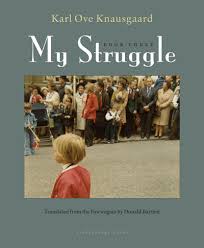
[READ: June 24, 2014] My Struggle Book Three
 I read an excerpt of Book Three just a few weeks ago. And in the post about it I said I wouldn’t be reading this book for quite some time. But then the book unexpectedly came across my desk and I couldn’t resist grabbing it while it was here. So it appears that I will now have to wait well over a year before Book 4 (which is, I think about 1,000 pages–yipes). I also see that Book Three is fully called “Boyhood Island” in Britain.
At the end of Book Two, Karl Ove was more or less caught up to the present–writing about what he was then up to (with a few years gap, of course). So it makes sense that this book is about his childhood–showing us how he came to be the man he is.
The book, amusingly enough, starts off with memories that he cannot possibly remember, and he even says as much. He is using memories of his parents and piecing together pictures from when he was an infant. In 1970, (Karl Ove was born in 1968) his family moved to the island of Tromøy 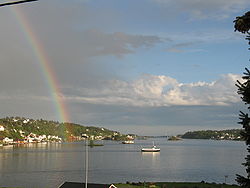 (and check out the idyllic picture that Wikipedia had). This is where Karl Ove spent his (rather traumatic) formative years. Their island is small, so he knows everyone in his school, but there are some amenities around like the Fina station and the B-Max, and there’s lots of soccer to be played and bikes to be ridden.
Things seem normal at first–he runs and plays with his friends, there is ample green space to run around in, and they have boats to sail on. And we meet two of Karl Ove’s earliest friends: Geir and Trond (so many people are named in the book, I’m very curious to know if any of them remember him). In an early scene they chase the end of a rainbow looking for a pot of gold (and have a discussion about what happens to it when the rainbow vanishes (the boys even play a prank on Karl Ove that they actually found the pot,a dn while he doesn’t initially fall for it, he is compelled to go back and they tease him).
But the looming figure here and throughout the book is Karl Ove’s father, who, at least according to Karl Ove’s memory, is pretty much a monstrous dick. He is demanding and exacting, unforgiving and seemingly uncaring. He is either bipolar or a drunk, jumping from goofy to outright rage in a mater of seconds. Karl Ove and his brother Yngve fear him unconditionally and, by the end of the book they both seem to hate him. The scene where their dad tries and fails to teach Karl Ove to swim is heartbreaking, especially when the dad goes home and tells their mom right in front of him “He’s frightened of water.” There are dozens of instances of fear and intimidation (often accompanied by a wrenching of Karl Ove’s ear). Like when Karl Ove turns on the TV for his grandparents (he wasn’t allowed to touch the TV but he wanted to do something nice for them). After a few minutes, the TV fizzed out and, naturally, he was blamed for it and sent to bed without supper (after some minor physical abuse).
His mom, on the other hand, was always kind and caring, always there with an ear and an encouraging word. He also loved his grandparents (on both sides, it seems), who were warm and welcoming and a nice change from his regimented lifestyle.
Aside from parental threats, the boys get up to what I think of as typically 1970s behavior–starting fires (with minimal consequence), peeing and pooping in the woods (a hilariously long section about that, including returning to check on it days later–also, in the TMI department, a lengthy explanation of Karl Ove’s constipation). Later the boys go to a dump and watch older boys shooting rats, then they go exploring in the dump, looking for magazines and other treasures. Later when they are older they explore an abandoned car and see the things that older boys have left there.
And then Karl Ove starts school. I wish a more specific timeline was given (it’s shocking how specific he is about some details but not others), because I’m unclear how old he is when he starts school. He says he could read at 5 and a half but that few other boys can read yet. His older brother hates school of course, but Karl Ove is excited to go, especially when they announce swimming lessons (although the humiliation that Karl Ove gets when his mom buys the wrong swimming cap is excruciating).
Throughout the book, Karl Ove feels persecuted–some of it justly, some of it is probably young nerves. But he is also prone to tears very easily–he cries throughout the book–which doesn’t help his reputation at all. It would be interesting to count just how many times he remembers crying. Thi sensitivity is not helped by the fact that his father teases him more than his friends do when he cries. (and he cries fora lot of different things, too).
About midway through the book he wonders if his mother was to blame for staying with his father–“she must have had her reasons” But then the worst news comes along–their mom is going to take some classes on Oslo to complete her training. She will be away from them from Mon-Thu every week for several months. How can she leave them with that man? And thus begins a cold and dark time in Karl Ove’s life.
Some other excruciating scenes–the one where Karl Ove eats cereal with spoiled milk because he’s afraid to tell his father the milk has gone bad; when he gets his candy stolen from some older girls (and his father mocks him); when Karl Ove earns money fairly but his father doesn’t believe him, and worst of all (and probably the most serious event in the book) when Karl Ove and his friend throw rocks off a bridge and hit a car windshield. And then later when he runs for office in school and gets not a single vote
Relief comes when his father goes for the same kind of study in Oslo, but he winds up staying away a lot more. And later he is transferred to Kristiansand, with the intent that the family will all move there. A great weight is lifted off the house when he is gone–Karl Ove and Yngve both felt freer.
Karl Ove experiences many heartbreaks. From an early age (7) he and Gier start playing with the girls in town. They are cool and fun, but soon they are seen playing with other boys. The love letter he writes to Anne Lisbet is both touching and funny. And the heartbreak leads to other thoughts of girls which leads to, of course, porn mags, and the quest to find them and the solitary place to read them. And of course, awkward sexual experimentation (in the junk yard, ew). And then later in the book, blindly groping a girl who is “easy.”
The section that was excerpted in The New Yorker was actually several sections that are pretty far apart in the book, so more context made them a bit more compelling here. We get the long story about the super hot girl that he finally gets to date and then takes her on the worst first date ever (it is as excruciating to read as one can imagine). She breaks up with him the next day.
Then, as they were nearing the end of yet another school year (I believe Karl Ove is 13 at this time) the kids start making fun of him for his actions and for his easy crying–he gets labelled a jessie because he tries to find ways to talk to girls (about clothes and at the dances). Even though he has dated girls, or perhaps because he has, they are especially mean to him. There’s one final girl whom Karl Ove falls in love with and of course that one ends badly, too. Worst yet, at the end of the book one of the girls in class tells him that none of the girls in the whole class like him.
Then seventh class ends with at the farewell party (Karl Ove was leaving with his family for Kristiansand, although it’s unclear if the class knew that). At this party, there was kissing and groping (even for Karl Ove)–wow, I never went to parties like that!
Music plays an important part in his early childhood, especially his brother’s taste in music. Some bands name checked: Stauts Quo Piledriver; The Beatles Sgt Pepper (it’s great to hear him write the lyrics with a Norwegian accent: “getting bettåh bettåh bettåh!”) and “Norwegian Wood” of course. And Gary Glitter, Mud, Slade, The Sweet, Rainbow, Rush, Led Zeppelin, Queen; and then later The Jam, The Stranglers, The Boomtown Rats, The Clash, Sham 69, Kraftwerk and of course Norway’s own The Aller Værste!
As with the other books in the series, this book is a combination of very deep focus on the mundane details of life followed by large gaps where huge periods of time pass, often without any real specificity of detail at all. So far nothing in this book is as mundane as the activities in book one, but he does get into intense detail (including people using their turning signals before turning as well as actually turning on faucets and other things that most storytellers leave out). Perhaps because we are used to getting very slow paced information prior to something really exciting, it gives a tension to this book that is not really there. You keep expecting something awful to happen but it never really does. Although in this case, everything seems equally traumatic for Karl Ove, so perhaps it is all horrifying for him.
These books have become a sensation, and I’m not entirely sure why I am so interested in them myself. Karl Ove is really not a very nice person (even if we kind of see why now). Perhaps it’s his honesty and his acceptance of his own flaws that makes it such an interesting read. I’m sure I also like the cachet of reading a book about Norway, which is very exotic to me.

 I Just Read About That...
Leave a comment