Feeds:
Posts
Comments

Archive for June, 2014

CV1_TNY_02_03_14Blitt.inddSOUNDTRACK: COURTNEY BARNETT-Tiny Desk Concert #348 (April 14, 2014).

cbThe first time I hear Courtney Barnett’s “Avant Gardener,” I fell in love with it.  A nearly spoken word almost slacker style vocal delivery of some really funny and very clever lyrics.  Plus a catchy chorus.  Swoon.

Then WXPN started playing it to death and I got a little tired of it. Thankfully, they found another track on the album (two eps together with the delightfully odd name The Double EP: A Sea Of Split Peas).  And that proved to be just as good.  Then I saw her live on a late night show and her live delivery was different and even more compelling.

In this Tiny Desk Concert, she plays the guitar differently on “Avant Gardener”, bringing in some new textures behind her accented Australian voice.  The second song “History Eraser” is another song from the EPs.  She has mentioned loving Nirvana, and I can see a similar style of guitar playing in this one.   The chorus reminds me of Liz Phair’s “Flower” which is no bad thing.

The final song is a new one about a suburb near Melbourne called Preston.  The song is called “Depreston,” and its about house hunting.  It’s another interesting story telling song with a great melody.

Barnett doesn’t do staggeringly original music, but it’s all really enjoyable.  And it’s fun to see just her and her guitar in this setting.

[READ: June 11, 2014] “The Emerald Light in the Air”

This story begins as one thing (which I liked) and slowly turns into something else (which I also liked but not as much).

As it opens, we see a man driving his father’s (and his father’s before that) Mercedes in Charlottesville.  There had been thunderstorms that afternoon and one of the roads is blocked by a large tree.

What I liked about the story was the way his present (driving, planning his dinner for his date tonight) was interspersed almost on a paragraph by paragraph basis with moments from his past.  The past is brought up by the present events–he is having a date with Mary Doan, the woman he lost his virginity to.  They happened to run into each other after all of these years.  Humorously, she didn’t remember him, even though she was a huge part of his life.

He is also thinking about his ex-wife.  He has some of her drawings and paintings in the trunk of his car.  He’s planning on taken them to the dump so they’re out of his house.   So he thinks back to their days as young artists together.  He also thinks back to the days when he was suicidal, and how now he carries a gun but only for his art, not for suicide. (more…)


Read Full Post »

CV1_TNY_01_27_14DeSeve.inddSOUNDTRACK: RODNEY CROWELL-Tiny Desk Concert #365 (June 16, 2014).

rodneyI’ve never heard of Rodney Crowell, although he’s apparently been writing country songs for nigh on 40 years.  And he looks like a rugged old country music star.

But his songs don’t feel all that country.  His first song “Famous Last Words Of A Fool In Love” is a delicate ballad with a pretty guitar melody.  The second song “Jesus Tell My Mama” is more of a blues song (especially when his female backing vocalists kick in and help out).  The final song “God I’m Missing You” (which is not about God) he does solo.  It’s another sad, simple ballad.

Crowell’s voice doesn’t really sound country, although I can see how it would be considered such.  It’s just a powerful voice and I enjoyed hearing him.

All told these three songs barely stretch to ten minutes.  But it’s an interesting snapshot of how an older singer can move out of the genre that he is known for.

Incidentally, NPR is putting up these Tiny Desk concerts so frequently I’m never going to be able to catch up.  Slow down guys!

[READ: June 11, 2014] “The Frog Prince”

I’m surprised to see a second Robert Coover story in the span of just a few months in The New Yorker.  Perhaps because these are only one page, he gets to have a second one.  Like “The Waitress” (which appeared in May), this story plays around with a fairy tale.

I enjoyed this one more than probably any fairy-tale-related story that Coover has done.  Because in this one he really explores the harsh reality behind falling in love with a frog prince.  For indeed a woman does–she kisses a frog and he turns into a prince.  Naturally, she has to divorce her current husband, but she does so willingly to be with this magical prince.

But the harsh reality is that a prince that comes from a frog is going to be very frog-like: bulging eyes, a whip-like tongue and a kind of constant slurp.  However, he also has the secretions that get her very very high.  She enjoyed licking him when he was an amphibian, but when he turned, there was only one place left that had those secretions, his nether regions: “he wasn’t the cleanest of princes, but the trip was worth it.”  She looks forward to spending more and more of her time high. (more…)

Read Full Post »

CV1_TNY_02_10_14Hanuka.inddSOUNDTRACK: AGES AND AGES-“Divisionary (Do the Right Thing)” (2014).

agesagesI’ve enjoyed this song in a couple of formats so far–studio version and Tiny Desk version.  Now here’s another one. Here’s how it was set up according to front man Tim Perry:

“We surrounded ourselves with friends, family (my mom is one of the violinists), and all of our favorite musicians from all of our favorite Portland bands,” says Perry. “We reached out to people who’d inspired us over the years: other artists, activists, organizers. We reached out to Northwest Children’s Choir. We reached out to PHAME, a choir of adults with disabilities. We reached out to a lot of other people we didn’t know but wish we did. It was all over and done in four short hours. And it was one of the best days of my life.”

If the song was inspirational before, it’s crazy emotion-inducing now.

[READ: June 10, 2014] “Moonlit Landscape with Bridge”

This title is surprisingly calm and pretty for what the story is really about.  The previous story of hers that I read was set in a kind of dystopian land.  And this one is set in an unnamed country after a life-altering storm.  Either she is writing a post apocalyptic type of novel, or she is exploring very dark themes indeed.

As this story opens we see the Minister of the Interior packing his things.  Slowly it is revealed that the country has been decimated.  He thinks to himself that he was prepared for crippling winds, but not for the water that came with the winds.  Consequently, most of the country is apparently underwater (the details of the storm and the details of the aftermath are incredibly vague).

There is no more Ministry, so his title is superfluous, but because of his title he is given an opportunity to flee the country in a government jet (all other airplanes have been grounded).  On his way to the airport, he sees people struggling, crying, looking for… anything.  They crowd his car and he longs to help them.  His driver, Ari, tells him to ignore them, there’s nothing that he can do for all of them.  But the Minister insists that they pull over so he can dole out the bottles of water he has in the trunk. (more…)

Read Full Post »

CV1_TNY_01_13_14McCall.inddSOUNDTRACK: PHISH-Live Bait 7 (2012).

bait7This free sampler from 2012 is practically a greatest hits collection for me.  There are 8 tracks on the collection and none of them is shorter than 15 minutes.

It opens with a 1995 concert in which “Wilson” segues into “Tweezer” (for a combined total of 30 minutes).  Then there’s a 13 minute version of “Stash” from 2010 and an 18 minute version of “Split Open and Melt” from 1999.  The songs meld very nicely together with just the slightest change in recording sounds making any notable difference.

“You Enjoy Myself” comes from way back in 1992, and it ends with an extended vocal nonsense section–all four of them mouthing crazy sounds in a rhythmic pattern.  The only song of the set that I don’t love is “Runaway Jim,” but the jam section is great in this one.

“Reba” from 1996 works perfectly with “Gumbo” from 1998.  And the set closes with another 1992 recording.  The band opens with “All Things Reconsidered” which Trey explains is a reworking of the NPR theme.  But he then tells the audience that they can sing along to the next song, David Bowie” (which opens with a little nod to the Simpsons).

There’s no sign of a Live Bait 10, unfortunately, but having 9 free releases of highlights from live shows is still pretty sweet.  If only their show in Philly hadn’t sold out.

[READ: June 12, 2014] “The Paper Revolution”

Dinaw Mengestu’s first story (in the 20 under 40 issue) was about a refugee which I felt was more than a stereotypical refugee story.  This new story is about student revolutionaries, and it looks at them in a different (and somewhat confusing) way.

The narrator, who is eventually called Professor Langston by his friend Isaac, is at the University in the capital city, Kampala.  When he first meets Isaac, he finds him an interesting fellow–a man studying politics, because what else is there to study in Africa?  When the narrator says he’s studying literature, that’s when Isaac calls him the professor.

Isaac is full of information that he loves sharing (starting his sentence with “Did you know?”) He lectures about the British rule and their plan to turn this city into a new London if they lost the war.  Isaac fills him with political theory, and the university was the ideal place for it “Every aspiring militant, radical and revolutionary in Eastern and Central Africa was ran to the university.”

He and Isaac watch the “radicals” and can tell from their shoes which ones are truly poor. But there is one boy–so rarely seen as to possibly be invisible–who was the genuine article.  And soon enough there is graffiti on the walls which everyone attributes to him.  But the graffiti is whitewashed and a sign is put up admonishing: “It is a Crime against the country to deface our University walls.” (more…)

Read Full Post »

CV1_TNY_01_06_14Ware.inddSOUNDTRACK: BROWNOUT presents Brown Sabbath (2014).

brownout_cvrI was intrigued by the premise of this album: Brownout is a nine piece jazz band and they play a selection of Black Sabbath covers.  The NPR site (where you can stream the album this week) explains:

They played a residence at an Austin club where they devoted a week each to the repertoire of artists like Black Sabbath to break the monotony of a long club gig.  Audience response, not to mention the fun the band had on stage reworking Sabbath classics, led to a full-length album.

So, this band plays a number of Black Sabbath classics, with, oftentimes, the horns standing in for Tony Iommi’s guitars or Ozzy Osbourne’s voice. Although there are also times when the (various) singers in the band try out their inner Ozzy (and often succeed).  They get pretty heavy for the heavy parts (and there are guitars so the do have appropriate guitar sounds from time to time).   But they also play some of the groovier songs too (like “Planet Caravan.”)

Other songs include “The Wizard” (probably my favorite here), “Iron Man” (which is very different from the iconic song, and is only vaguely recognizable as the song, but is very good nonetheless).  They also do “N.I.B.” a bass heavy song which takes on a different style (perhaps a bit too much like Dread Zeppelin).  “Black Sabbath” has no vocals, just a guitar playing the lines–and the horns in the beginning add a suspenseful accent. “Hand of Doom” plays that slinky dark sound very well (I just like the original so much that this one can’t quite compare).  And “Into the Void” which also has no vocals, but sounds a little too marching band here (but the middle instrumental section is really trippy).

So I enjoyed this take on classic Sabbath.  Although I don’t need to listen to it more than once.

[READ: June 13, 2014] “First Husband”

Looking back, I see that I have enjoyed a lot of Antonya Nelson’s stories.  And I enjoyed this one too.  She seems to have a great eye for little details, or interesting aspects of family life that are fun to unravel.  The thing I really liked about this story was the simple construction of the character relationships.

Lovey is married to William.  It is both of their second marriages.  But Lovey’s first husband was married before he married Lovey–she was his second wife.  Lovey’s first husband had several daughters, including Bernadette.  So for a time, Lovey was Bernadette’s stepmother (even though she was close in age to the oldest daughter).  Then when Lovey and her first husband split up, she was no longer Bernadette’s step mother.  But because the marriage lasted for more than a few years, the girls grew close to her, especially Bernadette.  When they divorced, Bernadette actually chose Lovey over her father.  So now Lovey is her ex step mother.  And William is something to Bernadette that there’s not a word for.

I love that.  Even though it’s probably not that uncommon, it is such a linguistic mess that its clear no one was ever prepared for that.

I especially liked that that level of detail is included even though it is not the crux of the story.  It is relevant, but it is not the crux.  The crux is that Bernadette’s husband (whom no one likes) is out drinking.  Again.  Bernadette is nervous about him coming home drunk and the fight they will have so she wonders if she can bring the kids over to Lovey’s house.  It is 2AM.

Lovey doesn’t mind.  Lovey doesn’t have children of her own–she feels that her first husband (Bernadette’s dad) deliberately kept her from having children during her prime years and now she is stuck.  And even though these children are technically nothing to her, their ex- step-grandmother, she still cares them.  And Bernadette’s oldest boy, Caleb, is the reason she is named Lovey–it was something that he could say when he was little.  So when the children come crashing over, Lovey welcomes them without waking William (who needs to be up early for his doctor rounds). (more…)

Read Full Post »

torSOUNDTRACK: THE KIDS-“Forelska i lærer’n” & “Norske Jenter” (1980).

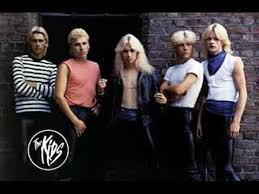
kids2 The Kids are a Norwegian band that was mentioned in Karl Ove Knausgaard’s story yesterday.  He is pretty disparaging of them as they were hugely popular when he was in school (and he liked other bands).  They sing in Norwegian and are quite poppy.

“Norske jenter” is the poppier of the two.  It’s pretty synthy, with a super catchy melody and chorus.  It seems just shy of being a sleek pop hit, but I can imagine that a band singing in your native tongue would fair well even without super slick packaging.

Of course, having said that, “Forelska i lærer’n” is nothing if not slick–check out these guys with their super blond hair.  Actually the video is pretty funny and with a name like “In love with the teacher,” it is quite a different subject than I expected).  I love the way they designed the teacher.  And that wink is fantastic.  If only the lead singer could act a little better.  kidsThe song is kind of a heavy classic rock sound–maybe a poppier version of Thin Lizzy (those guitar solos are very Thin Lizzy).  I’m of course very curious what the lyrics are.

I found two videos on YouTube (and apparently there are some more recent live songs)

Norske jenter: There’s no visuals in this video, just music:

But the video for “Forelska i lærer’n” is here in all of its glory–it looks much more modern than 1980.  The self pogoing at the end is fantastic.

[READ: June 15, 2014] Replacement

I found out about this book from Karl Ove Knausgaard, who claims that it is the best Norwegian novel ever written (he also has a quote on the back of the book).  I had never heard of Tor Ulven before.  It turns out that he has written mostly poetry.  And then he wrote a few prose-like poems and then this novel called Avløsning in Norwegian.  And then he killed himself.

This book was translated by Kerri A. Pierce and it has an afterword by Stig Sæterbakken.  And literally that is all I can tell you about the book for certain.

Why?  Because the back of the book and the afterword actually differ about what they say is happening in the story.  To a pretty intense degree.  The back of the book says that “the perspectives of unrelated characters are united into what seems a single narrative voice: each personality directing the book in turn.”  Whereas Stig makes the case that the book is all one narrator at different points in his life.

And why can’t you tell?  Because there seems to be different perspectives (all by men), and yet no one is named.  And then there’s the fact that some of the book is written in second person, while the rest is in the third person–this suggest at least two narrators, and yet it could also be a flashback.  There are at least four different time settings and seemingly different people.  There’s an old man in a wheelchair, there’s a security guard, there’s a taxi driver (I think).  There’s a guy who likes to list things, there’s another guy who thinks parenthetical thoughts.  And there’s an intense obsession with “her,” a woman who doesn’t seem fictional but is certainly mythical.

And what happens?  Well, nothing. (more…)

Read Full Post »

CV1_TNY_02_17_14Columbo_spine.inddSOUNDTRACK: THE ALLER VÆRSTE!-Materialtretthet (1980).

matThe Aller Værste! were a Norwegian new waves/punk band with elements of ska thrown in.  I only know of them because of this story, but I decided to check out some of their stuff since it is so relevant to the story.

This was their debut album, which has been ranked as the number 6 best Norwegian album of all time (by Morgenbladet, a Norwegian weekly newspaper).  The album opens with lounge piano and trombone before breaking into a ska-inflected “Du sklei meg så nær innpå livet.”  Lead singer Chris Erichsen sings in some unusually deep voices (some of which seem comical) in “Dødelige drifter.”  “Døgnflue” is a two-minute punk blast with a loud Farfisa organ running throughout.

“Bare du som passer på” has a distinctly Clash feel in the vocals.  “For dem betyr det lite” is powered by that organ sound, while “Bare en vanlig fyr” is very guitar heavy (and may have a different singer).  This is probably my favorite song on the album, there’s some great sections in it.

This sound of punk sensibility with a prominent organ (an vocals in Norwegian) really make The Aller Værste! stand out in 80s rock.  “Må ha deg” has some interesting backing vocals and sounds like a Clash inspired ska song (with more crazy vocals).  It has a slow instrumental section with a twangy guitar solo.

“Igjen” is 90 seconds of punk (but not very harsh punk).  The next few songs are all about 3 and a half minutes long.  “Bare ikke nok” has call and response vocals and an unexpected beat.  “Hong Kong” slows the sound down, with a prominent bass riff.  “De invalide” is an upbeat song with horns.  “Hekt” has some dissonant guitar over almost funky bass and a serious breakdown at the end.  “Discodrøv” has very fast drums as it opens, but it turns into a rollicking song with disco bass and big horns.

“Oppvekst” follows those horns with some fast (ska-like) guitars.  “Materialtretthet” opens with some great, wild bass and continues wit a very fast-paced song.  This is another favorite (it’s interesting that the title track is also one of the shorter songs on the record).  “Menneskelig svikt” sounds quite raw, with echoey distant guitars and vocals.  “Blank” is the final song on the album (reissues have added more tracks).  It has a distant echoey harmonica acting as a melancholy sound behind the vocals.

I hope that Karl Ove’s book somehow gets this disc in print, I’d like to listen to it on more than YouTube.

There’s a live version of the song mentioned at the end of the story here:

[READ: June 11, 2014] “Come Together”

I know that this is an excerpt form the third part of My Struggle which I plan to read in say six or eight months.  But I decided to read it anyway in part because I was intrigued by the cover picture, which is of a record sleeve with a man on a bicycle and the wheel is the inner label of an album.  That, coupled with the title “Come Together” made it pretty apparent that this would be about music.   And so it was.

As I said, this is excerpted from Karl Ove’s third book in the My Struggle series, which is called Boyhood.  I’m intrigued that this book is set in his teenage years since the first two were set much later–it actually felt like Book 2 caught us up to the present).  At any rate, this is one small section (chock full of details) about being young and being in love with music and with girls. (more…)

Read Full Post »

CV1_TNY_03_10_14Steininger.inddSOUNDTRACK: FEDERICO AUBELE-Tiny Desk Concert #350 (April 21, 2014).

faFederico Aubele is an Argentinian singer-songwriter.  He sings in both Spanish and English. And in this Tiny Desk Concert, he plays pretty guitar solos between songs which makes the three songs all seem like one long piece.

His guitar playing is clean and beautiful on the nylon string guitar.  He plays in the quintessential “South American”/”classical” style [some might even call this Flamenco, Paul].  And his voice is low and deep but also expressive.

The three songs here are “Laberinto Del Ayer,” “This Song,” and “Somewhere Else.”  They are each quite pretty and melancholy.  And when he starts speaking in Spanish at the end of the third song, his voice is definitely enticing.

[READ: June 10, 2014] “A Sheltered Woman”

In this story, the second or third I’ve read by Yiyun Li, the main character is an older women who goes by the name of Auntie Mei.  Auntie Mei is a first month nanny–she stays for only the first month, to make sure that the mother is breastfeeding correctly and that everyone is prepared to move on–her skills are very specific to the first month.  And she is in very high demand among Chinese immigrants.

She has worked for 126 families in the last eleven years.  And she never gets attached to any of the families–calling each mother Ma and each child The Baby.

With this new mother who, like all the other mothers is Chinese (but who wants to be called Chanel), Auntie Mei is having a bit of a hard time.  The mother is disinterested in her baby, claims to have postpartum depression (Auntie Mei says “Don’t speak nonsense”) and even had a dream that she drowned her baby in the toilet.  Mostly, Chanel is angry that her husband is not around–he has been away on business since the baby was born.  We later learn about the strange details of their marriage.

Auntie Mei tries not to get involved.  She keeps telling Chanel (and others in the story not to tell her details).  She feeds Chanel a thick soup (designed for breastfeeding) and massages her breasts when she does not produce milk.  But after a few days Chanel says she quits and leaves the baby entirely in Auntie Mei’s charge.  Auntie Mei protests but she can’t allow the baby to die so she takes over.  Chanel simply watches TV and complains–she won’t even go buy groceries. (more…)

Read Full Post »

CV1_TNY_03_24_14Juan.inddSOUNDTRACK: QUILT-Tiny Desk Concert #351 (April 26, 2014).

quiltQuilt play soft, 60s era hippie music.  Lead singer Anna Fox Rochinski (who reminds me of a young Susan Dey) has a lilting gentle and quite pretty voice.  And the rest of the band layer gorgeous harmonies over these complexly patterned songs.  The hippie imagery comes across on the lyrics too.  Take “Arctic Shark,”, which has a really enticing melody and Anna’s pretty voice singing lyrics such as “How can I proceed with thee? This eastern harbor’s full of grief All my heavy dreams are simply a luxury Horses in the pepper tree and the lighthouse floating in the sea.”  The “lead” guitar sounds like a sitar, which is pretty neat and continues with that 60s theme

On “Eye Of The Pearl,” Lead singer Shane Butler has a sleepy look that fits in well with the gentle dreamy songs. His voice is a little too delicate for my liking (but the backing vocals bring the song to life.  The whole feel seems like it was transported out of the 60s folks scene.  “Mary Mountain” is a bit more uptempo and as the whole band is singing together, it sounds really full and complex. Like the other songs this one seems to have several distinct parts, although this song’s parts are even more distinct—with loud chords interchanging with quiet plucking.

The final song is “Penobska Oakwalk.” Shane sings lead on this one, but his voice almost seems to delicate (whne Anna’s backing vocals come, in the song comes to life). I’ll have to hear if the studio version is the same (no, in the studio version, his voice is appropriately loud).  This one ends with this interesting series of images:

I’ve been packing bombs for a man in an idle tower.
Who traded this land for an open hand of flowers. How did we get so
Language deflated the zeppelin of the conscious. How did we get so
And now we return through the means of our destruction. How did we get so

Although they may be a little too idealistic, it warms the hippie who lives in my heart.

[READ: June 9, 2014] “Under the Sign of the Moon”

I have enjoyed most of Tesla Hadley’s stories even if the they are a little bit sad.  This one is a little bit sad, too.  It focuses on an older women who is on her way to Liverpool to visit her daughter.  She is taking the train, and marveling at the route that they take (one section is chiseled through a mountain).  She would like to be with her own thoughts (she has a lot going on), but a man sitting next to her feels compelled to talk.  First he tells her about the building of the railway line through the mountain, then about Liverpool.  She tries to give him the hint by opening and reading her book while he is talking to her, but he keeps interrupting, at one point even asking how the book is.

I enjoyed the way he was described as chameleon-like person–his accent seemed to change whenever he talked about a different place and he seemed the kind of person who would just make up anything to have something to say.  And, gah, the way he is dressed!  Like he is still stuck in the sixties, but with none of the coolness of that decade.  He is a little bit younger than her but she feels that he may actually be flirting with her which she thinks is ridiculous given her age and how asexual she feels lately.

She is thrilled to finally arrive at the station, to be away from this man.  But as she gets off of the train, her daughter texts to say she will be at least 30 minutes late.  She decides to go for coffee.  The man is in the cafe–he clearly wasn’t following her–and he is all by himself.  He has nothing to read and no phone to look at.  She feels sorry for him and decides to sit with him.  (more…)

Read Full Post »

CV1_TNY_03_31_14Sempe.inddSOUNDTRACK: MARIAN McLAUGHLIN-Tiny Desk Concert #363 (June 7, 2014).

marianMarian McLaughlin is a singer-songwriter from Washington D.C. who has self released one album.  In this Tiny Desk setting McLaughlin plays an acoustic guitar (and some very unexpected chords) and sings while a string trio plays very eccentric melodies (and often not the ones you might expect) behind her.

Indeed, McLaughlin sounds like she might be right at home at a Renaissance Faire (her long hair and floral dress speak to that as well).  Her voice isn’t especially quirky but her delivery certainly is. And when the strings really get going (as they do in many places) the music is really powerful and more than a little off-beat.

“Heavier-than-air” seems to have many parts in its 4 minutes. While “Ocean” brings in some amazing low end with the bowed double bass and cello.  It also has an extended violin solo which is quite pretty.

“Horse” is the most intense song of the three, opening with an interesting guitar motif and that great bowed bass.  True, it’s unusual to hear the line “we are in debt to our equine friends” and later, “rhythm like a paradiddle,” but when the strings (but not the guitar) start playing a super-heavy almost heavy metal riff for a few bars, it is really intense.  There’s no question that McLaughlin is a unique voice, and I imagine that mainstream success will elude her.  But I really admire this kind of eccentric songwriting, and I am curious to check out her album at bandcamp.

[READ: June 9, 204] “The Big Cat”

I enjoyed this story quite a lot although I didn’t really care for the title (in relation to the story, the title itself is fine). There were so many images and turns of phrase that I think would have been much more interesting as a title. But if that’s all one has to complain about, that’s no too bad.

This story is from the point of view of a man who was happily married to a woman who snored.  In fact all of the women on her side of the family snored.  One holiday visit with her family he had many sleepless nights listening to the crazy loud racket of “the rip saw” (Elida’s mother) “the welders” (her sisters) and the polisher (Elida herself).  He says “sometimes they snored in unison—which was terrifying” (this made me laugh out loud).

They have a daughter together, Valery, who does not snore–as of yet.

He and Elida were from Minnesota but they lived in Hollywood for a time.  He was a relatively successful minor actor—lots of commercials, TV shows, etc and she was a film editor.  They were becoming successful in their jobs.  But then when Valery was 12 and unhappy in school, Elida decided it was the nature of Hollywood, so they moved back to Minnesota.  This ended his acting career so he found new work doing something else. (more…)

Read Full Post »

« Newer Posts - Older Posts »