 SOUNDTRACK: HARI KONDABOLU-Waiting for 2042 (2014).
 I knew Hari Kondabolu from the much missed Totally Biased with W. Kamau Bell (in fact the liner notes even have Hari thanking Kamau for employment—although at the time of this release, that employment was terminated).
As Hari jokes at one point during this show (recorded in Oakland, CA in 2013), he is “obsessed with race.” And how could he not be. To be alive in 2014, you should be obsessed with it, especially if you are paying attention. And his jokes about race are not only salient, they are different. Like the first one on the disc, “My White Chocolate Joke.” The set up is simple, chocolate is dark and creamy and delicious, why would anyone need to make a white version of it? This leads to a punchline that if you like white chocolate you are racist. But as with most of Kondabolu’s jokes, the punchline is just a set up for a much deeper joke—this one having to do with White Jesus. It’s very funny and really well done. “A Feminist Dick Joke” is self referential and funny, especially when he criticizes his own joke for not going far enough. “Moving to Canada,” pokes fun at Americans who say they are leaving for political reasons and then pokes fun at Canada for not being the panacea these people say it is anyway.
I loved “Environmentally Friendly Pollution Machines” which is about how eco-tourism is encouraging us to see things before the tourism industry destroys them. “Toby” is such a wonderfully extended joke in which people like me who don’t get the initial joke are gently upbraided until the joke is fully revealed to us and even though we just had a joke explained to us, it was still funny. And the call back at the end of the disc is genius.
“Weezer Broke My Heart” is a very unpolitical joke about the band Weezer and that their fan base demographic has not changed in a decade–and how that’s really creepy.
There’s a lot of race jokes in the next few pieces. The title track about how in 2042, whites will be the “minority” is simply hilarious (whites are only the minority if you consider that the races are “whites” and “everyone else”). And then the hilarious joke about how “Asians are Well-Behaved” (the Chinese restaurant bits are awesome) and the wonderful dichotomy of Mexican stereotypes (stealing our jobs but also being lazy). There’s also the very funny joke about how minorities never get to time travel for real (referencing the Martin Lawrence movie Black Knight and Back to the Future just to show how current and hip he is) because there would be some real changes.
There are also a number of jokes about homosexuality, and how heterosexuals are totally flamboyant even though they don’t realize it (showing off your spawn is pretty flamboyant, frankly). And the extended riff in “Matthew McConaughey on Tolerance” is just terrific.
Jokes dealing with all of these topics are bound to be inflammatory, but Hari is also not afraid of the deadly curse words, (he actually makes me uncomfortable in one joke with how many times he says the word fuck, although is very funny).
All in all this is a very funny standup show from a comedian who is very funny and will, with any luck, find a wider audience. (Of all races).
[READ: June 20, 2014] Arcimboldo
Giuseppe Arcimboldo was a phenomenal painter who is best known for his paintings of people’s portraits which are made out of fruit. But he was also a master of detail in realistic sketches, drawings and painting as well. This tiny book (270 pages) with a paragraph of text on every other page, is a wonderful introduction to the man beyond the fruit.
Perhaps the most amazing thing about his work is that it was done in the 16th century. I think many of us tend to lump him in with the surrealists or the modern period. But he worked in this style long before. For context, his father was friends with a student of Leonardo da Vinci.
Arcimboldo was born in 1527 to nobility. Interestingly, there are variations on the spelling of his name: Acimboldi, Arisnbolde, Arcsimbaldo, Arzimbaldo and Arczimboldo. Giuseppe even signed his first name in different ways as well: Giuseppe, Josephus, Joseph or Josepho. The book doesn’t indicate if this was some kind of intentional obfuscation.
The first dozen or so pages contain amazing illustrations by Arcimboldo–primarily studies of nature, both flora and fauna. They have a distinctively 15th/16th century style, and they are amazingly detailed. A little later, Arcimboldo began doing studies in deformed creatures–birds with three legs , goats with weird hooves. Whether this was just because he wanted to explore nature in great detail or because he liked weird things, the book doesn’t say.
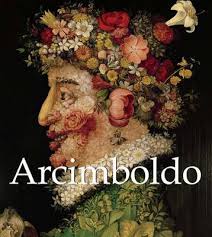
 Mostly this book is an excellent collection of Arcimboldo’s portraits. There are multiple “realistic” portraits through the book–showing that even though Arcimboldo is known for the fruit faces, his technical skill were wonderful. But the bulk of the book is full of these optical illusions. The text explains that Arcimboldo worked with series called The Four Seasons and the Four Elements and that these were designed to go together (in terms of color and tone). He created these series several times, adding new backgrounds to the later versions.
So,the book cover (Spring) was done three times (1563, 1573, and 1577) as were all four of the Four Seasons.
In addition to foods, Arcimboldo also made hidden face paintings in other themes.
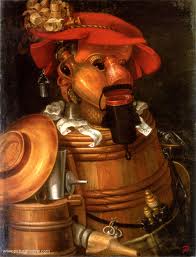
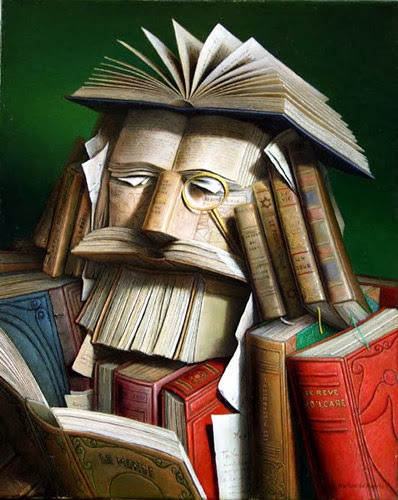
Like the sommelier (left) and the librarian (two version below). He also did ones of cooks and gardeners, all thematically appropriate. Critics differ as to whether these were meant to be mocking portraits of people, or if the subjects genuinely enjoyed them (this is not the right book for that kind of discussion). Although the paintings were all commissioned and people really did like them.
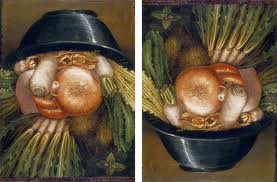
The final kind of painting that he did (at least in this book) is a reversible kind. There are several in the book. The one called The Gardener is below. As you can see, if you flip it over, it becomes something else entirely. Quite a cool trick.
 The two bad things about Arcimboldo are that some of the paintings are lost and (in my opinion this is bad) that most of these paintings are held by private collectors, with only a few of them in museums. So most of us will just have to rely on books like this to be able to see the images.
  The plus side is that this book shows lots of detailed close ups of the paintings to really let you see just how much Arcimboldo put into these masterpieces.
Look him up online and be amazed!

 I Just Read About That...
Leave a comment