 SOUNDTRACK: CRYPTOPSY-“Slit Your Guts” (1996).
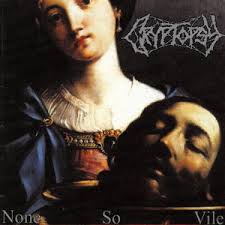 I had never heard of this band until I saw the song mentioned in the article. The song is impossibly fast with speeding guitars, super fast (inhuman) drums and an indecipherable growl as vocal. In other words, a typical cookie monster metal song. And yet, there is a lot more to it and, indeed it took me several listens before I could even figure out what was happening here, by which time I had really fallen for the song.
There’s a middle section which is just as punishing and fast but which is basically an instrumental break–not for showing off exactly but for showcasing more than the bands pummel. It has a short guitar solo followed by a faster more traditional solo (each for one measure, each in a different ear). Then the tempo picks up for an extended instrumental section. The melody is slightly more sinister, but it sounds great. There’s even a (very short) bass solo that sticks out as a totally unexpected (and fun) surprise.
Then the growls come back in, staying with the new melody. The vocals are so low and growly that they are almost another distorted instrument rather than a voice.
After that there’s a lengthy proper guitar solo. As the song comes to a close, it repeats some previous sections before suddenly halting. It’s quite a trip. And it definitely makes me want to hear more from them (whatever their name means).
[READ: April 14, 2014] “Destroy Your Safe and Happy Lives”
Robbins, who is a poet, but about whom I know little else, takes us on a sort of literary tour of heavy metal. His tone is interesting–he is clearly into metal, like in a big way (at the end of the article he talks about taking his writing students to see Converge (although he doesn’t exactly say why)), but he’s also not afraid to make fun of the preposterousness of, well, most of the bands–even the ones he likes. It’s a kind of warts and all appreciation for what metal is and isn’t. many people have written about metal from many different angles, so there’s not a lot “new” here, but it is interesting to hear the different bands discussed in such a thoughtful (and not just in a fanboy) way.
His first footnote is interesting both for metal followers and metal disdainers: “Genre classification doesn’t interest me. Listen to Poison Idea’s Feel the Darkness followed by Repulsion’s Horrified and tell me the main difference between hardcore punk and metal isn’t that one has a bullshit positive message and one has a bullshit negative message.”
But since Robbins is a poet, he is interested in metal’s connection to poetry. And in the article he cites William Blake (of course), but also Rilke and John Ashbery and (naturally) Milton’s Paradise Lost, as well as Shelley, Lord Byron and Charles Baudelaire. He talks about them not because they are cool poets, but because they have also talked about because of metal’s “most familiar trope…duh, Satanism, which might be silly–okay, its’ definitely silly, but has a distinguished literary pedigree”. Besides, he notes that Satan has the best lines in Paradise Lost (and I note that just as Judas has the best songs in Jesus Christ Superstar).
But sometimes this Satanism turns into a form of paganism which then turns into nature worship. From Voivod’s “Killing Technology” to black metal’s romanticism of nature (sometimes to crazy extremes–but that’s what a band needs to do to stand out sometimes). Metal is all about the dark and primordial, a”rebuke to our soft lives.”
And yet, as a poet, Robbins has some quibbles with metal:
Although metal lyrics provide a trove to such sentiments, no one should listen to metal for the lyrics, which are mostly unskillful. They’re also mostly indecipherable (Yes, there are plenty of exceptions… I said ‘mostly’).
I enjoyed Robbins quoting metal-hating critic Chuck Eddy who at least acknowledged that metal “is more varied than any other white-rock genre.” Robbins name checks Guns N’ Roses, Converge, Iron Maiden, Carcass, Kvelertak, Baroness, Hammers of Misfortune, and Grave Miasma, as a small list of bands that are very different (although he could have certain been even more diverse). Some of the above bands I’ve never even heard of.
Metal was largely ignored by music critics as it developed. Robbins says “this critical negligence means that metal has had the freedom to develop from its bluesy origins in England’s working class into one of the most vibrantly imaginative and complex genres of popular art without a lot of outside interference or notice.”
And yet for all of his love of the genre, unlike some other things, he understands that others may not like it. I feel the same way. He mentions the new Deafhaven album which received praise even outside of metal circles last year and which I think is great and yet I wouldn’t force it on people who don’t like the style–it’s not going to convince anyone who doesn’t like noisy rock. Although his example is even funnier:
I can understand why a person would not care to devote much time to music that involved a lunatic growling “Colon, cry for me!” over an unremitting tornado of guitars and drums (not that you can really make out what Lord Worm is growling about on Cryptopsy’s “Slit Your Guts.”).
Even though I myself do not listen to metal as much a I used to, I can still enjoy a good thrasher. And, indeed, I find that there are times when I listen to music that is heavier than anything I ever listened to in my metal hey day. My favorite personal anecdote was that back in 1981 I was looking for music that was “even heavier” than anything else I listened to. I didn’t know what it was, but i was sure I could find it. It was slim picking back then, especially since I was a) in a suburban mall’s record shop and b) with my 80-year-old aunt. Oh, and because since the likes of Metallica wouldn’t be around for a year or two. I wound up picking Ozzy’s Diary of a Madman because it sure looked heavy. Well, it absolutely is not heavy, but I did love it. And I think of her every time I listen to it.
I really enjoyed this article for introducing me to bands who moved beyond the simple growly sludge metal that I don’t really like.
Online at Harper’s website, Robbins included this, his Top 5 Metal Albums and Their Poetic Counterparts (albums released after 1980):
1. Death, The Sound of Perseverance (Nuclear Blast, 1998). In the state with the prettiest name, the late Chuck Schuldiner basically invented death metal. This is my favorite Death record, although Human is a close second. It’s proggy, sinister, majestic. The death-obsessed Thomas Lovell Beddoes comes to mind. But the album’s on-a-dime swaps — rocketing melodies for eerie minor-key riffs for industrial brutality — call for a counterpart with weird, intricate metrics. I suggest the poems of the Jesuit priest Gerard Manley Hopkins (Schuldiner found Satanism silly, and he loved animals).
2. Slayer, Reign in Blood (Def Jam, 1986). It might be a coincidence that so many fans use the words “chaos” and “pandemonium” to describe the contradictory turmoil of this speed-metal landmark — fast, tight, in and out of control. But Chaos is Milton’s word for the “womb of Nature” containing the “dark materials” from which God creates the universe, and Pandemonium his name for the “High Capital / Of Satan and his peers.” And Milton, as Blake knew, was “of the Devil’s party without knowing it.” So Paradise Lost is the poetic counterpart of Reign in Blood (whose comic-horrific cover depicts the goatish Evil One borne across a lake of fire and blood). “Go and speed,” a personified Chaos tells Satan in the poem; “Havoc, and spoil, and ruin, are my gain.”
3. Converge, Axe to Fall (Epitaph, 2009). Converge is my favorite band. Jane Doe is, by critical fiat, their stone-cold masterpiece, but this later slab of metal punk is the one I love most. The ferocity of Jacob Bannon’s screams and Kurt Ballou’s bunker-busting guitars suggest the Flanders-Field carnage and machine-gun rhythms of Christopher Logue’s new-wave version of the Iliad’s battle scenes, All Day Permanent Red: “The noise they make while fighting is so loud / That what you see is like a silent film.”
4. Guns N’ Roses, Appetite for Destruction (Geffen, 1987). Yes, there’s filler, but this record’s had its hooks — and what hooks — in me since I first saw the video for “Sweet Child o’ Mine” in high school. Someone pointed out to me that there are more allusions to GN’R in my first book of poems, Alien vs. Predator, than to any other band or author. Therefore my own work is the poetic counterpart of Appetite for Destruction. If that’s too obnoxious, well, so are GN’R. But please also see, for destruction and appetite, Chelsey Minnis’s Poemland and Ooga-Booga by Frederick Seidel.
5. Mastodon, Remission (Relapse, 2002). Riffage. Huge, mud-caked barn doors of riffage. Aluminum siding of riffage slicing through trees of riffage in a hurricane of riffage. The American mastodon (the name means “nipple tooth,” which would also be a good name for a metal band) weighed around five tons, which is exactly how much the Atlanta band’s debut record weighs. But there’s a progressive complexity here too — Bill Kelliher (guitars) and Brann Dailor (drums) trample forests, then carefully diagram each leaf. Their fellow Atlantan James Dickey comes to mind, especially in the whiplash backwoods homily “May Day Sermon”:
Ah, children,
There is now something else to hear: there is now this madness of engine
Noise in the bushes past reason ungodly squealing reverting
Like a hog turned loose in the woods . . .And, for good measure, five more favorite records (come up with your own poetic equivalents at home!): Iron Maiden, The Number of the Beast; Carcass, Necroticism: Descanting the Insalubrious; Pig Destroyer, Phantom Limb; Dissection, Storm of the Light’s Bane; Manilla Road, Crystal Logic.

 I Just Read About That...
Chuck Eddy doesn’t hate metal; he wrote an entire book about metal.
Really? I’d never heard of him until I read this articles and they both made it sound like he didn’t like it. I’ll have to check him out then. Thanks