 SOUNDTRACK: BECK-Modern Guilt (2008).
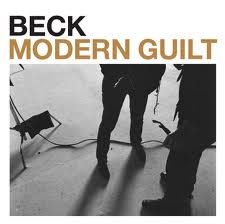 As I mentioned, I missed Modern Guilt when it came out. I guess I had burnt out on Beck after The Information. But man, I have recently gotten into it big time. It may be my favorite Beck album of all. It is brief and simple but with enough going on to keep iot more than just interesting. The feel is consistently retro by Beck but Danger Mouse throws in enough modern elements to keep it totally fresh (at least six years after the fact).
“Orphans” opens with a hyper drum beat and keyboards, but once the chords and Beck’s vocals come in it has a very sixties folk/psychedelic vibe. But those drums keep coming it, making it sound very modern. This has one of the catchiest verses that Beck has sung in addition to a great unexpectedly poppy bridge. The song is unmistakably Beck, but the flourishes are very Danger Mouse. “Gamma Ray” opens with a surf rock sound and backwards backing vocals. It sounds very “future”, but future from the 60s. This song ends abruptly just under 3 minutes, it’s especially abrupt after the length of some of his more recent albums. “Chemtrails” opens like mid 70s Pink Floyd–synths and falsetto vocals. But when the drums come crashing in it totally changes the song to a more modern sound–and yet that bass is still very Pink Floyd. “Modern Guilt” has a very simple beat and seems like a simple catchy song. Then the keyboards come along top and it feels kind of spacey. Then the second guitar riff comes in underneath the song and it’s grounded again. There’s so much going on in this little poppy gem.
“Youthless” is another straight ahead simple rocker, this one has disco synth lines over the top. It reminds me of “Cellphone’s Dead” from The Information (I keep waiting to hear “One by One, gonna knock you out”). It’s the only song on here that reminds me of another of his songs. “Walls” has a cool vocal melody that plays off of the music very well. It also ends abruptly–a very cool two and a half-minute song. “Replica” has very contemporary chaotic drumming that pins this floating song. “Soul of a Man” makes me think of Deep Purple’s “Hush” for some reason. But I love the way the guitars and noises just seems to come and go leaving the classic rock rhythm pulsing underneath it all. “Profanity Prayers” has a very punk feel–buzzy guitars and a fast beat, and yet it’s also smoothed over somewhat with an interesting backing vocal line. “Volcano” is a slow song that anchors the album nicely. It runs a little long, but this brief album earns a longer coda like that.
I just can’t stop playing this.
[READ: April 2, 2014] “Shopping in Jail”
Just when I thought I had caught up with everything that Douglas Coupland had published, I came across this book, a collection of his recent essays. I enjoy the very unartistic cover that Sternberg Press has put on this. It looks extremely slapdash–look at the size of the print and that the contents are on the inside front cover. But the essays contained within are pure Coupland and are really enjoyable.
I have read a number of his older essays in recent years. And here’s the thing: reading old Coupland essays just makes you think, ho hum, he knew some things. But you don’t really think that he was on the forefront of whatever he was thinking. So to read these essays almost concurrently is really fascinating.
His thoughts are science fiction, but just on the cusp of being very possible, even probable. He also looks at things in ways that the average person does not–he notices that on 9/11 people didn’t have picture phones–imagine how more highly documented it would have been. These essays are largely about technology, but they’re also about the maturation and development of people and how they relate to things. Coupland can often seem very ponderous, and yet with these essays he seems prescient without actually trying to predict anything. I enjoyed this collection very much.
“On Supersurrealism”
Everybody throws around the word surreal, which is kind of interesting given its origins. If surrealism had been created now, it would be a meme that was gone in a week.
“On Reading Ed Ruscha”
Examples of discovering Ruscha-like works in the real world–a bronze No Smoking plaque, a hotel employee sharpening a pencil on a curb, digging a hole in the desert.
“On Craft”
Craft has gone from “not-art” to a kind of political movement.
“Convergences: Gods without Men by Hari Kunzru”
Gods Without Men, Kunzru’s latest novel is a work of what Coupland calls Translit–in which locations are everywhere and nowhere. And, man Coupland makes this book sound fabulous.
“British Columbia”
We think of British Columbia as having no past, but it is there, and Coupland imagines traveling through it.
“Do You Like the Talking Heads?”
Coupland proposes that liking the Talking Heads is a litmus test for whether or not you are Generation X. This article is about his book Generation X turning 30 and how weird its success has been for him. He explains that the book was originally called 52 Daffodils. Just imagine how different things would be in our world if it had been.
“Everybody on Earth is Feeling the Exact Same Thing as You: Notes on Relationships on the Twenty-First Century”
Several bite sized chunks about how the internet has made things different. This is a listicle and a very fun one. I liked how he said Looking for Mr Goodbar just seems ancient. “Like people lived in badly furnished caves connected by landlines.”
“All Governments Seem to Be Winging it Except for China”
Coupland travels to China and expects to see what we all think we’ll see there–slave labor, darkness, unhappiness. But it seems that China has totally embraced the 21st century in ways that the West hasn’t. Their buildings are beautiful and open–they have embraced personal happiness even while embracing communism and they really have a sense of the kind of output they want to have. He says that whereas Western leaders are politicians, Chinese leaders are economists. It’s a great article that was a real eye opener for me and demystifies China.
“I am You and You Are Not Me: A Three-Part Look at Biography”
I loved this piece. It looks at technology and how modern technology would impact not only the past but also your own future. The first parts wonders what if George Washington was somehow able to transport to the 21st century and get an extreme makeover–ease all that ails him, fix his poor teeth, give him three weeks of recuperation–imagine how great he would be then. Or would he? In the second part he talks about the game show Remote control and their game Dead or Canadian. This leads to him talking about Marshall McLuhan who is both. He discusses writing the biography and how he would do things differently now. The final section really made me think a lot. He talks about cloudgängers–people who exist somewhere on earth who are very similar to us. Like uncannily similar (based on all kinds of data records that a supercomputer could scan). And what would it be like to meet someone almost exactly like you in interests, tastes, desires etc. What about the top ten most like you? Or the top 1,000? How far would you have to go before deciding someone was not enough like you anymore?
Sounds like the basis of a great novel. I guess it was reading this collection as it came out, but I found this whole collection thought-provoking.
For ease of searching, i include: cloudgangers

 I Just Read About That...
Leave a comment