 SOUNDTRACK: BAD RELIGION-Christmas Songs (2013).
 There’s been plenty of press about this Bad Religion Christmas album. Greg and Brett have been interviewed on NPR’s Weekend Edition.
So what is a Bad Religion fan to make of this disc? Bad Religion has, as its name states, no tolerance for any religion, especially Christianity. So what the hell?
Well, as anyone who has grown up in America knows, these songs are ubiquitous. But more importantly, these songs are quite good. So why not give a try at punking them up. What I appreciate about his album is that the band plays these songs absolutely straight. Whatever their beliefs, they do not mess with the songs. (I have absolutely enjoyed mocking versions of these songs, and I have many many goofy versions of them, but Bad Religion has never been goofy, so they sound like real Bad Religions songs–lyrics aside).
And so we get fifteen minutes (seriously) of great respectful punk renditions of traditional religious and secular Christmas songs. In true Bad Religion form, the songs barely make it over 2 minutes long, but the lyrics are completely understandable and their harmonies are outstanding. (Bad Religion has always had great harmonies but they are used to wonderful effect here). Their version of “Hark, The Herald Angels Sing” is amazing (even if I find it unsettling that some of his rhymes are weird (like that he pronounces it BethleHAIM to rhyme with proclaim). The acapella opening is really impressive (Brett was in choir as a kid). When the band hits the line where the drums play a counterpoint (for just one line), it’s really fantastic. “O Come, All Ye Faithful” is just straight out punk. “God Rest Ye Merry Gentlemen” features some great backing vocals. The Ramones-feel of “White Christmas” is a weird touch, but their delivery is spot on.
“The Little Drummer Boy” (a song I’m not terribly fond of in general) is quite good in this rendition–especially after hearing Brett say how complicated the measures are in this song. It’s hard to do a bad version of “Angels We Have Heard on High” when you can harmonize as well as this band does. And their version is great (I love the backing vocals on this as well). Theirs is certainly the most aggressive version of “O Come O Come Emmanuel” I’ve ever heard (and I rather like it). And “What Child is This?” has a solid riff to start with (it’s interesting to hear it on the guitar). And again, the chorus is stellar.
They finish off the album with a remix of “American Jesus” a very anti-religion song (and perhaps a palette cleanser). I didn’t notice how it is a remix, but it still sounds good.
Of course if you don’t like punk, you won’t like this, but I was really impressed with the care they put into these renditions.
[READ: December 24, 2013] Bad Santas
This book looks at the history of Christmas, but specifically at the creatures who caused mayhem and violence during the long winter holidays. Indeed, our “traditional” Christmas celebration is a relatively new construct (you will be shocked to see how new it actually is).
 In Greece, during the twelves days of Christmas, goblins called Kallikantzaoi would steal things, destroy property and even abduct children. In Finland, an evil goat called Joulupukki would demand gifts and punish evil children (he has since been turned into basically Santa Claus.
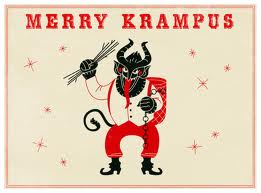 And in parts of Italy and Germany, the witch Perchta would climb down the chimney. But instead of giving presents to children, she would rip out their intestines and replace them with straw and stone. (There’s a wonderful doll of Perchta here). And anyone who has recently since the Grimm Christmas episode now knows of Krampus who is not only a real Christmas creature, (meaning Grimm didn’t make him up), he is still active and you can get Krampus cards.
The book looks at all aspects of Christmas and begins with the origins and St. Nicholas who was originally nothing like Santa Claus. He was a saint from Turkey and probably died on Dec 6 (hence the feast day). Aside from these facts, not much else is known about him. He eventually became the patron saint of just about everything—sailors, women, prostitutes, virgins, everyone. But more importantly, Nicholas was so impassioned about his religious beliefs that he once punched out another bishop. He was imprisoned, but when he emerged the next day he was clothed in glorious robes—a sure sign that Jesus agreed with him.
With that background in place, we move on to some of the darker stories. And we see how violence could be used in religious belief.
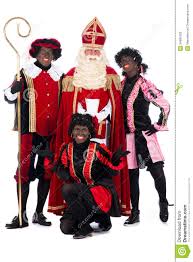 Sinterklaas comes from the Netherlands and is still active today. In the fourteenth century teachers would pass judgment on students work around Dec 6. Good students would get sweets and bad students would be beaten with a rod. Similarly Sinterklaas would arrive on Dec 5 and test childrens’ knowledge of Scripture. Those who passed received treats. Those who failed would be beaten by birch rods. This was not metaphorical—uncles would dress up and administer this. Sinterklaas was later accompanied by Zwarte Piet (Black Peter) who was a Moor and would put bad children in a sack and take them to Hell. There are obviously many racial issues with this depiction which I’m not going to get into, but he was originally “black” because he was the one who went down the chimney—later iterations are less easy to handle.
But Zwarte Piet is nothing compared to Krampus who is literally a devil. He arrives at Christmas and asks if the children have been good. If they have or, interestingly, if they have not, and they admit it, he’s okay with that. But if you lied about being bad Krampus would put you in a sack and drag you off (especially if other children are watching). In myth, he would eat you.
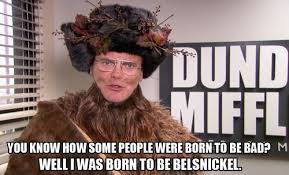 Some other violent Christmas fiends are Belsnickel (a combination of the name Nicholas and the German word for ‘to wallop someone’) which was demonstrated on The Office and Schmutzli (in Switzerland). Both of these creatures would dole out punishments.
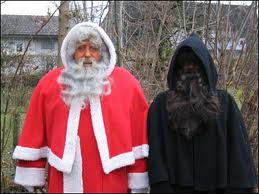 These traditions morphed over time with Krampus turning into Krampusnacht, a night of debauchery and chaos when young men would dress up and run wild in the streets threatening people with sticks and being inappropriate with the ladies. Krampusnacht is still around but in a more orderly and less assaultive fashion. (See more about Krampus)
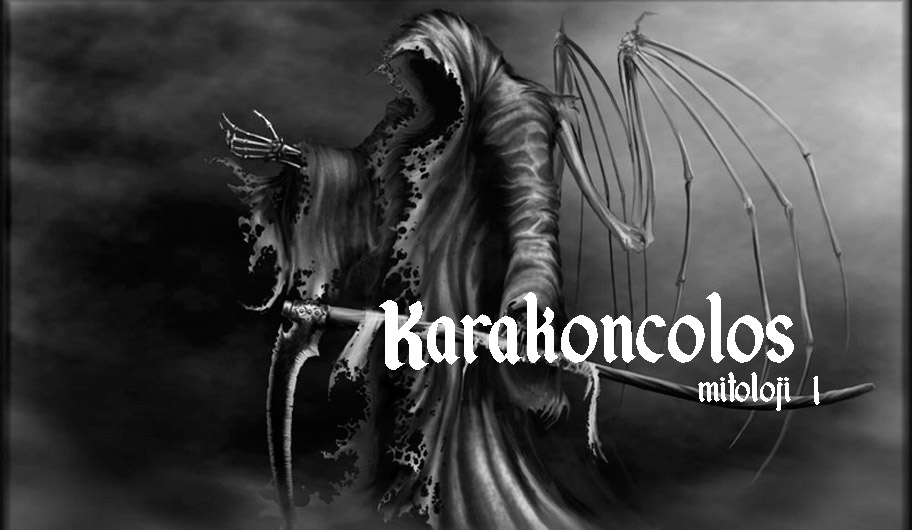 Karakoncolos is from Eastern Europe and is a cross between the Devil and a Sasquatch. He comes into your house and imitates your behavior. Sometimes they lure people out into the snow until they freeze. And of course there is the Norse myth of Odin and the wild Hunt (this dates back to pre-Christian times)
Julebukk is a Scandinavian figure known as the Yule Goat. And in Lapland, Staalo would capture and eat wayward children.
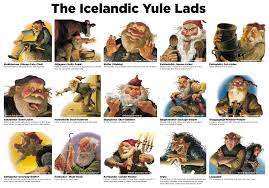 The Yule Lads were Danish ogres who would come starting on the 12th of December and staying until Jan 6. Depending on the time they either did mischief or outright violence. But perhaps the most terrifying is the Icelandic Christmas Cat who was a gigantic ferocious beast who would eat children who…did not receive any new clothes for Christmas. Holy crap.
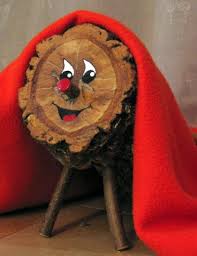
 But not every strange story is violent. There is also Caganer, the pooping peasant, a Catalonian tradition. He often appears in nativity scenes leaving a pile of poop. So proud are Catalonians of him that Maremagnum shopping center made a 19ft tall Caganer one year (see bottom, ha ha). They also celebrate with a tio de nadal—a log that defecates presents.
 Later traditions showed the Yuletide Holiday was a time for chaos and fun (less violence). In some places peasants were able to switch places with their lords for the holiday time. And there was also The Lord of Misrule, an English creation which is similar to Mummers and Wassailers. Initially Wassailers were drunken revelers who demanded food and drink and if they did not get it they would do damage). And Mummers dressed in costume (as they still do) but used their anonymity to cause all kinds of wantonness.
When FOX News speaks (endlessly) about the (completely made up) War on Christmas now, they don’t know the half of it—the real war on Christmas happened centuries ago. In trying to Christianize the pagan tradition they came up with ideas that were sort of like Santa—the Christkind was a baby who was born on Christmas but who managed to bring presents on Christmas Eve. But it was devout Puritans who wanted to ban Christmas altogether. And they mostly succeeded. It was almost completely eradicated in and England and in Scotland–which gave rise to Hogmanay, the New Year’s tradition.
But these festivals are hard to kill and soon a more secular Christmas Man came around. And with it came the story from Diedrich Knickerbocker which described old fashion Christmas traditions, just like the ones we used to know. The story was published in his 1809 book A History of New York. The traditions became a huge hit and many people immediately began following these ideas of Santa Claus. The trouble is that Knickerbocker was actually Washington Irving and the whole thing was a joke. But Clement Clarke Moore further solidified the images and story of Saint with his 1822 poem Twas the Night before Christmas. And then it was Thomas Nast’s illustrations who really solidified his appearance. And of course, Rudolph the Red Nosed Reindeer was invented by Montgomery Ward stores in 1939.
As the book says, everyone knows Christmases were better in the past. They even knew that in the past (even in the 16th century they were saying that). I took out this book for the creepy weird creatures and came back with a much fuller awareness and appreciation oo everything that is Christmas. It’s a very funny and very enjoyable read.
Happy Christmas everyone.


 I Just Read About That...
Leave a comment