 SOUNDTRACK: BEN FOLDS FIVE-The Sound of the Life of the Mind (2013).
 The first Ben Folds Five album in over a decade opens with a big noisy sound and then quickly shows the diversity of the band by pulling back and showing a mellow verse with Ben’s piano and occasional bass. But then the chorus comes in and Robert Sledge’s bass is once again masterful. While Ben is clearly the leader of the band, there is something about the BFF’s bass that is so notable. And this album rocks in BFF’s unique way–rollicking piano, and noisy buzzy bass.
“Michael Praytor, Five Years Later” has some great harmonies (the kind that BFF do so well). “Sky High” is the kind of social commentary ballad that Ben excels at. And the title track is a fast moving rocker that has more great harmonies.
“On Being Frank” is a Sinatra inspired song with strings. While “Draw a Crowd” continues Ben’s humorous vulgarity in a very unexpected way: “if you’re feeling small, and you can’t draw a crowd…draw dicks on a wall.” “Do It Anyway” the single, which inexplicably wasn’t huge, gets more and more fun with each listen–to scream along with “OKAY!” is very cathartic.
“Hold That Thought” is one of those mellow but speedy numbers that I love from Ben. And when then bass plays that high solo bit near the end (oh that bass), the song kicks into new levels of excellence. “Away When You were Down” is another string-filled mellow song. The final track “Thank You for Breaking My Heart” reminds me of “Boxing”, a mellow piano ballad which is, obviously, heartbreaking.
This is a great return to form. There’s some heavy rockers and some pretty ballads. It’s nice to hear the Five back together again.
[READ: October 5, 2013] 3 book reviews
This month Bissell reviewed three books.
The first book is a biography of Flavius Jospehus called A Jew Among Romans  by Frederic Raphael (who also wrote the screen play for Eyes Wide Shut). I had never heard of Flavius Jospehus but evidently without him we would have no historical accounts of time from around the beginning of the Common Era. His writings are pretty much the only works that have survived.
And his story itself is interesting too. In 70 A.D. the Romans destroyed Jerusalem. This attack has had more impact on current life than can be explained. Judaism lost the Second temple, Jewish Christianity soon disappeared beneath the waves of Gentile Christianity, even Islam was shaped by this because a Mosque now stands where the Second Temple was. And nearly all modern forms of anti-Semitism can be traced back to this attack in some way. Flavius Jospehus chronicled this time as a Jew in a reasonably impartial way (which led many to call him a traitor). His books Jewish Antiquities and The Jewish War are the sources for almost all of our knowledge of that era, including about Pontius Pilate.
Bissell calls Raphael’s book “Magnificently odd” and says that it is full of excellent details but also factual errors. Most peculiar of all are the “relevance -straining” footnotes which touch on Dorothy Parker and Arnold Schwarzenegger among others. But for all of this, the reality of the book is compelling and, as far as I can tell, worth a read.
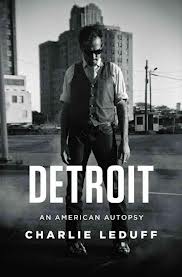 Detroit: An American Autopsy by Charlie LeDuff also seems to have a strange sense subject straining content. Bissell says that LeDuff seems to have written this book about Detroit as a way of grieving about his former employers at the New York Times. LeDuff is from Detroit and has many personal associations with the troubles of Detroit (his sister was a drug addict and was killed while she was making money as a prostitute, his niece died of a heroin overdose). But as Bissell says, bonafides do not necessarily make for good writing. For instance LeDuff complains about his former Times editor calling some of the people of Detroit “losers.” Le Duff tells us: “Say the word slowly enough and it sounds like you’re spitting.” Which, no matter how I try to say it, is simply not true.
Bissell himself is from Michigan and he is very familiar with LeDuff’s work. He moved up from Detroit through the ranks and earned a job at the Times (and even won a Pulitzer). Hi investigative work has always been very good. But in this book he just seems to be ranting about the Times, which he quit to work for the Detroit Times. Bissell does admit that his journalistic work in the book–the meat of the book–is excellent, but the personal antics keep getting in the way. Indeed, while at the Detroit Times a story of his was edited so he quit that paper and now works for Detroit’s Fox 2 News, where I imagine investigative journalism is a top priority.
 The final book he talks about is Tenth of December by George Saunders. As anyone who reads this knows, I have mixed feelings about Saunders’ work. But what’s especially funny is that Bissell (although a devout fan of Saunders) also doesn’t understand exactly why people like him so much. As he says, Saunders’ prose has no splendor, his ideas about corporate America range from obvious to very obvious and his sense of humor is often juvenile. Despite this, Bissell loves him and says his new book is his best yet.
He references “Victory Lap” (which I really liked) and “Escape from Spiderhead” (which I also really liked) and “Tenth of December” (which I also also really liked) as masterpieces. Other stories in this collection which I have read which Bissell does not mention include “My Chivalric Fiasco” (I liked a lot), “Home” (which I didn’t like but then did), “Al Roosten” (which I liked). There are three stories in this collection that I have not read: “Sticks,” “Exhortation” and “Puppy,” (which I just printed from The New Yorker). So, unless there are major changes to the stories, I have read almost all of this book.
But back to the review. Bissell says that none of the stories compares to “The Semplica-Girl Diaries” a story whose narrator I hated so much I almost couldn’t finish the story. And although Bissell quotes from the narrator he doesn’t say anything about the weird and off putting style. In my post about that story, I write that I am often disappointed by Saunders, but seeing how I actually reacted to his stories, that seems to be quite false. I have some kind of grudge against him which is utterly unfounded, and I will remove that grudge immediately. I don’t think I will be rereading all of the stories in this collection, but i will certainly track down the two stories I didn’t read. And, heck maybe I’ll give “Semplica” another shot.
Oh right, back to Bissell. I agree with Bissell’s assessment of Saunders: he writes “sleepy literary fiction and inject[s] 50 ccs of absurdist sci -fi” and “he writes funny, hopeful stories about truly horrifying predicaments.” So lighten up, Debraski.

 I Just Read About That...
Leave a comment