 SOUNDTRACK: WXPN (88.5 Philadelphia)
  and wxpn.org online-Prog rock Marathon (2012-??).
Every January, Dan Reed plays a prog rock marathon on WXPN. This year I was able to enjoy portions of it. I rather wish the playlist was still available (you can search, but only by artist), because I’d love to rave about the tracks they played (like the live “Supper’s Ready.”)
I was delighted by the great mix of songs they played and (as I learned from reading this book) I was surprised by how many prog artists I didn’t even know.
In 2014 I’ll be listening again and maybe this time I’ll copy the playlist to document what I’ve missed.
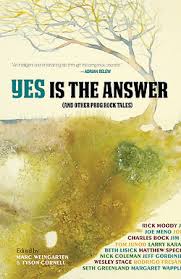
[READ: July 7, 2013] Yes is the Answer
This book was sitting on a cart outside of my cube. I was intrigued by the title (it didn’t have that trippy cover, so I didn’t know what it was). But “Yes is the Answer” was calling me. Especially when I looked at the cover and saw that the cover had an excerpt from a William Vollmann story in which the protagonist plays In the Court of the Crimson King (track 5) for Reepah and watches her face as they band went Ahhhhhhhhhhhhhhhhhhhhhhhhhhhhhhhhhhhhhhhhhhhhhhhhhh!.
Quoting Vollmann (from The Rifles), playing King Crimson? What could this book be? Then I saw the subtitle and I knew I had to read it all.
I’m not going to review these essays because that would be like making a radio edit of a side long track, but I’ll mention the band the author focuses on and any other relevant details.
MARC WEINGARTEN-“An Introduction”
Weingarten says we all knew prog was ridiculous but we loved it because it was ridiculous. He also makes a fine distinction between prog and (the dreaded) Jazz Fusion (which was mindless noodling).
SETH GREENLAND-“Here Comes the Knife”
The knife in question came from Keith Emerson, when he stabbed it into his organ (I can’t for the life of me figure out why, what it did to the sound, and if it ruined the organ, but I had heard of him doing this). But this was with The Nice (ELP had not happened yet). [I actually don’t know The Nice at all, believe it or not]. The author was 12 at the time of the show and had been taking piano lessons; Emerson changed everything.
TOM JUNOD-“Out, Angels Out”
When I read this I didn’t realize Junod was the writer for Esquire (such a manly magazine for a prog rock fan). He talks all about how he claimed to know the meaning behind the cover of Peter Gabriel’s first solo album (that was his cachet during college). He never did, but people always asked him about it. This piece talks about growing up with prog and Genesis (he even had a friend who called himself Rael (after the protagonist of The Lamb Lies Down on Broadway). As many of these tales do, drugs are involved and, as some of these show, drugs made things go horrible wrong (Rael had a bad reaction). This has a sweet ending (and a kiss for Gabriel!)
PETER CASE-“Your Magic Christmas Tree”
This is all about LSD and The Incredible String Band (another prog legend that i do not know at all). Case makes me want to hear some of their stuff though.
MATTHEW SPECKTOR-“Yes is No Disgrace”
Specktor says that Yes is more cringe-worthy than most other bands (so many of these authors seem to be really embarrassed about their love of these bands which I find kind of annoying in this book–if you’re writing in this book you don’t have to try to be cool).
WESLEY STACE-“Achilles’ Heel”
Stace talks about the Canterbury scene, a scene about which I am unfamiliar. Although this book really brought to light how nearly every prog rock band (good prog rock band) is British, which I find fascinating in and of itself. Some of the bands in the Canterbury Scene are Soft Machine, Caravan (who I’m intrigued by) and Matching Mole–who have great lyrics witness:
Stace says that most prog lyrics are rubbish but not in the Canterbury scene. More exploration is needed to determine the validity of this. For more bands in this list see this Wikipedia entry.
RICK MOODY-“Defending the Indefensible”
Moody is talking about Emerson Lake and Palmer. He attacks them with common complaints and then defends against the attacks. 1. They are twats (they are certainly egomaniacs). 2. They love classical music (so?) 3. They toured with an orchestra (a bad idea, as other have learned) 4. There was robot imagery (yes, but by H.R. Giger!) 5. Up to Date Equipment (which means they sound more dated than anyone else). 6 Virtuosity! 7. They didn’t put out that many albums (that is the surprise, really–five albums in eight years, and many of those just had arrangements not new material) 8. Their last album, Love Beach (that is indefensible). Although he claims it is responsible for Asia (I can’t bash Asia’s first album…after that it’s sketchy). I enjoyed Moody’s look into his like for ELP.
PAUL MYERS-“The Cherokee Record Club”
This was a local club (actually just a basement) where Myers and some friends talked prog and listened to records.
LARRY KARASZEWSKI-“City in My Head”
This is all about Todd Rundgren, another legend with whom I am almost entirely unfamiliar. This article made me check out some stuff on YouTube.
JIM DEROGATIS-“Ode to the Giant Hogweeds”
“The Return of the Giant Hogweed” is a Genesis track. Derogatis justifiably criticizes late period Genesis (in a very funny way), especially at the end when the author got to interview them and asked if they missed making, you know, good music, the answers are surprising. (Evidently Banks does, Collins…not so much).
JAMES GREER-“The Grand Parade of Lifeless Packaging”
Greer played bass in Guided by Voices. This article talks about The Lamb Lies Down on Broadway and prog’s influence of Robert Pollard and GBV.
JOHN ALBERT-“The Sartori Underground”
A sad tale of prog and drugs.
RODRIGO FRESAN-“A Clockwork Wall” (translated by Mara Lethem)
An interesting article contrasting Pink Floyd’s The Wall and A Clockwork Orange.
ANDREW MELLEN-“Do Gay Guys Listen to Yes?”
Probably not, but they should.
MARGARET WAPPLER-“The Fool Explorers”
The first woman in the anthology! Strangely, this story is set in the 90s (Wappler was a fan of Sonic Youth, etc). She and her boyfriend made In the Court of the Crimson King their make out music. How odd.
NATHAN LARSON-“The Angular Wheel”
Larson was in Shudder to Think, a band that, while defiantly not prog, was actually kinda prog
BETH LISICK-“Catch the Mist”
Although with that title this should be about Rush (and it does mention “Tom Sawyer”), it is actually about Beth’s boyfriend’s band and how she started her own band The Beth Lisick Ordeal.
NICK COLEMAN-“Hung Up on These Silver Strings”
All about Be-Bop Deluxe, about whom I am utterly ignorant.
JEFF GARDINER-“Set an Open Course for the Virgin Sea”
If the rest of this book is kind of a fun buzz (with a few bad trips), this is the ultimate buzzkill. Gardiner talks about ending his time with prog after seeing Styx in concert. He wanted to be proggy and mystical and have sex on a mountain. His girlfriend even agreed, but it was a bad idea. And he hates Styx too. Basically he comes off like a cooler-than-thou jerk.
CHARLES BOCK-“In the Court of the CrimsonKing02”
This article is more about hair metal from a GeoCities site (egads) called MetalSludge which was all about metal (by a couple of guys who never made it). It sounds very funny. But the end of the article talks about a guy who posted all the time called CrimsonKing02 (implying of course that there was already an 01). Not really a prog article at all, and with a major downer end
JOE MENO-“There is No Rush”
I was pretty excited to read this because at last we’d get some words about Rush. But instead, Meno explains that in his first car accident he was listening to Rush and in his second a friend put on a Rush tape and now there is no more Rush allowed in any of his vehicles. I was bummed about that and wanted more about Rush. However, I totally enjoyed they way he deconstructed the video for Tom Sawyer and talked about Canadians taking over the world.
I enjoyed this book about 75%. The fun articles were great, the others not so much. Are you telling me you could find no one willing to write about mid 70s Rush? About how Relayer is a maligned but great Yes album? A bit more about Jethro Tull?
And what’s with all the bad drug experiences these people had with prog? I mean, more people died in this book from listening to prog than from playing it. I mean I get that prog is weird and bizarre, but I don’t have any downer moments from any of it.
If there is a volume two (which they say there might be) I hope it’s more positive and has some Fountain of Lamneth! But if you want to read some interesting insights about some classic British prog, this is a good place to look.

 I Just Read About That...
Leave a comment