 SOUNDTRACK: SAN FERMIN-“Crueler Kind” (2013).
This was the final song that NPR played in their summer new music collection. It was a band that Bob didn’t know, but he liked the song and then saw them live and put the song here.
It opens very simply, quietly with beautiful harmonies over a simple synth. After about 45 seconds, the drums and horns (!) kick in and the backing harmony vocals take on more of a choral sound (AHHHH!) that punctuates rather than accompanies the vocals.
The main riff stems from that horn—a bass saxophone? And yet during the verses, everything resorts to that pretty, mellow sound.
It’s a very interesting mix of musics, and it reminds me of some of the more experimental bands of the 1990s. I’ll bet they would be fun to see live. And I’d like to hear more from this album.
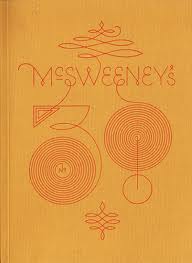
[READ: June 20, 2013] McSweeney’s #38
And with this book, I have now read all of the McSweeney’s issues (except that Mammoth Treasury which I will get to, probably by the end of the year). This one was a great collection of fiction and non-fiction, it also had an inserted comic. The book itself was paperback, with a nice, textured cover and a cool design for the numbers. In looking for a picture I learned that it came in two colors (the yellow that I received and a black cover with white lines).
It continues with the later issues’ less frivolous style (in that there’s nothing weird about the book) and throughout, the quality of the work is great. I really enjoyed this book. It opens with letters and contains color pictures, too.
Letters
DEEJAY
Is a Canadian soldier who used McSweeney’s #35 to help a fellow soldier learn to read. Sadly the other soldier was killed soon after.
PAUL CURTIS
A brief letter about being upstaged. At a clergy convention when asked to talk about something surprising, Curtis said he wore a dress in front of his congregation. No one reacted. It was only when someone said he was still alive after his third heart attack that the fellow members reacted.
RORY DOUGLAS
The story of a neighbor’s cat tube—an extension that comes out from the front of the house (any reasonable person would describe it as penile) in which the cat is permitted to walk around, but is still in this tube.
JEN STATSKY
Looking for a macaroon recipe from Helen Hunt’s grandmother. Did it get published in McSweeney’s? Or maybe it was Redbook. Oh, maybe it was really Andie MacDowell and it was in Marie Clarie.
SLOAN SCHANG
Could not buy a beautiful gas range because it had a preset button for Chicken Nuggets. Why do children love nuggets so much? I agree with the decision not to buy it.
JASON POLAN
A complaint to Kinko’s regarding the promised prince of a service. It includes a drawing of the offending clerk.
DAVID HENNE
A suggestion for bohemian Brooklyn hipster bars—include an audio book jukebox. It would be awesome and kids from all around would come to hear what was playing. Also, drinking heavily while listening to audiobooks reveals alternate endings.
JOHN MOE
I love the description of the Minnesota Timberwolves as not all that interested in playing basketball but being there mostly for some exercise. But really this letter is about asking for Havarti cheese at a Subway and getting nothing but incredulous looks. And the more he insisted he was telling the truth the more absurd he sounded , as if he was asking for Blamptonshire or Flogvers. I liked this letter a lot.
PETER ORNER
Addressed to Phoebe, this letter tells of Peter’s attempts to find peace and structure at a monastery. Where, it turned out, the rigid schedule was entirely optional. (Optional for visitors not the monks). Despite this optional structure he feels the need to flee. But in his down time instead of writing his novel he’s been reading Francois Mauriac’s Life of Jesus, which talks about Jesus’ life before he became capital J Jesus—amid the petty talk, the jealousy, the small dramas. Orner finds this comforting. Jesus was the Son of God but no one knew it. Did He? And what did Mary and Jesus talk about at the dinner table after Joseph died—in those quiet family moments—when she knew he was the Son of God but nobody let on yet. Oh and the monks also sell jam, hymnals, books and coffins.
JOEY LATIMER
A code, written in BASIC showing how to create Transfobot–a mighty robot hero.
JON WURSTER
The drummer for the Mountain Goats writes to McSweeney’s to say what he’s thinking while hurtling through North Carolina in the van. He talks about working in the very mall that they are passing, when he sold NKOTB records and Body by Budweiser shirts. He relates a few customers that he remembers all these years later. Like Sam who wanted to know the titles of songs–which he sang—the titles of which were always in the part that he sang). Or the customer who wanted to know what song went “Siamese don’t like it/Not the cat’s fault, not the cat’s fault.” And how these experiences helped him learn to deal with people.
PETER MEEHAN
On his first trip to japan, Meehan marveled at the spectacle but also the little things. Like the women handing out facial tissues (with a picture of a bunny on it). They seemed to be everywhere. He was grateful for the tissues, but realized that there were no garbage cans anywhere. How can New York have 4 on every intersection and Japan, which has so many things we don’t, not have garbage cans? And where do the Japanese put their tissues?
Main Stories
ARIEL DORFMAN-“Where He Fell”
This is fascinating story that starts out as one thing but turns into something else. As the story starts a couple are in a hotel room. They are awoken by the man next door who seems to be threatening a woman over and over. They finally decide to act and discover it is not at all what they thought (it was a funny reveal, one with consequences later). This prologue doesn’t have anything to do with the main part of the story which is that the woman has traveled to Paris to create n art project. It is the thirtieth year of the death of her brother and she is here to create an installation taking pictures of sites around Paris where people were killed in the war. Interestingly, Paris and the war had nothing to do with her brother’s death, she is using it as a metaphor in her art. I enjoyed this story which was challenging in its complexities.
CHANAN TIGAY-“The Special Population Unit”
The subtitle of this essay is Arab Soldiers in Israel’s Army. And it is a fascinating look at Arabs who were born in Israel and who, because of their transitional nature, are not forced to join the Army but often do—because it is their homeland too. And yet, their people are treated disgracefully, even those who have served. There are many color photos showing life in the army as well as life outside of the army. It was a very powerful story about something that I knew nothing about.
NATHANIEL RICH-“The Northeast Kingdom”
I was confused by the title of this story because it is all about a man who has lived for a long time. In fact, during the course of the story, he comes close to breaking the record for the oldest person alive. Once he becomes famous for this, he starts getting badgered by all manner of people—the worst seem to be his relatives, who all want him to tell them his secret. As far as he can tell the secret is to just keep breathing (and to want to stay alive more than anyone else).
The title comes towards the end of the story when the man is whisked away by his grandson (the only person he trusts) after they pretend that he has died. They go to North East Kingdom in which the story plays out in a wonderful way. I really enjoyed this one a lot.
RODDY DOYLE-“The Hens”
Because I know that in Ireland bachelorette parties are called “hen parties” I assumed this stories would be about some kind of party. Well, it turns out to actually be about hens. The story centers around Felicja, a Polish immigrant who has been looking for work—any kind of work. She receives a call from a woman, Dee, who wants her to look after her chickens while she is at work. Felicja confirms that that is what she really wants. It is. So, off she goes to chicken sit. And since chickens don’t do anything, it’s an easy job. Until she goes inside one day and one of the chickens has left the area. Well it turns out that the chicken has gone next door and that is bad news because the neighbors—women in various states of marriage—have a feud going on about the chickens (which is all subtext for other things). And so, Felicja is taken on a few raids of the neighboring chickenhouses. Felicja has been keeping a diary of all of this. Inevitably, Dee finds out. And far more comes to light than could ever be imagined.
STEVEN MILLHAUSER-“Rapunzel”
This is a retelling of the Rapunzel story. It takes different points of view throughout the story, giving a fuller spectrum of ideas as it plays out. I assume this is a retelling of the original story as it is quite gory in the middle. I’ve been disappointed by this kind of retelling in the past but I have to say that this version was really quite good.
JACK TEAGLE-“The Jungle”
This was a comic book insert in the middle of the book. It is a very funny and rather surreal look at a man trapped in a jungle. Keith, the man, is haggard with a full beard. He also has a talking cat companion. But…could it be…is there someone else here with him? The punch line is hilarious.
The back cover of the comic has a few ads like one for Nathan Englander’s home roasted coffee which you could have gotten with a coupon, as well as a giant poster that was available while supplies lasted. See, although these aren’t really timely issues, sometimes they are.
ADAM LEVIN-“Cred”
This two page story looks at how much cred a man will get for dating someone who appears to have (but doesn’t) and unflattering figure.
BISI ADJAPON-“Of Women and Frogs”
This story opens with a nine-year old girl being told that if she touches a frog she will turn into a man. She is told this by her eleven year old friend who knows everything. She doesn’t want to turn into a man so she stays away.
The first section shows us the girl in bed with her papa, supposedly medicated for an earache. But she spit out the medicine, and she awakens while he is having sex with a woman in the bed. The woman sees her but she pretends to be asleep when her father tries to find out if she is awake or not.
The rest of the story shows what the narrator, Esi’s, life is like when her father is not around (her mother is not there). Auntie and Sister Yaa think of her as an outcast, since she is not like them and they find fault with everything she does (their punishment for her exploring her own body is horrifying). I feel like there should be more to this story, at least a little redemption beyond a few drops of honey.
RACHEL B. GLASER-“The JPEG”
Anna is an unsuccessful glass artist who graduated from Rhode Island School of Design. But she eventually does get a piece into a show. Unfortunately it is a virtual show and her piece was sent as a JPEG. In order to see the piece she had to create an avatar of herself which she was utterly incapable of controlling within the virtual gallery. We next see her trying to communicate with an ex-boyfriend. While they are having a talk, RISD calls to ask for money. Rather than dealing with the ex, she winds up talking to the student about her future. While the story overall was okay, I really enjoyed the last section in which she imagined all of the contacts on her phone lining up in alphabetical order and meeting each other. Like Jason an ex-boyfriend standing next to her cousin Jackie (and no doubt making out). Her gynecologist next to her sister. I feel like that would have made a more interesting story than the art gallery part.
ALIA MALEK-“Talat Hamdani”
This narrative looks at the life of Talat Handani whose son was in New York City during the 9/11 attacks. Over the course of those terrible days, he went from killed to possibly alive to possibly a terrorist. And all along he was actually someone who went to help. It’s a harrowing tale of injustice and comes from Malek’s collection Patriot Acts: Narratives of Post-9/11 Injustice.
DAVE EGGERS-“Chapter One”
This is indeed the first chapter of a new book from Eggers. In it, a man named Alan is on a flight to Saudi Arabia for business. We learn through the course of the chapter that he has very little money left, that he is divorced and that his daughter is now fighting with her mother (his ex-wife). He composes letters in his head to her trying to figure out the best way to placate the scenario. But he also knows how important this deal is, both for him and for his daughter who needs money for school. So he tries to put everything out of his mind so he can sleep. There’s a lot of wonderful details in this chapter and I wonder what will come of this novel.
DAN GUTERMAN-“Introducing the New Life Cube”
The back page is an ad for the New Life Cube, which will revolutionize your life. It’s quite amusing.
~~~~~
And lo, the next McSweeney’s issue that I read will be hot off the presses with no line waiting (except for #10, I know).

 I Just Read About That...
[…] indeed, the story is quite simple. I had read an excerpt from it in McSweeney’s 38 and enjoyed it quite a bit–not realizing that it was from this book, of course. The excerpt […]