 SOUNDTRACK: IRON MAIDEN-Killers (1981).
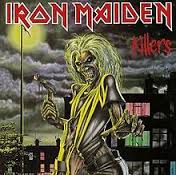 Killers picks up right where Iron Maiden left off–indeed many of these songs were written at the same time as the first album. The difference is new guitarist Adrian Smith.
It opens with the great (but simple) instrumental “Ides of March” which segues into the blistering “Wrathchild.” And it’s on this song that you can tell some of the rawness has been removed from the recording. The guitars sound a wee bit more polished.
And you can tell the band are getting a bit more symphonic with the bass harmonics that intro the wonderful “Murders in the Rue Morgue” a song that feels long but actually isn’t. It has several parts that all seem to signal the end until Clive Burrs drums come pounding in to restart the song. Very cool. “Another Life” is another fast punky song, and while I like it, it is probably one of the weaker songs on the album. But that’s okay because it is followed by one of Maidens greatest instrumentals–“Genghis Khan” which has beautiful symphonic soaring solos over a cool propulsive beat.
“Innocent Exile” opens with another great noisy slappy bass riff that only Harris was doing at the time. “Killers” is a classic track: fast and yet complex, with a very cool riff. “Twilight Zone” sees Di’Anno reaching for higher more operatic notes. He makes it, but you can just tell that the band needs more from their vocalist. “Prodigal Son” opens with a pretty acoustic guitar intro. I used to like this song quite a bit (whatever Lamia is), but I can see that it’s actually quite long and meandering (maybe this one is more like “War Pigs”). It’s pretty but could probably be a bit shorter. “Purgatory” sounds like track off the first album–fast raw and punky with screaming riffs. “Drifter” ends the disc with a cool bass line and some more thrashing. It’s a solid ending for an album that overall works pretty well, but which kind of shows that the band had to either do something big on the next album or get stuck in a rut.
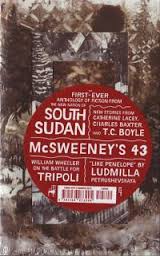
[READ: June 1, 2013] McSweeney’s #43
And with this issue I am almost all caught up with my McSweeney’s. More impressively, I read this one only a few days after receiving it!
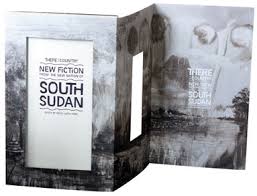
This issues comes with two small books. And each book has a very cool fold-out/die cut cover (which is rather hard to close and which I was sure would get caught and therefore ripped on something but which hasn’t yet). The first is a standard collection of letters and stories and the second is a collection of fiction from South Sudan. Jointly they are a great collection of fiction and nonfiction, another solid effort from McSweeney’s.
Letters
NATHAN C. MARTIN-Wrote “Big Windows” in Issue 40 and now wants the contributor copies because his were sent to an incorrect address, the address of a man named Nogivenname Prophet. And they were supposed to be for his girlfriend. He’d also like to get paid for the story–a very elaborate and lengthy letter.
THAO NGUYEN
Went to a general practitioner because she was close to her house, but the G.P. really started pushing other services on her–OB-GYN, birth control, etc–it was very uncomfortable. But very funny to read.
AVERY MONSEN
Wonders how McSweeney’s deals with the blues. She imagines a man trying to teach a duck to write.
DOOGIE HORNER
Upon being asked where he got a cool cardigan admits, The Gap. And people are uniformly disappointed that it isn’t from a cooler place and then he feels bad. But should he be made to feel bad because of where he shops?
RACHEL SOMMERVILLE
Sommerville is a Private Investigator (for real) and actually voted against her own job when she voted to pass California’s Prop 34 which would repeal the death penalty. Her job is to dig up information on people to get them off of death row. She then goes on to explain life without parole and how it seems perhaps worse for the prisoners than the death penalty.
PATRICK SHAFFNER
Has moved to Chicago and doesn’t really like his neighborhood. However, there is a neighborhood cat that he likes a lot and he asks McSweeney’s (the closest thing to a lawyer that he has) if he can legally take the cat when he moves. No answer is given
The Stories
 CHARLES BAXTER-“Charity”
The first part of this story shows an elaborate explanation of Quinn’s disappearance–sparked by his meeting with Black Bird which involves money and drugs. The second part of the story opens with Quinn’s boyfriend explaining that the first story is what he had created to explain the disappearance of Quinn. He can only construct this elaborate fantasy. He and Quinn met in Africa, doing charity work (it’s not easy being white and gay in Ethiopia). Reality conforms a little to his story from part one. There is a man named Blackburn and after some cajoling he says where Quinn might be found. And once he finds Quinn, a whole new chapter of their lives begins. It was a dark story indeed.
LUDMILLA PETRUSHEVSKAYA-“Like Penelope”
This is the story of young girl named Oksana who works very hard (as does her mother). She hates her name, for it is too fancy for her. She wishes she had something more plain like Lena. She also hates that her mother is always giving things to people–they have so little themselves and yet she always helps other. Like the old lady her mother has brought home. The lady is grateful, of course, and makes Oksana a dress and says she looks like Penelope Cruz. The ending is quite sweet and surprisingly uplifting.
T.C. BOYLE-“Burning Bright”
I loved this story and I loved the way it was constructed. The Burning Bright in the title is off course a reference to the poem for it is about tigers. It is done in multiple sections, first from the man who captured and raised a Bengal Tiger intent on re-establishing the wild population (most tigers are born in captivity now). Then there is the girl Siobhan whose sister is going to be getting married at the San Francisco zoo. Her mother is crazy at this point and she is trying her best to stay composed. At some point we learn that one of the tigers at the zoo recently mauled someone so the zoo itself is shut down to visitors–but her mother’s influence has allowed them to still have the wedding. Then we hear the story of Vijay a young boy who loves going to the zoo. He wants to be a vet, although he’ never admit that to his family or friends. He likes to go to the zoo to watch the animals but his friends like to go because it’s a place to get high. Which they do on Christmas. And soon enough all of the stories connect. This story was exciting, engaging and really enjoyable.
NOOR ELASHI-“The Texan from Gaza Does Yoga in Prison”
This is nonfiction from a young woman whose father has been in Gaunatanom North–arrested on charges of contributing to a terrorist group, even though the group in question was not a terrorist group and USAID donated to them as well. It’s all part of the war on terror. The story itself is about their visits when the family goes to see him and how weird the whole thing is. The first visit goes pretty well but the second is marred by suspicions.
CATHERINE LACEY-“Moment Stay”
The protagonist is a woman who has trouble remembering things. In this sad story the “moment stay” is her wish that this or any moment would stay with her. There was some beautiful writing here although the overall story was less than I wanted.
WILLIAM WHEELER-“Zero Hour”
This was nonfiction, subtitled “The Covert Struggle for Tripoli and the Future of Libya.” I admit I don’t know a lot about the Libyan revolution, but this story comes from the ground there and it follows the uprising as people plan and then execute the insurrection. The fact that so many of Qaddafi’s own soldiers turned against him shows just how unpopular his oppressive regime proved to be. This story is one of power and cautious optimism.
BOOK 2: There is a Country: New Fiction from the New Nation of South Sudan
 NYUOL LUETH TONG-Introduction
Tong explains the origins of South Sudan and how hard it was or him to find writers for this first ever compilation of South Sudanese writers. He is of course bummed that this first compilation of Sudanese writers is all in English, when there are so many languages and cultures in South Sudan. But most of these writers have fled South Sudan and are living abroad. Consequently most of the stories are about the hardships they faced. I wish he had addressed why there are no women writers, but he doesn’t.
EDWARD EREMUGO LUKA-“Escape”
This is the story of a man’s escape from the South as the invaders from the North come to terrorize the community. It is through the help of others that the narrator is able to escape, although he vows to return.
VICTOR LUGALA-“Port Sudan Journal”
The story of a man travelling through the country looking for his family. He works hard and faces nothing but disappointment, until the kindness of a stranger changes things for him. It was nice that this story had a slightly happy ending.
NYUOL LUETH TONG-“The Bastard”
This is the story of a woman who makes bad choices and how it affects her son. She has been punished for her bad choices–choosing the wrong man, being dismissed by that same man later in life and then taking up with another bad man even later. It is a sad story and yet the narrator is full of life and vitality–appalled at his mother’s decisions but somehow resigned to his fate.
TABAN LO LIYONG-“Lexicographicide”
I wanted to like this story so much because of the title. But it was mostly just confusing. The narrator tells us about a man who intended to become the ruler of their island and to create a dictionary that would prove you lived ther. And then shows the last six notes that were left with his body when it was found dead. But the notes don’t really say much about what the man planned to do.
DAVID L. LUKUDU-“Holy Warrior”
This is the story of a holy man in the midst of a war. It is a brutal story which shows the pointlessness of all the fighting.
JOHN ORYEM-“Potato Thief”
This was one of my favorite stories, because it was heartbreaking and funny at the same time. In it a boy brings a potato from home to eat as a snack. One of the other boys in class asks for some but the boy refuses. And soon enough there is rumor going around that he stole the potato from the school’s garden. This rumor gets taken more and more seriously and ultimately impacts him directly. It was very well written.
SAMUEL GARANG AKAU-“Light of Day”
This was an interesting story of young love. It’s told mostly from the point of view of the boy, although the end shifts perspectives a bit. I enjoyed the way there was some adversity to overcome, although I did feel like the end was a bit of a wish fulfillment.
ARID GAMAL-“Tall Palms”
This is an excerpt from an epic poem about the author’s childhood. It was a bit abstract, but the details were really interesting.
~~~~~
This was another solid volume from McSweeney’s. It’s cool that they introduce South Sudanese writers to an American audience. And I’m glad that the South Sudanese writers were able to write about more than the military conflicts they experienced. I also find that I enjoy the non-fiction pieces in these issues very much–they are informative and generally quite engaging.

 I Just Read About That...
Leave a comment