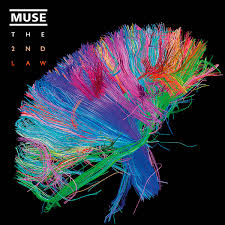
 SOUNDTRACK: MUSE-The 2nd Law (2012).
 Muse are over the top. No question about it. And that’s why I like them so much.
So when the new album opens with crunchy guitars that give way to keyboards that sounds not unlike a Bond movie, it’s not really surprising. The first verse is fairly mellow, building until Matt Bellamy hits some crazy high notes and the heavy bass guitar kicks in. But unlike some previous albums, this one is not all heavy heavy guitar rock. There’s some electronic elements as well. Especially on the single “Madness” (which was debated about on the alt rock station I listen to, wondering if it was too dance-oriented). The song uses a dub format for repeating the Muhmuhmuhmuhmuh madness, but the verses are so catchy it’s hard to resist. It also has a major Queen feel (a common complaint about them, although it’s not like Queen are still making music). For Muse, this song is kind of understated until the big verse at the end when Bellamy can really soar. “Panic Station has a big thumping bass and drum along with some screams that sound out of an 80s metal band but there are horns that give it a dancey feel–always a contradictory outfit, Muse.
“Prelude” sounds indeed like a prelude to what proves to be “Survival” it is big and anthemic (as Muse tends to be). It is uplifting and, as one may recall, it was the official song of the 2012 London Olympic Games (which is fitting it’s all about winning).
“Follow Me” slows things down a bit in the beginning, but it of course comes back with lots of bombast (this is Muse after all) but there’s also elements of electronica (is that dubstep sound?) and backing vocals that remind me a lot of U2. “Animals” has a kind of slinky bass line that wends its way through the song’s guitar solos. By the end of the song it has grown much heavier with shouting crowds and a furious double bass drums.
“Explorers” is a ballad that grows and retracts. “Big Freeze” has another big chorus. It’s followed by “Save Me,” a gentle ballad with harmonies. Then “Liquid Freeze” picks up the pace a bit. This is all leading to “The 2nd Law: Unsustainable” which is my favorite weirdo song in ages. It is so crazy over the top and audacious that I love it. It opens with crazy strings and a fast talking jittery computer voice. And when she reaches the word “unsustainable,” the song goes absolutely bonkers, with crazy sound effects–I would assume most people hate this track, but I think it is very cool. The final track “The 2nd Law: Isolated System” is a kind of denouement for the whole album–a piano ballad of 5 minutes that has a bit of a dance feel to it.
I can’t get over how much I enjoy this record. It’s definitely not as heavy as past muse records, but it has some great experimentation and Bellamy absolutely knows a great melody.
[READ: March 8, 2013] Mister Orange
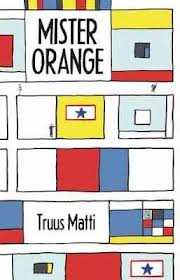
I was walking past the New shelves in the library and this book caught my eye (who says placement isn’t important?). Something about the title and the cover design was really appealing. I looked at the blurb–it’s about an American kid during WWII. I wasn’t really sure I wanted to read that, but then there was a line about an artist and comic books. I immediately thought about The Adventures of Kavalier and Clay which is also about comics in the 1940s (although this book is NOTHING like that one at all), and I decided to grab it. Besides it was only 150 pages.
Well, I never would have guessed that the book is a historical fiction novel about Piet Mondrian, one of my favorite artists of all time.
So the story is about a boy, Linus, and his family living in New York City in 1943. His oldest brother, Albie has volunteered for the war. His mother is disappointed in him as she believes that all war is wrong and that nothing good every comes from war. She is so disappointed, in fact, that she does not hang the blue star that all families with soldiers are given to hang in their windows. Linus wonders if she is not proud of her son for fighting for what he believes in, but his mother says “Flags are for celebrating, and there is nothing to celebrate about war.” She doesn’t even let him go to the parade for the departing soldiers.
When Albie leaves, the rest of the family is stuck waiting for word from him. But life goes on at home and with Albie gone, that means that everyone moves up in responsibility (and shoes get handed down). Simon (now the oldest at home and a sullen teenager) takes on Albie’s work at the newspaper, Linus picks up Simon’s grocery delivery route (their family owns a grocer’s shop) as well as Simon’s shoes, which are way too big, and Max takes over looking after the youngest children: Sis and Willy. For the most part we follow Linus as he learns the new route and learns a bit more about the city.
The most excitement comes from Mr Orange. He is a new to the city and has asked for deliveries of a case of oranges each week. Linus calls him Mr Orange because he can’t pronounce the man’s last name. Mr Orange is an artist, and he offers an entirely different world from Linus’ home. As we’ve seen from the list of children, one can imagine that Linus’ home is loud and chaotic and busy. Simon sleeps in the bunk above Linus and Linus never has a moment to himself. Mr Orange offers starkness. His apartment is painted white and he has squares of primary colors that he pins to the walls and moves around.
Linus is also full of questions. His father is too busy with life to answer them, but Mr Orange encourages imagination and the questions (like Why don’t smells have names?). And so Mr Orange encourages Linus to stick around. He offers him oranges and plays him his new favorite kind of music (on a record player!) called boogie woogie. Linus is mesmerized by everything and even tries to learn the dance moves of boogie-woogie.
But Linus also can’t stop thinking about Albie. Albie is an artist. He loves Superman and even drew his own superhero, Mister Superspeed. Linus enjoyed looking in Albie’s notebooks to see how Mister Superspeed developed over the years. Linus even begins talking to Mister Superspeed–as a substitute for Albie. And when Mr Orange talks to Linus about primary colors, Linus imagines a primary colored costume that Mister Superspeed would be wearing.
They hear from Albie a few times and he’s always upbeat. But one of the letters tells them that a friend of Albie’s who lives right around the corner from them (but who they never knew) was killed. Later Linus sees that their blue star has been replaced by a gold star. And Albie himself, who seemed so strong actually sounds scared in his letter home (a letter that Linus wasn’t supposed to read).
Not to mention Mr Orange seems to be feeling ill–coughing a lot and wearing pajamas all day. And yet, despite Mr Orange’s illness, he remains ever optimistic about the future (he is certain that the Allies will win the war) and the importance of the imagination. He gives Linus hope, something that no one else seems to be able to do. And before the end, several things happen in Linus’s life that will have a major impact on him.
The end of the book returns us to the beginning of the book when Albie is running towards a building that displays a painting (which by now we know is a Mondrian painting. Although his name is never actually given in the story there is a very brief biography about him at the end of the book.
I was so incredibly moved by this book, both from the emotional up and downs of Linus ‘ family to the incredible passion of Mr Orange to the scene where Linus finally gets to see the painting that Mr Orange wouldn’t show him because it wasn’t finished.
This was an incredible work of historical fiction, it really captured the era amazingly. And I will say at this point that I’m really impressed with the portrayal of New York City in the 1940 from a Dutch author. The book was marvelously translated by Laura Watkinson–you’d honestly never know it was a translation.
The topic of the war is a little heavy, so I guess this is a Middle School aged book; it deals with the complex questions and death in a straightforward way. Maffi’s first novel Departure Time received some honors, so it’s clear that she knows what she’s doing. I’ll have to investigate that book too.
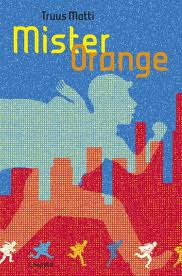 Oh and talking again about the cover. When looking for the cover to post, I found this other cover and I can say without question that I wouldn’t have looked twice at this book if it had this cover. Funny how that is.
And this is Mondrian’s painting Victory Boogie Woogie.


 I Just Read About That...
Leave a comment