Feeds:
Posts
Comments

Archive for 2012

SOUNDTRACK: SURFER BLOOD-Tarot Classics (2012).

I really enjoyed Surfer Blood’s debut album.  This EP is a little stopgap until the next one. Although the sound is unmistakably Surfer Blood–poppy hooks and a very recognizable singing voice, the band sounds a little bit different here.  They haven’t lost any of their catchiness–there may be even more on the opener, “I’m Not Ready” (who doesn’t love when the guitar and vocals match each other?)  “Miranda” has that fun thumping chorus that is always fun to sing along to.

“Voyager Reprise” moves away from the surf-styled songs of their debut into an alt-rock of the 90s sound–when guitars were noisy (until they were quiet for a bit) and guitar solos happened between verses instead of as the third verse.  And “Drinking Problem” has a kind of early Depeche Mode (in vocals, not synths) feel–quite a departure from their debut.

In the way of EPs, the final two songs are remixes.  I’ve never been a fan or remixes and these don’t do much for me, but i do wonder if they will have any impact on their future sound.

[READ: June 14, 2012] “Olds Rocket 88, 1950”

All this time I thought there were only five of these short essays in this sci-fi issue of the New Yorker.  And yet tucked away near the back was the sixth one by William Gibson, a pioneer in science fiction.

Gibson’s recollection is of being a child and having everything seem like science fiction–something that is notably absent these days.  Like the chrome trim on his father’s Oldsmobile Rocket 88, the prevalence of spacemen and space-themed ideas everywhere.  Even the word Tomorrow was capitalized.

Then he recounts a personal incident.  He got in trouble with his parents for arguing with an Air Force man.  The man said space travel would never happen. But Gibson knew it would.  How could it not?  And science fiction shaped this worldview.  Not that he believed the stories would come true, but that his entire mindset was that in the future “things might be different…and different in literally any way you could imagine, however radical.”

What a wonderfully freeing notion.  To me, this sort of future-looking lifestyle accounted for the unprecedented achievements of post 1950 America.  Now that we no longer think of tomorrow with a capital T, we don’t seem as enchanted by the future.  Perhaps it was a naive outlook, but you need a certain degree of naiveté if you hope to do anything radically new.

Gibson ties in the sci-fi books he bought for a dollar to other fantasists: J.G. Ballard, Ursula K. Le Guin, Michael Moorcock, and how these thinkers weren’t all that far off from the likes of Kerouac and William S. Burroughs.  And he believes that without science fiction, he might not have been interested in what these other radical writers had to say.

It’s a short piece, but it really made me wish for more chrome and space-age technology in our lives–when people weren’t afraid to dram big.

Read Full Post »

SOUNDTRACK: JAPANDROIDS-“Fire’s Highway” (2012).

I regret dismissing the suggestions of the NPR folks the other day.  As the more I dig into their suggestions, the more I like–seems their selections are better than their descriptions of said selections.  Take this description of the Japandoids’ album: “snarling punk meets the fist-in-the-air anthemics of Born to Run-era Springsteen and his modern-day equivalents in The Gaslight Anthem.”  I’ve never really liked Springsteen (I know, a Jersey boy, too).  I think it’s more about production (and saxophone) than anything else.  So, comparing bands to him is never a sell for me (even if it may be true).  To me, this sounds much more like a low-key Arcade Fire (with literally no pretensions to anything–I mean, there’s only 2 Japandroids).  Granted, Arcade Fire owe a lot to Springsteen too, but they do something different with his sound, which is why I like them.  [I’m not going to be able to argue my way out of this].

Anyhow, this song is a four minutes of punky guitars and a stupidly catchy chorus.  The fact that it’s only two guys makes it all the more remarkable that it sounds like a full band.  And perhaps, the biggest difference for me is the singer’s voice which feels very early 90s alt rock/punk.  Whatever it is, I’m a fan and will certainly be listening to more of this album.

[READ: June 14, 2012] “The Clockwork Condition”

Like most young men of a certain bent, I loved A Clockwork Orange.  I’ve watched it dozens of times and I’ve read the book.  What I especially like about the story is that my feelings about it change as I get older—which, while not the point exactly, is certainly a theme in the story–how age makes things seem different.  The most important thing I learned from this article is that there was an epilogue in the British version of the book that was not available in the American version (or the film).  And it seems to be pretty important.  What a strange thing to leave out.

Incidentally, Burgess wrote the book in 1962 and the film came out in 1973, which is why he was wrote this in 1973.  He says he was asked about Issues that arose from the film.  And he talks a lot about them.

But he also gives a lot of background.  The title of the book comes from the expression “as queer as a clockwork orange” which is Cockney slang for something so weird it subverts nature.  It was a perfect title for an idea he was going to write about—how people suggested using aversion therapy to change juvenile delinquent behavior.

So this article goes on for a pretty long time, raising all kinds of questions.  It’s really articulate and fascinating and really makes me want to re-read the anti-authoritarian novels I read in high school: 1984, It Can’t Happen Here, Brave New World.   He even talks about B.F. Skinner, who proposed that aversion therapy (which is what Alex gets in the book/movie) was wrong and that positive reinforcement was always more effective.  Skinner worked with animals (Burgess jokes about that) and the whole “you get more flies with honey” attitude works better for training animals he says.  The same is true for people.  Besides, aversion therapy removes freewill. (more…)

Read Full Post »

SOUNDTRACK: CARLY RAE JEPSEN-“Call Me Maybe” (acoustic) (2012).

I had never heard of this song until about three days ago.  I’m led to believe that this song is massive, and yet somehow I missed it (which is fine).  I first read about it  as “the song that Justin Bieber made famous.”  So I listened to it and I hated the overproduction of it.  Then one of the folks at NPR picked it as her favorite song of the year (the discussion was split 50/50 between love and hate).  And I had to agree that after another listen, it was really catchy.  But I still hated the overproduction.

One of the people in the discussion said that an acoustic version would be great.  So I found one (there are actually a ton online…this song really must be huge).  And indeed, the acoustic version is pretty nice.  It is insanely catchy (and remarkably sweet).   And her voice is very intriguing–I think her voice really makes the song.  Absent all of that obnoxious production, this is an enjoyable pop song (although, the keyboards are pretty awful still on this version–loose the keys, Carly).

One acoustic version (that’s barely 2 minutes long) is available here.

[READ: June 13, 2012] “My Internet”

I was poisoned against the story because I read just one line of Karen’s review: “Let’s face it – without Jonathan Lethem’s name on this, it’d never get out of a slushpile.”  That was a pretty big hurdle for this story.  And it never cleared it.   I’m going to have to agree with Karen—possibly not as harshly, but with a general….huh?  I have a hard time believing that this found a publisher.

The idea is kind of interesting:  there is a another internet tucked away inside the internet we all know.  There are only 100 people who are on it, and they were all sent special invitations to join.  There are only two rules on this Internet—no money and no animals.  But for some reason (explained by the end), the narrator is unhappy here, and he wants to create his own internet within this other internet (which is within the global internet).

And that’s pretty much it. (more…)

Read Full Post »

SOUNDTRACK: PHISH-“In the Aeroplane Over the Sea” (2010).

My friend Jay sent me this clip of Phish covering Neutral Milk Hotel’s wonderful song.  He was at the show and sent me a link  to the YouTube video.

The original of this song is wonderful–always sounding like it’s going to collapse in on itself but never actually doing so.  It is full of angst and emotion and after the first listen, where you say, “is he really going to sing the whole thing like this?” you are totally hooked.

The Phish version evens a lot of that angst out.  It’s a strange thing to say about Phish, but they make this song far more commercial.  They turn it into a pretty ballad.  And that’s kind of a shame since the original is so iconic.

In Phish’s defense, this is part of one of their sets (they unveiled a new cover on every day of the tour), and it’s not like they are trying to record a definitive version of it or anything.  So they make it into a Phish song–with a long solo and everything.  And the solo sounds like a total Trey solo.  I’m not sure what songs surrounded this one, but it sounds like it fit perfectly into their set.

As the folks at Stereogum say, “If you’ve always felt “Aeroplane” needed more guitar solo, this is your lucky day.”  For me what it did was make me want to listen to the original–and that’s never a bad thing.

[READ: June 5, 2012] “Quests”

This essay opens up with a history lesson.  In the early nineties, Pizza Hut sponsored the Book It! program to promote reading.  For every ten books you read you got a free pizza.  Well, it turns out that they either still do this or they do it in a modified form because my son has been getting these free pizza coupons all year.  Of course, we live in New Jersey, where the pizza is plentiful and delicious (there are at least 4 excellent pizza places within ten minutes of our house).  And you’d be a fool to eat Pizza Hut, even if it is free.  My son is pretty bummed about this, because of course he wants to redeem his prize.  And I suppose one day we’ll let him do it, but it would painful.  I actually don’t even know where a Pizza Hut is by us.

But that’s got nothing to do with Russell’s essay.  She realizes the truism that there is no greater pleasure than reading for pizza.  Because it’s not just reading for escape and fantasy, now you’re a breadwinner. Literally.  Russell’s genre of choice was fantasy (Terry Brooks in particular–I love that she realizes later in life that he took his ideas from Dresden and Hiroshima and how it blew her mind). (more…)

Read Full Post »

SOUNDTRACK: PHISH-The Man Who Stepped Into Yesterday (1987).

This record was created by Trey Anastasio as his senior project at Goddard College.  The thesis included an essay piece and this collection of songs (recorded by Phish) relating this epic tale from the band’s fictional land of Gamehendge.  It was never officially released, but since Phish is so free with the tape trading, it is pretty widely available online (heck, even Wikipedia has a link to the Lossless SHN download of the album).

This release is legendary in the band’s history because they have played all of the songs from this album many times in their live shows (some much more than others, of course).  And while they have more or less played the Gamehendge saga a few times in concert, I’d always wondered what the original story was all about (many songs have since been added to the saga as it grew larger).

So here in all its tape-hissy glory is the original.  My first thought is that I guess it was hard to get good sound recording equipment in 1987 (or else this is a multi-generational copy—the “white cassette” from a year earlier sounds better).  And there seems to be a few flubs in the narration (which could be from copying).  I actually surprised he didn’t use a more authoritarian voice for the narration.

For fans, this is fun to hear because of that narration.  Live, the narration varies all the time, not always explaining what is going on the same way (some live narrations are far better and much more interesting).  But here you get it straight from the source.  The narration is accompanied by rather pretty instrumental music (which varies depending on who he is speaking about).  But for those of us who know all of these songs, the biggest surprise is finding out that “AC/DC Bag,” “The Sloth,” and “Possum” were part of the story (or maybe the biggest surprise is learning from the narration what the hell an AC/DC bag is (a robotic, mechanized hangman, of course).

The story is pretty interesting (Wilson and the Helping Friendly Book and all that), although by the end it loses itself a bit.  And I’m not really sure that “The Sloth” and “Possum” fit into the story at all.   But hey, he was a college senior when he wrote it, one can forgive a little sophomoric nonsense, right?

[READ: June 11, 2012] “The Republic of Empathy”

This is the first fiction I’ve read of the sci-fi issue.  I’m not sure if it’s supposed to be sci-fi, because it’s not really, at least not in terms of genre (I’d say sci-fi fans would object to the designation of sci-fi for this).  But it is futuristic and neat.  I especially enjoyed the humor and the construction of the story—Lipsyte is usually good for both of these.

It begins with William.  Williams is married to Peg.  Peg wants to have a second child as a gift for their first child (who has just grown out of the new baby smell).  William thinks this is crazy, but Peg says it’s a dealbreaker.  The next day William, who works for a flip-flop company, smokes a joint with an ex-cop friend, Gregory on the roof of their building.  On the roof across from them, they see two men fighting. And then one falls of the roof—splat.

Gregory says he’s seen this before but that William will be traumatized.  And he is in his dreams, but he’s even more traumatized when he dreams that his wife is pregnant and they already have two kids.  Oh, and that the neighbors, the Lockhorns, masturbate each other in the living room with the windows open.

Section two is from Danny’s point of view.  Danny is Gregory’s son.  Every few weeks Gregory is dating a new, younger lady.  This one is only a few years older than Danny.  It’s gross (and Danny feels like a bad YA narrator as he relates the story).  This is all before (I assume) Gregory comes out of the closet.  Because William knows that he’s gay in the above scene. (more…)

Read Full Post »

SOUNDTRACK: PALLBEARER-“Legend” (2012).

For the past several years, NPR has been one of my favorite resources for new music.  They feature a new song every day, they play first listens of new albums, they have downloadable concerts and much more.   And every year their best albums picks invariably feature and album or two that I hadn’t heard of which prove to be amazing.

But this first half of the year’s album picks are really kind of disappointing. It’s a diverse mix (Leonard Cohen, Sharon van Etten, Bobby Womack, fun., some rappers I don’t know, a little classical, Spiritualized).  I’m not saying these choices are bad, I actually haven’t heard most of them.  But there was nothing that made me jump up and say, how did I miss that?

But then there was this cut from Pallbearer.  It’s a dirgey death metal song, slow and heavy.  Lately I’ve enjoyed death metal but I’ve been disappointed by the vocalists.  Pallbearer has a guy who can sing and whose voice rings through the sludge.  And there is sludge–some of the notes sound like the guitar is completely de-tuned.  But what’s cool about the recording is that it doesn’t sound sloppy or mushy–you can hear the sludginess in all its clarity.  The guitar solo is interesting too.  It also soars above the sludge, but it’s not a shredding solo, it’s melodic and quite pretty.

I’ll check out more from Pallbearer.  I’m always excited to see NPR promoting death metal.  It’s as good juxtaposition as the parts of this song itself.

You can see the NPR choices here.

[READ: June 10, 2012] Ghostopolis

Sarah gave me this book after reading it quickly and raving about it (this after our friend Megan gave it to her and raved about it).  And I read it quickly and will rave about it now too.

The book opens with an airplane that is having engine trouble.  The airplane, it turns out, is being flown by a little boy name Garth Hale.  Because it’s a toy plane (the reveal is great).  He’s being gross (barf bags everywhere) until his mother can’t take it anymore.  But she has reason to be gentle with him.  She has just found out that her son’s disease is incurable.

Meanwhile Frank Gallows is a special agent whose job is to send ghosts back to the afterlife.  He has a cool handcuff-like device that he has to attach to the ghosts’ arms or legs.  He then pushes a button and poof, back they go.  His first assignment today is to get Benedict Arnold (who plays a big role later on) out of the world.  Then he goes after a horse–a skeletal nightmare horse–which is overpowers for him.  As it floats through a wall, Frank manages to shackle its legs and poof.  Only after the poof does he realize that the horse was on top of a little boy.  A boy named Garth Hale.   Frank is in big trouble. (more…)

Read Full Post »

SOUNDTRACK: FEIST-“Femme Fatale” (2011).

The funny thing about The Velvet Underground is that it seems like it would be very hard to fail at covering them.  Their songs are pretty open to interpretation.  But, it’s even more true if you wanted to do it pretty straight.  I mean, while Lou Reeds voice is unique, Nico’s isn’t really.  It’s slow and languorous, sexy and distant.  I would never have thought to describe Feist that way and yet she fits into the Nico mold very nicely.

This cover comes from the Velvet Underground Revisited show from 2011, with a band comprised of members of Radiohead, Air and Supergrass.  Feist did vocals for this one.  It’s not an earth-shattering cover.  In fact it’s pretty spot on.  Maybe everyone who hears this will start a band too.

You can hear it here.

[PLANNED: Summer 2012] #OccupyGaddis

I had my books all planned out for the summer.  A series of smaller books to get through before trying to tackle any really big books that are on my shelf (and there are plenty).

And then came #OccupyGaddis.

William Gaddis is an author, like Thomas Pynchon, who writes large, unwieldy novels which are something of a bedrock for contemporary American fiction–like The Velvet Underground–not many people have read him, but those who have all went on to write wonderful books.  And he forms a kind of continuum of (among many many others) Joyce>Gaddis>Pynchon>Wallace which means that I ought to be reading him.

I read JR about a decade ago.  I remember a few things about it–basic plot details and the fact that you never know exactly who is speaking.  I wasn’t keeping this blog then, so I didn’t exactly take notes on it or anything.  It’s kind of a blur.

So Lee Konstantinou is running #Occupy Gaddis this summer.  It is meant  to be an Infinite Summer type-deal.  Unlike Infinite Summer which was weekly, he’s planning on posting every two weeks.  I’ll try to do my weekly post (work permitting), by picking a midpoint as a Spoiler Line.  Since my recollection is that JR is like one large block of text with no breaks anywhere, my spoiler line will be pretty arbitrary.   But here’s his:

June 29: pp. 150

July 15: pp. 300

July 31: pp. 460

August 15: pp. 610

August 26: done!

(more…)

Read Full Post »

SOUNDTRACK: SQUAREPUSHER-Solo Electric Bass 1 (2009).

Yesterday I said that one Squarepusher CD was enough for me.  I did some digging and found out that he has put out a whole bunch of CDs.  And, to the surprise of me, at least, not all of them are crazy electronic music.   This CD, as the title states, is a collection of electric bass solo songs.  The songs were performed live as part of the Jazz à la Villette 2007 festival and were played on an electric six-string bass with no pedals or effects.

And that is all you get—serious solo bass songs.  The man behind Squarepusher, Tom Jenkinson, is apparently a virtuoso musician (who knew?) and these songs really show off his chops (just listen to the insanity of “Seb-1.05” (catchy title, eh?)).  He can play some impressive Spanish-sounding songs–that would probably sound better on a guitar, but sound more impressive on a bass (“Seb-1.06”).  He’s got some great slap stuff going on (“Seb-1.03”), and he really knows from melody (also “Seb-1.03”).  True, 12 all bass songs can meld into one another, but the crowd really loves it (and like a lot of things, seeing it is probably more impressive than just hearing it).

It’s not exactly “fun” listening (even if you love bass solos).  Only 850 copies of the disc were released, so it’s not like they expected a big audience for this.  But it is pretty neat to hear a) how good he is and b) that his main musical output is noisy electronic noodling.  That gives me even more respect for his electronic output.

[READ: June 5, 2012] “The Spider Women”

Margaret Atwood is another author I wish I had read more of—and I’m getting there.  I often wonder if I should just read an author start to finish and be done with him or her or if that just leads to madness.

Much like Miéville says in the previous essay, children don’t read genres, they just read what they like.  I loved Atwood’s idea that “below a certain age, [children] don’t distinguish between ‘true’ and ‘not true,’ because they see no reason why a white rabbit shouldn’t possess a pocket watch, that whales shouldn’t talk, or that sentient beings shouldn’t live on other planets and travel around in spaceships.”  After all, sometimes reality lives under the bed and has sharp claws. (more…)

Read Full Post »

SOUNDTRACK: SQUAREPUSHER-“Dark Steering” (2012).

Hot on the heels of a review of LMFAO I get to the other side of the spectrum in electronic music—Squarepusher.   There’s no big choruses, heck there’s no words, but this music shares something with LMFAO.  Well, actually it really doesn’t—except maybe keyboards.

Squarepusher play dark angular music. It’s very electronic and alien (and sounds like it may have been used in the background of Skinny Puppy songs back in the day). It’s abrasive and the sounds are otherworldly and yet in this song, there’s a melody to it.  I have but one Squarepusher CD—that’s probably enough for me.  But I am always interested to hear new music by him.  It’s impressive the way he can take a song that starts out so noisy and get it to sound like real music by the end.  It like the science fiction of music.

[READ: June 5, 2012] “Forward Thinking”

I have read only one book by China Miéville—Perdido Street Station.  I found it to be quite challenging for a bunch of reasons and figured I wouldn’t read more by him.  And yet I find that images from that book stay with me to this day (at least ten years on).  So maybe it’s time to give him another shot.  But where to start?

This entry in the New Yorker’s Sci-Fi issue is written as an “E-mail sent back in time to a young science-fiction fan.”  And I loved it.  I enjoyed how it started (with the author knowing that E-mail doesn’t exist at the time the recipient will get this—so who will it show up?)  And I loved the central question: “How did you get into this stuff?”  The sender knows that the kid will get asked this a lot, but the question should be turned around: “How did you get out of it?”  Because all kids love sci-fi concepts.  It’s just that some move away from it as they get older.

Miéville includes a few key moments in (his) sci-fi history: Page 40 of “The Tale of Mr. Jeremy Fisher” by Beatrix Potter.  What?  Indeed, for this is the first time that (you) will be ware of knowing something the protagonist doesn’t—that there’s  fish coming up to get him.

Next is Chapter 13 of Golem100 by Alfred Bester.  I have never heard of this book.  Although Miéville does warn us about it—he read it far too young and there’s some sadistic violence in it, what attracted him (and me, now) is the disrespect for text—part of the story is a musical score, another is a picture.  It sounds cool.  And of course it is long out of print. (more…)

Read Full Post »

SOUNDTRACK: LMFAO-“Party Rock Anthem” (2012).

My son doesn’t seem to care about music.  It’s shocking to me since I love music so much.  He really likes They Might be Giants’ Here Comes Science, but I think more for the words than the music (which makes me proud for other reasons).  He likes the music from Kirby and Star Wars and he liked some Mogwai because it sounded like a soundtrack to a movie.  When he sings to himself it’s always the tune from Christmas Carols.  In fairness, I didn’t really appreciate music until I was 7 or 8, but so many young kids seem to really be into music (with amazingly bad taste), that I’m not sure what to think.

So the other day he was singing some words to this song.  I was shocked.  Where in the hell had he heard it anyhow?  Then the other night his CD player didn’t work so I tuned in a random radio station and he heard this and wanted it on.  So, he finally has a song that he likes.   I hadn’t really listened to this song, so I figured I’d give it a try.

I don’t really have an opinion of it.  It’s a dance song.  It reminds me of Daft Punk and maybe early Prodigy.  I’m a sucker for the keyboard riff that sounds kind of twisty (fake electronic music appeals to the sci-fi geek in me).  Lyrically it’s innocuous enough I guess–it is a dance song after all (wait are they dissing The Beatles and Led Zeppelin?).  The funny thing to me about songs like this is that they are all kind of interchangeable–each year or so someone comes out with a new dance theme that everyone can pogo to and do X to and “have a good time.”  I think perhaps that this was even played at a recent Cub Scout function to the confusion of most of the adults.

Since my son doesn’t dance and would certainly never dance in public (I don’t even think he’d even “put his hands up”), I’m not quite sure what the appeal of this is to him (“other kids like it” is probably as far as it goes).  But hey, maybe this is a gateway into his actually wanting to listen to his dad’s music.  [And when does he ask me what LMFAO means?  Probably never, because he has no idea that that’s the band’s name].

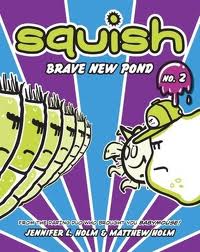
[READ: June 6, 2011] Squish: Brave New Pond

The second squish issue depends a bit on the first one.  There are a number of references in the book to the first one (with a comment about half way through that says to just go and read the first one already).

In this one Squish, who is an amoeba, is reading a comic about Super Amoeba.  He’s a superhero who helps everyone in Small Pond (including an amusing scene where a girl drops her ice cream and he flies to her rescue).   But then he is asked to join The Protozoans, heroes who help the World, not just Small Pond.  And Super Amoeba is thrilled  and is soon off to join them (in their spiffy (and tight) uniforms).

This parallels to Squish’s own situation.  It’s his first day of school.  And he has decided to make some changes.  Maybe he won’t hang out with his old friends so much, maybe he’ll try to become more popular, maybe he’ll even get picked for the kickball team, and maybe, just maybe, he’ll get to hang out with The Algae Brothers, the biggest, meanest, coolest kids in school.  [This story line has striking parallels to Queen Bee, eh?  Does anyone ever make stories from the POV of kids who are already popular?].

He has a hard time ditching his old friends (they’re so clingy).  But it turns out that last year, when Squish stood up to Lynwood, the meanest amoeba in the pond, the Algae Brothers noticed.  And when they recognize him, they invite him to hang with them (where nachos with cheese are actually delivered to their table at lunch!).  He’s made it!

Being cool is pretty great.  Sure he misses his old friends a bit, but everyone is in awe of his new found status. (more…)

Read Full Post »

« Newer Posts - Older Posts »