Feeds:
Posts
Comments

Archive for December, 2012

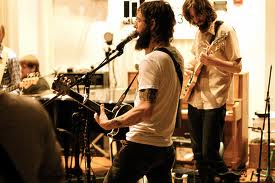
CV1_TNY_12_03_12Thiebaud.inddSOUNDTRACK: BEIRUT-Tiny Desk Concert #159 (September 21, 2011).
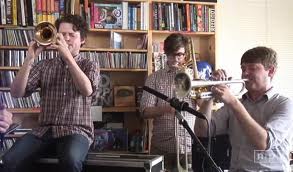
beirut tinyI don’t know a lot about Beirut.  NPR seems to like them and all I know about them comes from the shows NPR streamed.  This Tiny Desk concert is only 12 minutes long and the band doesn’t chat very much.  But they play three songs: “East Harlem,” “Santa Fe,” and “Serbian Cocek.”  This last song was meant as kind of a goof, a treat for the people who showed up (Beirut had just come back from Bonnaroo and were exhausted), but they allowed NPR to include it in the stream, which is a fun treat.

Beirut play a kind of jaunty horn-fueled eastern European-flavored music.  “Serbian Cocek” has a very tradition feel–an instrumental fueled by trumpets that’s very hard not to dance to.  They are certainly not to everyone’s cup of tea, but if you like some Europe in your rock, they are worth checking out.  Even if in this set they aren’t hitting the highest notes that they might otherwise hit.

[READ: December 1, 2012] “Literally”

This story runs a gamut of ideas in a very short span–death, race, marriage, public transportation, soft serve ice cream and the misuse of the word literally.

And perhaps there is too much crammed in here.  It’s not that the story suffers but by the time you get to the end of the story, the title seems irrelevant.   It refers to paragraph five in which Richard “liked to make his son smile by using his favorite word incorrectly.”  And then it’s not used again (unless you want  to argue that the end is somehow a literal moment, but I really don’t).

The story switches back and forth between Richard’s daughter Suzanne who works at the Dairy Queen and Richard’s son Danny, a smart alec kid who engages in the time honored tradition of mocking his sister (although she is completely oblivious to his taunts).  The story is also about Bonita, Richard’s housekeeper.

Every since his wife died (recently, in a car crash), Richard has become painfully aware of how much his wife did–even simple acts like communicating with Bonita.  Richard knows very little Spanish, while his wife was fluent.  His wife also helped out with Bonita’s son Isaac, who is “nervioso.”  So Bonita brings Isaac over most days.  Indeed, because of the districting, Richard and his wife agreed that Isaac and Bonita could claim that they lived with them, so Isaac could go to the better school.  Danny and Isaac get along very well, and often get absorbed in a game called “town” (which helps Isaac to relax). (more…)

Read Full Post »

CV1_TNY_11_26_12Blitt.inddSOUNDTRACK: BAND OF HORSES-Live on KEXP, October 19, 2007 (2007).

bohgibsonBand of Horses plays in New York at Gibson Showroom for the CMJ Festival and KEXP was there for the broadcast.  The band plays six songs and they sound really great here–I’m always amazed by their harmonies.  They had just recently released Cease to Begin, and so they play “Is There a Ghost” which sounds perfect live (I’m not sure if it has been a hit by then).

I’m confused that in “Marry Song,” they state that he switches to the double neck guitar.  Not that I doubt that he does, but there’s so little guitar in the song, it seems an odd choice.  Regardless it sounds pretty, as does “Ode to LRC”–one of my favorite BoH songs.

The chat with the DJ is great, as she reminds the singer about 6 or 7 years ago when he was pushing his new label and the band Carissa’s Weird and how all of a sudden he was playing with them behind the drumkit and now he’s fronting Band of Horses.  There’s a  comment about the band relocating back to North Carolina (and no longer being a “Seattle” band).  And they joke about the song “Detlef Schrempf” and how they have had a sports guy on both of their albums so far.

The play “Par One” which he says he hopes he doesn’t screw up because he forgot the words the other day.  The final track “Am I A Good Man,” is a cover of a Them Two song.  I’m always mixed about bands dong covers.  It’s fun to hear their take on things but I’d much rather hear an actual BoH song than one by someone I’ve ever heard of.  Having said that, this song is really good, very retro-sounding with a cool 70s style keyboard solo.

It’s odd that the band hasn’t been back on KEXP since 2007.  You can hear this one here.

[READ: December 1, 2012] “Bull”

Mo Yan’s story (translated by Howard Goldblatt) opens with a technical detail about forcing water through the arteries of slaughtered animals.  Lao Lan perfected the method for doing this that required far less water.  It was also suggested that he used a bit of formaldehyde to keep his animals looking fresher than the other butchers’ wares.  The person who suggested the formaldehyde was Luo Tong, the narrator;s father.  [I know that it’s the reader’s responsibility to keep characters straight, but is it really that hard to not have your two main characters have these three names: Lao Lan Luo?].

The narrator’s father was an expert at judging animals–he could look at any beast and guess the weight and overall meat content.  He would put his hands on the beasts just for show.  But he was always right within a kg and at the market, his word was bond.

There’s a brief interlude in which we see the narrator’s homelife.  We learn that Luo Tong is cheating with “Auntie Wild Mule.”  There’s a funny sequence in which the narrator reveals that he knows his mother’s name (a no-no apparently) because Luo Tong told it to Wild Mule.

The story seems like it might just be a story about the village and Luo Tong’s proficiency at his skill (he never accepted any gifts from anyone so as to not seem unjust, everyone agreed he was fair–crazy, but fair).  But then as the day’s trading is ending, Lao Lan walks over to where Luo Tong is sitting and pisses on the ground right in front of him (from the amount and the smell, the narrator surmises he has been holding it a long time).  Luo Tong does nothing.  Literally he just sits there.  The narrator is mortified at his father’s cowardice and it is clear that Luo Tong must have lost some respect here.

When the day finally ends and the merchants give Luo Tong his cut, Lao Lan deliberate drops the money in the puddle of urine.  The narrator calls his father all manner of names and says he can no longer respect him.  Lao Lan states that the narrator should consider being his (Lao Lan’s) son instead.  The narrator is offended by this as well and charges at him (but misses).  And the narrator sulks. (more…)

Read Full Post »

« Newer Posts