 SOUNDTRACK: QUASI Live at SXSW, March 8, 2010
 I really enjoyed a few Quasi albums back around the turn of the century, and then I kind of forgot about them. But this set is really great. The always excellent Janet Weiss on drums and harmonies and the wonderful Sam Coombs on guitar and vocals. Around the time of this album, American Gong, they added Joanna Bolme on bass which really fills out their sound. The first song, “Repulsion,” rocks harder than any of their older stuff (which was more keyboard based). Indeed this album was apparently much rockinger than any of their earlier releases–I must check it out.
This set was recorded during SXSW from the Gibson Showroom in Austin. They play five songs in about 20 minutes. “Never Coming Back Again” has a far more country feel (especially the backing vocals which have a real twang. The lengthy instrumental section of “Black Dogs and Bubbles” is great–especially check out Weiss’ drumming. “Little White Horse” is a shambolic rave of a song–fun and noisy.
The set ends with the inspiring Rise Up, a short stomper that encourages you to, yes rise up. Weiss and Coombs both have other bands that they play in, so Quasi never seems like a full-time project. But that seems to make their music all the better. Listen here.
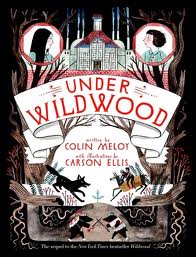
[READ: November 1, 2011] Under Wildwood
I enjoyed Wildwood, but I wasn’t blown away by it. So I admit I wasn’t totally excited to read this one (especially since I had some other books lined up). But Sarah managed to get it from the library (I guess it was not as a big a deal as I assumed it would be?) and I decided to give it a go.
I found it a little slow at first, but after about 40 pages, the book totally took off and I was fully engrossed. Whether it was because there was less exposition since this was a sequel or because the story itself was more exciting, I couldn’t put the book down. And, more importantly, the book did not feel like its 550 pages were excessive. He really filled up every page with story.
But I was a little concerned because part of the story is set in an orphanage–a setting rife for cliché. But Meloy has some great ideas and although he does use the orphanage as a scary setting (and employs some clichés from all orphanages) he transcends the conceit with some great characters and some evil owners who use demerits to completely move the story along outside of the orphanage–a great plot idea.
But let’s back up.
The story opens with Curtis on a mission for bandit training. (If you need a refresher on everything that happened in the first book, check the original post–there is very little hand holding to get you up to speed in the book. It’s not absent, but it’s also not very thorough either, which is good). Septimus the rat is on Curtis’ shoulder–they work as a team. And Curtis is doing very well, except for the final part where the trainers surprise him.
Then we jump to Prue who is still reeling from her experience in the Impassable Wilderness. She’s back at home and in school, but things don’t feel right. The only person she feels like opening up to is a new hippie teacher named Darla.
What I really liked in this story was the introduction of Curtis’ family. It never sat well with me that Curtis just decided to never go back home. And we now see how that impacted his family–his mom and dad are totally freaked out (I would have thought Prue might have talked to them). And as their story begins, The Mehlbergs are heading overseas to follow a lead about Curtis. In one of the more far-fetched sequences of the book (and this is accepting that it is about talking animals), the parents drop Curtis’ two sisters off at an orphanage for two weeks because they can’t afford to fly all of them to Asia. Crazily implausible, but quickly skimmed over at least.
As mentioned, the orphanage is a dark and scary place–the children do manual labor all day long. And this location was kind of a yawn until it is revealed that Mr Joffrey Unthank (ha), the owner of the orphanage is really trying to gain access to the Impassable Wilderness. So when Rachel and Elsie (Curtis’ sisters) stumble upon a secret, the orphanage part of the story grows more interesting than the IW story.
Back in the IW, the bandits have been dispatched by unknown forces. Prue has been drawn back in by the murmurings of the plants who alert her that the Dowager Governess is in danger (and indeed she sacrifices herself for the good of Wildwood). Prue convinces Curtis and Septimus that they must travel to the Dowager’s location and witness her death. And so the kids spent much of the book travelling through the Wilderness, avoiding danger, and coming to terms with what exactly Prue’s “mission” entails.
On their way back to the bandit enclave, Prue and Curtis meet the Moles. Sir Timothy and the Knights Underwood are facing an insurrection by Dennis Mole. This is a lengthy section in which the blind moles believe that Prue and Curtis are Overdwellers (gods) come to help in their battle. Most of this sequence is played for comedy and yet, like the battle i the first book, there is terrible bloodshed. But this time there is something Prue can do to stop it. And what is wonderful about this seemingly throwaway scene is how some major plot clues are revealed.
There is anther plot about children lost in the Periphery–the section that acts as a transition between the real world and the Impassable Wilderness–a section that effectively leaves you trapped, unable to go into either world and where time stands still. (It’s also where all the stray cats and dogs wind up). A man named Carol is living there taking in all of the stray animals and children who come to the Periphery. And they live in a strange house where they all work but where they never age. Carol plays a much larger role in the story. And when Rachel and Elsie encounter him, it joins all kinds of plot threads together.
Indeed, all of the threads align beautifully until… sadly, nothing happens.
I didn’t know that this was book two of a trilogy. I blame The Empire Strikes Back for making it acceptable to end a piece of fiction with a blatant cliffhanger before the next one. Basically, this book ends with a great diaspora of characters–some looking for each other, some running from each other and yet all of them seemingly within shouting distance of one another. And that’s fine in some respects, but for me there just wasn’t enough resolution for this book to be satisfying on its own (especially since book three probably won’t come out for another year).
Having gotten that gripe out, though, I enjoyed this book a lot more than the first. It felt faster paced, there wasn’t quite as much of the politics and geography of the first book (which was necessary in that book since he was creating a new world, but it is not missed here). There were a lot fewer talking animals which was kind of a shame, but the ones that do talk were worth it (I especially enjoyed when Septimus went to the real world and had to keep his tongue silent).
This is an enjoyable series and now I am really looking forward to what I assume will be the final book in the trilogy.
Oh and Carson Ellis’ illustrations are wonderful (but what else would you expect).

 I Just Read About That...
Leave a comment