 SOUNDTRACK: DEERHOOF-Live at CMJ Gibson Showroom (2008).
 I don’t know much about Deerhoof (I certainly didn’t know they’d been around over a decade). I heard them on Pitchfork TV (they had two videos on it about two years ago which I rather liked). This set was recorded live at CMJ by KEXP.
The DJ is very familiar with the band, and the repertoire is casual and funny (although the Gibson joke falls flat). They play four songs and each one is virtually an instrumental. The voice is mixed so low on “Blue Cash,” I didn’t even realize she was singing until the third time I listened, so I don’t know which songs have words. “Tears of Music and Love” is a bit wilder (with some great crazy drumming in the middle). “Fresh Born” has a bit more of a sinister edge what with the intense riff and the scratchy feedbacky bridge. It’s my favorite song of the set. “Basketball Get Your Groove Back” sounds a bit like “Roadrunner” so it’s less than thrilling end to the set.
I expected the band to be a lot weirder than this, I admit, but it’s still a good set. You can listen here.
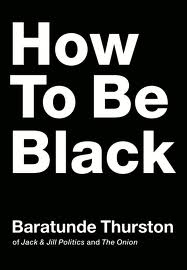
[READ: September 20, 2012] How to Be Black
Karen at A Just Recompense posted about this book a little while ago and after just a few lines, I had to stop reading her post so I could get the book. I had no idea who Thurston was before I read the book, but it sounded so good. And it was. Although it wasn’t exactly what I was expecting.
This book is a combination autobiography of Thurston and “how to” book. Thurston went to a Quaker School and a black militant program at the same time and also went to Harvard before becoming a stand up comedian; he’s co-creator of Jack & Jill Politics and director of digital at The Onion (that’s some serious cred for a geek like me). As I said, in addition to being his autobiography, this is also something of a how-to manual for being black. It’s funny, but not cheesy-over-the-top funny (stereotypes are played with but also deconstructed), it’s “serious” funny, and it’s very enjoyable. And it covers topics that one might not expect, like talking about the Nigerians he has met who are offended at his name. Baratunde is a twist on a Nigerian name, although his family is not Nigerian, his mother wanted him to have a traditional African name. And he is quite annoyed at the Nigerians who assume he doesn’t know what his named means. He does (and the example he gives is very funny).
Looking at the title chapters, you get a sense of the tone of the book: Do You Know What an Oreo Is? How to Be the Black Friend, How to Speak for All Black People, How to Be the Black Employee, How to Be The Angry Negro, How’s that Post-Racial Thing Working Out for Ya?
I was particularly intrigued by “How to be the Black Friend,” especially in light of the realization that every sitcom has a token black friend (some more successfully “integrated” than others). It’s a weird conceit in the shows, a nod to inclusion without really being inclusive, and it always makes me wonder how well the character will be written (again, some much more successfully than others). But this chapter is wonderful for telling black men and women how to be “the black friend” (and it’s clear that this chapter is meant for white people to read too). This chapter is a good example of how the book appeals to all readers (except overt racists, of course).
“While the Black Friend’s value to White America is long-established and readily apparent upon slight reflection, it’s The Black Friend’s value to Black America that is truly underappreciated…. The Black Friend is a key intelligence asset, like the CIA operative both transmitting and receiving valuable information that continually helps prevent a race war by increasing understanding, lowering tensions, and offering diplomatic back channels…. For example, a good Black Friend can see the artistic merit in Nirvana’s “Smells :Like Teens Spirit” rather than dismiss it as simply “a bunch of white people music.”
I found special resonance with “How to be the Black Employee” since my office had two black employees so naturally I thought about them when read this. I loved that the Black employee is given options on how to act–whether to speak for all black people or to be “angry.” Very funny and yet possibly very true.
The Introduction, “Thanks for Celebrating Black History Month by Acquiring This Book,” sets the tone perfectly. As Karen puts it very eloquently, “I never felt called out or scolded, though. More like a tap on the shoulder, a whispered word to the wise. From a Black Friend.” The Introduction also gives ten things that you can do during Black History Month: Avoid Being Explicitly Racist (if nothing else it shows a lack of discipline); Observe Anything and Everything that President Obama Does (“every single thing Barack Obama does is historic If he clogs the toilet in the White House bathroom, he’s the first black president to damage White House plumbing”); Demonstrate Your Superior Knowledge of Black History in Front of Your Black Friend(s) (“Have you heard the latest tracks from the Carolina Chocolate Drops? It’s like this amazing fusion of old-school jug band meets Gaelic music meets hip-hop. Oh you haven’t heard of them? Man you should really check it out! It’s so real!”). And of course Watch BET (“Never mind that it’s not owned by a black person anymore. You can still learn a lot from BET. Primarily you will learn that black people love reruns, and if you’re lucky, you’ll catch the Tyler Perry movie! I know the Internet Movie Database says Perry has written over ten films and there maybe be several titles and even different casts, but if you’ve seem one Tyler Perry movie you’ve experienced the entire canon. The man has only made one film and you can watch it on BET repeatedly” (later in the book we get the simple rule: “Fuck BET.”)
There are a few sections where Thurston brings in his “panel” to talk about blackness. This gives him a nice sample of other black people to compare experiences The panel includes: Cheryl Contee (co-founder of Jack & Jill Politics), damali ayo, Jacquetta Szathmari, Elon James White, Derrick Ashong, and Christian Lander (a white Anglo-Saxon Canadian included as a control group and to “defend against the inevitable lawsuits claiming reverse discrimination” he’s also the author of Stuff White People Like) and W. Kamau Bell. I recently heard W. Kamau Bell on NPR’s Bullseye and he was very funny. And his new TV show with Totally Biased with W. Kamau Bell is hilarious and should be enjoyed by all. I was happy to have seen one episode just before I read the book, and I’m really happy that it was picked up for more episodes.
The panel answers questions like when they first realized they were black, if they were called too back or not black enough if they can swim (see, he touches on stereotypes–the segment about watermelons at office parties is uncomfortably hilarious (and Karen quotes it as the intro to her post).
I enjoyed this book quite a lot. Thurston is a great writer and has led a very interesting life. I look forward to more from him (and his panel).

 I Just Read About That...
Leave a comment