 SOUNDTRACK: …AND YOU WILL KNOW US BY THE TRAIL OF DEAD-Live on KEXP, March 12, 2009 (2009).
 Back in 2009, …And You Will Know Us by the Trail of Dead had been hit by a truck. Really. Evidently no one was hurt too bad, but they did have to cancel a show in Salt Lake City.
Nevertheless, they managed to get to KEXP to play a four song set from their latest album The Century of Self. The opener “The Giant’s Causeway” is full of bombast and noise and has a surprisingly catchy melody in the middle. It merges into “The Far Pavillion” (just like on the album) which sounds like pretty typical Trail of Dead–rocking and yet melodic, with some good screaming parts.
“Luna Park” is something of a surprise to me as it’s a piano-based ballad (which I suppose Trail of Dead plays, but which I don’t associate with them). “Bells of Creation” also opens with a piano, but it quickly grows very loud. It’s a cool song with lots of depth.
I had actually stopped listening to Trail of Dead after Worlds Apart (and album I liked, but I guess the band fell off my radar) so it’s nice to hear they’ve still got it. At least as of three years ago.
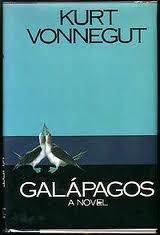
[READ: September 17, 2012] Galápagos
Each of these 1980’s era Vonnegut books gets darker than the last. In this one the entire human race is wiped out (except for a few people who spawn what eventually becomes of the human race in a million years). For indeed, this book is set one million years in the future and it is written by a person who was there, one million years in the past when the human race destroyed itself. It’s not till very late in the book that we learn who the narrator is and, hilariously, what his relationship is to the Vonnegut canon.
In typically Vonnegut fashion, the story is told in that spiral style in which he tells you a bit of something and then circles back to it again later and comes back again later until finally 200 or so pages into the book you get all the details of what is happening. Interspersed with the respawning f the human race (and flippers) is the story of the Adam and Eve and Eve and Eve and Eve and Eve who created the human race–how they got to be together, what their lives were like before and what contribution they made to humanity, such as it is now.
In another bizarre and fascinating twist, every character who is going to die in the near future gets a star next to his name so that the reader knows that that person is going to die. We get a lot of things like ★Andrew MacIntosh for many pages until the character finally dies. And pretty much everybody does die. Well, obviously if it is set a million years in the future, but aside from that part, only a few of the characters survive.
So here’s how these few people managed to create a new human race in the Galápagos Islands.
Back in 1985 , there was planned the “Nature Cruise of the Century” which was to take celebrities to the Galápagos Island to see all the beauty on the natural world. The list of celebrities is impressive–Mick Jagger, Jackie Onassis, etc. And this list was guaranteed to create more buzz. But before the celebrity list was announced, the first person to sign up for the cruise was ★Roy Hepburn. ★Roy Hepburn was the husband of Mary Hepburn, who proves to be one of the few survivors in the book.
★Roy Hepburn had a brain tumor, which caused him to leave his job and sign up for this crazy expensive cruise. His wife was a nature teacher in high school and Roy thought she would really love the cruise. But he died before the cruise could set sail and she was all set to cancel until his dying words were that she go on the cruise for them. So she did.
The other family on board is Hisako Hiroguchi, a teacher of ikebana, and ★Zenji Hiroguchi, the inventor of the voice translator Gokubi and its successor Mandarax. The Mandarax survives along with the few remaining people and provides comforting (or not) quotes to the passengers.
Another survivor is Adolf von Kleist, captain of Bahía de Darwin (the name of the boat offering the cruise). In typical fashion, this captain doesn’t know anything about piloting a ship, his job consisting mostly of greeting people and smiling. So when he finally does take the wheel, chaos ensues.
Amusingly I almost forgot the person who is really the main character, at least in the beginning. James Wait is a swindler. For his entire life (after being molested as a child) he swindled women out of money. He created a new identity every so often and made a fortune off of heartbroken women. He plays such a huge part of the story that it’s astonishing he doesn’t survive very far into it.
So what about everyone else? Well, there was a massive economic downturn just before everyone was set to arrive on the boat. So none of the celebrities–since they pay attention to this sort of thing–were going to travel to places hit most hard by the downturn, where riots and war were already breaking out. The downturn coincided with a global plague which made everyone on the mainland sterile. Thus the end of civilization.
And thus it is only the survivors who can procreate (one of them involuntarily). Hisako Hiroguchi was pregnant when on the ship and she gave birth to a baby with fur on her body. And she proves to be one of the mothers of the future race–which evolves to be excellent swimmers and catchers of fish and most importantly to have a far smaller brain.
As the narrator says, all of the troubles are caused by “the only true villain in my story: the oversized human brain.” Indeed, the narrator repeats over and over that the big human brain is the big enemy in the story, since it teaches us to lie and deceive and be bored and kill for sport (or to act like James Wait). The newly evolved species has a much smaller brain, and it suffers none of these problems. And the human race is much happier.
This book has a part two, unusual for Vonnegut books, which gives us a lot more detail about the narrator. It explains what the narrator is doing one million years in the future. And it gives his connection to the Vonnegut universe.
Strangely, despite all the detail that the story gives, it never tells us exactly what happened to humanity or to the current humanity to have turned them into what they are.
I didn’t love this story as much as some of the others. It was pretty exhausting and there was a ton of repetition. There were plenty of humorous parts and it had a lot of Vonnegut wit, but overall, this one ranks pretty low on my list of his books.

 I Just Read About That...
Leave a comment