 SOUNDTRACK: CIRCLE TAKES THE SQUARE Live at Black Cat Washington DC, August 31, 2011 (2011).
 I had never heard of Circle Takes the Square before seeing the link to this show on NPR (Thank you, Viking!). I like the band name (Hollywood Squares reference), and couldn’t imagine what they sounded like.
Song titles like “In the Nervous Light of Sunday” and “We’re Sustained by the Corpse of a Fallen Constellation” and even “Non-Objective Portrait of Karma” lead one in many possible directions. But it turns out that the band is sort of pigeonholed as screamo, a post-hardcore style that allows mostly for screamed vocals. And yet these guys also incorporate intricate playing, odd time signatures and some beautiful instrumental passages.
Even though the band plays fast, they don’t play only short songs. The shortest songs run about three minutes but they have two songs that are over 6 minutes, with several different sections.
I listened to this show a few times and I confess I never really got into it. I liked some of it but I was never fully able to grasp what was going on. It could have been the recording quality. Usually NPR shows are crystal clear, but this one was a bit muddy–which may have been intentional from the band as they are pretty raw sounding. I did like the split male/female vocals which added a cool depth to the songs. But mostly I was impressed by the kind and almost sweet attitude of the lead singer. He was polite and thankful to the audience (thanking them for braving the weather–the show was during Hurricane Irene–thanking them for coming from both far and near and talking about how excited he was about Pg. 99, the headliners. It’s funny to hear polite thankfulness and then screaming lyrics like: “Embrace the sweet sound of self-destruction.”
I’d like to hear a studio release before passing final judgment, because there was a lot to like here.
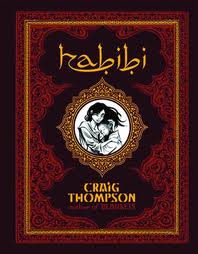
[READ: August 29, 2012] Habibi
I saw this book in a review by Zadie Smith in Harper’s a while back. I didn’t realize at the time that the author was the same person who did the wonderful Blankets.
This book is an amazing piece of art. And the story is very good too.
So this massive book (almost 700 pages) is the story of a woman born into a fictional Middle Eastern country called where the Qur’an is studied and women are more or less chattel. As the story opens Dodola is sold by her father to a wealthy man who becomes her husband. The scene of her deflowering, while not graphic at all, is very disturbing nonetheless. She is afraid of this man and cowers in the fear until they gradually start to see each other as human beings. And although their age difference is substantial (and yes, gross), she learns to appreciate him.
Until he his killed by the king’s men and Dodola is taken away to the king’s palace to be sold as a slave–her hair is tied to another girl’s hair so they cannot escape.
Through a series of events, she does escape, and when she is hiding out she manages to save the life of a black baby named Cham. She calls him Zam after the Well of Zamzam (Arabic: زمزم) in Mecca, the holiest place in Islam. And while she is only 12, she takes care of this 3-year-old boy and raises him as her own child.
Where? well, they find a boat in the desert (it is all explained) and they hide out from everyone in their shelter. They are able to steal food from caravans, but eventually Dodola is caught by the traders and is forced to trade herself for the wares. She is ashamed and doesn’t want Zam to know, but eventually he sees her. And he is ashamed for her and for himself that he can’t stop what happens.
Meanwhile, Zam is getting older. He is getting urges–and Dodola is the only woman around. He suppresses all of his feelings and grows more agitated. But he also wants to help, so he goes in search of water. And then he goes missing.
Dodola goes looking for him but she is captured and taken into the king’s harem. Zam, meanwhile, realizing that Dodola is gone goes to the city. He meets all kinds of people–most of whom are starving and trying to do anything to get money, including the eunuchs who dress as women and parade around. Zam is repulsed by them (as most people are) and tries to hide from them. Eventually, he is captured but is taken in as a king’s guard (he has grown very large). Years pass in this situation with each assuming the other is dead. Until they are reunited and must find a way to safety.
That story in itself is pretty complex, but throw in a huge amount of material from Islamic history as well as many quotes from the Qur’an and you’ve got an amazing epic story that ties in centuries of history including Moses, Solomon and the Virgin birth. I have never read anything in the Qur’an, so I’m incredibly ignorant. And I had no idea how many of the Qur’an stories are the same as the stories in the bible. Including the virgin birth. That is part of the point of the story–showing how the foundation of these religions are all the same. And it is quite enlightening.
As are all of the meanings and stories of the Arabic characters. For instance, the title of the book Habibi (حَبيبي) is an Arabic word whose literal meaning is my beloved. The story even shows how the word came to be (by adding lines to the original word–it’s very cool).
The only thing I don’t really cotton to is the numerology aspect of the book (which I assume is a truthful accounting of Islamic reading). Numerology is a fools game, easily read in a million different ways. But it works nicely in this story nevertheless, and it helps to pave the way for a lot of explanations and beliefs.
Now as for the art. Astonishing is barely adequate to express how beautiful this book is. Thompson draws beauty in everything–from the different characters, to the medical depictions to the background designs, to the natural world. Since this book is all about women and sexuality, there is a lot of nudity in the book. Zadie Smith found it a bit off-putting but I found it very effective. It really depicted the nakedness that women felt. There are no genitals in the book but there are a lot of breasts (for sexuality and nurturing). And they are depicted amazingly realistically. But so is the uterus when he displays Dodola’s pregnancy. And so is the rest of her body when he shows her strength and determination.
The crowds in the city are also wonderfully detailed–no inches of paper are spared. And again, the background designs are stunning. I can’t imagine how long it took him to make this book, nor the amount of reasearch that went into it.
The story is moving and beautiful as well. This is a staggering book, and I hope it has been justly rewarded.

 I Just Read About That...
[…] Craig Thompson–Habibi (2011) « I Just Read About That… […]