 I had hoped to read a lot of commentary and observations about JR this week as a nice finalization to the summer reading. But a couple of things happened. First, we went on vacation, so JR was the furthest thing from my mind. Second, I had a really hard time finding commentary.
I somehow missed the whole Goodreads discussion—which I read just the other day and enjoyed. And I also had a really hard time with the LARB tumblr account. I don’t know if this speaks to tech non-savvy, but man, that’s a hard thing to search. It took several tries before I noticed the teeny search window at the bottom, and when I finally got it to search what I wanted I found the results less than spectacular. So I was able to piece together most of Lee’s comments, which I rather liked, but I wish I had been able to read them as we went along (Googling #OccupGaddis only brought that initial tumblr page, which was very frustrating).
I also looked at a bunch of stuff over at williamgaddis.org, which is an amazing site full of really great research. The annotations are wonderful, although many spoilers lurk there so be warned. And if you haven’t visited the site proper, holy, is there a lot of great stuff. Like a complete cast of the book as well as notes and articles and even music from the book (complete with audio clips). There’s also some stories including a few from Gaddis himself—one of these is a “what happened to JR” twenty-five years later piece. Wonderful!
But so I didn’t get to do a ton of extracurricular reasearch this week. And as my memory of the book slips away, I’m going to write just a few final words.
Although JR is a dark book about a the sorry state of contemporary (circa 1970s) America, and although there’s not a lot of hope for redemoption—among the kids or the adults, I found the book to be very funny. I like a darkly comic novel and boy was this one. I also found the book to be immensely quotable.
The more I think about it the more apparent it is just how fully realized Gaddis made most of the characters just by their speaking voices—he is amazing at giving so many people little tics and phrases to keep them distinguishable. Had I realized it would be that obvious I would have tried to keep track of them from the start, as there were a few people who I never quite got down.
Indeed, the biggest problem I had was keeping some of the minor characters straight. There are many many characters who go by one name but are also referred to by another name by different people. In fact, I had a hard time keeping straight most of the Majors and Generals and authority figures—which probably says more about me than the book.
I’m impressed at the way the narrative was able to flow with all of the different parts coming together so fully by the end. True there were one or two things that seemed like maybe they could have been tied up a little better, but I can’t say I expected neat bows on this book.
The elephant in the room is of course the style of the book—almost exclusively unattributed dialogue. I admit that I once wrote a story with unattributed dialogue (I don’t think I was inspired by Gaddis). Anyhow, it was only 5 pages and two characters so it was pretty easy. But the amount of work that must have gone into keeping this straight must have been astonishing. I have to wonder if he wrote it with attribution first and then removed it all and cleaned it up to make it more obvious who was speaking. But more impressive than keeping all of that straight is the amount of information he is able to give out in this manner. It makes it so much harder to not have descriptives. Just think of how much easier it is to write “Major Hyde dropped the phone” than to think of convenient (or not) ways of saying that in dialogue. And then to have so much of the dialogue interrupted is pretty amazing (and of course far more difficult for the reader).
So, was there a point to writing like this? Is Gaddis simply immersing us in a world of nonstop chatter and too much information and double speak and cross talk, or is there something more? Why make us work so hard for the book. It’s hard to say who actually does work hard in the story. A lot of what happens seems to be accidental. Bast works hard for JR but he doesn’t work hard at all for himself. Gibbs is supremely smart but when he tries to sit down and work he gets nothing done. The folks over at Diamond Cable are knowledgeable but seem to have their secretaries or underlings do the hard work—which gets the underlings nothing, really). Even in the art world, Eigen’s play is stolen and produced under another’s name, Schepperman paints but doesn’t see anything for it and Zona just sits around and seems to get richer. And even Amy and Stella, they inherit their wealth and power. So, why make the audience work if nobody in the book does?
I suspect that hard work is its own reward, I certainly found it to be so. This was my favorite book of the year so far, and I know that it won’t be leaving my consciousness for a long time to come.
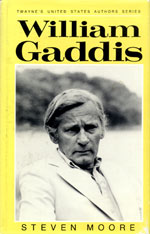
Incidentally, the book image I used for this post is a biography of William Gaddis by Steven Moore. The book is out of print by the entire book is reprinted here.

 I Just Read About That...
Leave a comment