 SOUNDTRACK: PINK FLOYD-Alan’s Psychedelic Christmas (1970).
 I’ve always loved Pink Floyd’s Atom Heart Mother. I have no recollection of how I stumbled upon this live bootleg, but when I saw that it contained one of the few live recordings of “Alan’s Psychedelic Breakfast” I had to give it a listen.
So this show is from 1970 and was recorded in Sheffield just before Christmas (Nick Mason evidently introduced the show while wearing a Santa Claus suit). The sound quality is pretty good given that it is 40 some years old. There’s a bunch of hiss, and the quieter talking bits are hard to understand, but the music sounds fine.
So the show opens with “Alan’s Psychedelic Breakfast” and what is so silly (and I assume funny to watch (a little less funny on bootleg) is that the band made and ate breakfast on stage. As Collectors Music reviews writes: “This is the only known live recording of ‘Alan’s Psychedelic Breakfast’ but also hosts an amazing performance by the band which included them making morning tea on stage which is audible. Just like most of their earlier performances, the performance of “Alan’s Psychedelic Breakfast” slightly differs from the album version due to some nice jamming done by the band, especially Gilmour with his delay pedal.” As I said, some of the audio is static and hard to make out in this song–the band is conversing during their tea, but who knows what they are saying. And who know what is o the radio.
Then the band gets down to business. One of things I love about this period Floyd which is so different from their later work is that the played really long spacey jams often with very few lyrics. So we get a 12-minute version of “The Embryo” (the only available studio version is a very short one on Works which is quite a shame as the song is really good). A 14-minute workout of “Fat Old Sun” which is usually only about 5 minutes.
There’s a great version of “Careful with that Axe Eugene” and “Set the Controls for the Heart of the Sun” (15 and 12 minutes respectively).
Then in a killer version of “Saucerful of Secrets,” just as they get to the end, there’s a power failure (at least according to the song title). The band is rocking out just hitting the climax when suddenly all you can hear are un-miked drums. Ha. After a couple of minutes, power comes back and they pick up from just before where they left off.
Then the band launches into a full 31-minute version of “Atom Heart Mother” complete with horns and choir of voices. It sounds quite good (the horns seem a little sketchy but that might be expected with such staccato music).
The set ends and the band needs an encore. Apparently they couldn’t remember anything else because they just re-do the last few minutes of “Atom Heart Mother” again.
One of the things that cracks me up about these shows in the 70s in England, is that the audience is so polite. Their applause sounds like a classical theater rather than a rock show. And with a bootleg you know they didn’t try to make the audience sound bigger than they are.
The whole package is a fun trip.
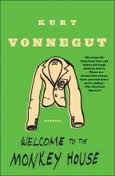
[READ: August 17, 2012] Welcome to the Monkey House
So this book is Vonnegut’s second collection of short stories. But there’s a twist. This collection contains all of the short stories from Canary in a Cat House except one. It also contains many of the stories he had written since then as well as stories not collected in Canary. So you get basically 18 years worth of stories here. And it’s interesting to see how much he has changed over those years (during which he wrote 5 novels, but not yet Slaughterhouse Five).
Since I read Canary a little while ago (see comments about the stories here), I knew that his 50’s era stories were influenced by WWII. So it’s interesting to see how his stories from the 690s are not. They deal more with day to day things and, of course, abstract concepts about humanity, although politics do enter the picture again once Kennedy is elected .
- Where I Live (1964)
This was a good story to open with because it shows the then-later-period Vonnegut’s mindset and location. This story is about Barnstable Village on Cape Cod (where I assume Vonnegut lived since there are a number of stories set on the Cape). This is a very casually written story about an encyclopedia salesman who goes to the local library and sees that their two encyclopedias are from 1910 and 1938. I enjoyed this line: “He said that many important things had happened since 1938, naming among others, penicillin and Hitler’s invasion of Poland.” He is told to talk to the library directors who are at the yacht club. I love the attitude that Vonnegut creates around the village which “has a policy of never accepting anything. As a happy consequence, it changes about as fast as the rules of chess.” For really, this story is about the Village more than the encyclopedia salesman, and it’s an interesting look at people who move into a new place and want it to never change.
- Harrison Bergeron (1961)
This story is set in 2081 where everyone is equal. They are kept equal through a series of handicaps imposed on them. So the intelligent hear a loud noise in their ear every minute or so to keep them from processing thoughts thoroughly and the athletic are given sandbags to wear all the time so that they don’t stand out and the beautiful are given ugly masks. And nobody can ever ever ever remove these handicaps without suffering severe penalty. This story is about the mother and father of one man who has broken free of these handicaps and the repercussions for doing so. It’s a really nasty attack on attitudes about imposed equality and its also a sad story.
- Who Am I This Time? (1961)
Although the previous story was a harangue against people being the same, this story is about people who don’t know who they are. Specifically, it is about Harry Nash, the town of North Crawford’s best actor. But he has absolutely no personality of his own. It’s only when given a script that he comes to life. And he is phenomenal on stage. For the town’s staging of A Streetcar Named Desire, Harry is cast as Marlon Brando but they need a Stella. A young woman who is in town temporarily working for the phone company is drafted to play Stella. We learn that she move locations every eight weeks when the phone company is done. She can’t act at all, until that is, Harry reacts to her–suddenly she is filled with life because of Harry’s acting. Vonnegut takes this to a logical extreme leading to a rather funny story.
- Welcome to the Monkey House (1968)
This story was outstanding. It involves another dystopian future where the population has gotten way too big. So the World Government has a two-pronged solution–Ethical Suicide Centers and Ethical Birth Control. The ethical suicide centers are locations where you go and relax with a beautiful woman and when you said so, she would inject you with a poison. The birth control was different. Rather than trying to make sex and procreation a moral issue, the government simply gave everyone a drug that numbed you from the waist down–sex became a non-issue. If you refused to take the drug (and became a nothinghead) you received a $10,000 fine and ten years in jail.
So this story is about one such nothinghead known as Billy the Poet. Billy the Poet went around raping the beautiful Hostesses at the Suicide Parlors (who were virgins of course). But the hostesses were tough–strong, muscular women who could take care of themselves, so one Hostess, Nancy can’t imagine how the women let the rapist do this to them. Of course Billy eventually meets Nancy and the story turns out to be not what it seems. It’s a great look at so many issues–propaganda especially, but also fear of pleasure and individuality.
- Long Walk to Forever (1960)
In the Preface, Vonnegut says he wrote this story and it was published in “The Ladies Home Journal, God help us.” He thinks he titled it “Hell to Get Along With” and they retitled it. It proves to be a very romantic story (he calls it “a sickeningly slick love story”) which describes an afternoon he “spent with his wife-to-be.” If it is actually true, Kurt was a romantic little cad. It’s a charming story.
- The Foster Portfolio (1951)
see Canary in a Cat House review
- Miss Temptation (1956)
This was a strange story in which a small town must endure the annual visit of an actress. She makes herself beautiful and struts down to the newsstand for her New York papers every day wearing bells on her ankles and hoops in her ears. One day a solider back from the Korean War returns to this small town and he is angered by this woman who makes him… feel. He publicly humiliates her. And then he learns that she is human underneath it all. This story felt like it had a point more than a purpose.
- All the King’s Horses (1953)
see Canary in a Cat House review
- Tom Edison’s Shaggy Dog (1953)
see Canary in a Cat House review
- New Dictionary (1967)
This is another not-quite short story. It is kind of an essay although it might be fiction. In this piece the narrator discusses the nature of dictionaries (a sort of prototype to David Foster Wallace’s “Tense Present”). The narrator states that Mario Pei reviewed the third edition of the Merriam Webster Dictionary and declared that it had residual prudishness for excluding certain four letter words. The narrator says he never would have looked in unabridged dictionaries if he hadn’t thought there might be dirty words in them. I liked this line: “one dictionary is as good as another for most people, who use them for spellers and bet-settlers and accessories to crossword puzzles and Scrabble games. But some people use the for more than that” (119). And of course the debate comes down to prescriptive or descriptive. To discover which type of dictionary you have look up ain’t and like. Funny example s (which I assume are true) follow.
- Next Door (1955)
This story is about an old house divided into two dwellings with very thin walls and how the residents do their best not to hear each other. This night is the first night that young Paul is going to be allowed to stay by himself while his parents go to the movies (he’s 13). When they leave, Paul can hear the next door neighbors arguing. They get louder and louder, turning up the radio to drown themselves out. Then Paul gets the idea to use the show’s all-request format to speak to the fighting couple (the marvel at the technology involved is adorable). The result is completely unexpected and very funny.
- More Stately Mansions (1951)
see Canary in a Cat House review
- The Hyannis Port Story (1963)
This is another story set on Cape Cod and is written about John F Kennedy and his next door neighbor, who is a huge Barry Goldwater fan. This man hated Kennedy so much that he had a huge poster of Goldwater’s face put in his window (which faced the Kennedy compound) and which had lights directed on it all night long. The story is mostly about the neighbor and his attitudes about Kennedy and his family and his flotilla in the bay (the Coast Guard is there as Kennedy’s personal fleet, etc). Eventually a Romeo and Juliet type story develops between the neighbor’s son and a Kennedy cousin and it changes everything.
The narrator of the story is a storm window installer, who will appear in another story as well. His telling of the story brings an interesting everyman angle to it, especially when he can’t get to his storm window installation job (at the neighbor;’s house) because Kennedy is in town and Secret Service are everywhere.
- D.P. (1953)
see Canary in a Cat House review
- Report on the Barnhouse Effect (1950)
see Canary in a Cat House review
- The Euphio Question (1951)
see Canary in a Cat House review
- Go Back to Your Precious Wife and Son (1962)
And this is the other story in which the storm window installer shows up. The installer is putting windows and a bathroom fixture in the house of Gloria Hilton, the famous actress. When he arrives, Gloria and her third husband (the writer) are fighting and she eventually shouts the title at him. Turns out this is her she is his second wife–and he just up and left them for her one day. The narrator winds up talking to him about his ex-wife and son and encourages him to try to make up with them (his son refuses to speak to him and he’s only 12). It’s a surprisingly human story given the outlandish of some of the elements. Like when the narrator and the writer get drunk together and start talking about their wives–when the narrator gets home he says things to his wife that maybe he oughtn’t have. There are a a lot of funny moments in the story, though, and I rather like this narrator.
- Deer in the Works (1955)
see Canary in a Cat House review
- The Lie (1962)
The lie is a big one. All of the boys in the Remenzel family has always gone to the Whitehill School for Boys–generations of them have gone and they have donated alot of money. So what happens when one son isn’t accepted? The story gets (intentionally) very awkward at the end. It’s a very good one.
- Unready to Wear (1953)
see Canary in a Cat House review
- The Kid Nobody Could Handle (1955)
This is a surprisingly down to earth story (although I see it was written in the 50s when Vonnegut was less speculative about his fiction). It’s basically about a kid no one could handle. A tough guy with polished leather boots who defaces school property. And how a music teacher is able to reach him. It was a little obvious, and a little less than fully believable.
- The Manned Missiles (1958)
see Canary in a Cat House review
- EPICAC (1950)
I loved this story. EPICAC is a computer–the largest one in the world. It was created to destroy the enemy–to learn every detail and to use it to its advantage in getting them. One of the men who is charge of its maintenance develops a friendship with this machine (he feeds in queries and EPICAC spits out answers). So the machine helps him to woo his co-worker who thinks he is unromantic. But then EPICAC gets jealous. It’s funny and kind of poignant.
- Adam (1954)
This is a story about the beauty of giving birth. At least for those who are aware of how precious life is. It’s a little maudlin, but it’s very well constructed.
- Tomorrow and Tomorrow and Tomorrow (1953)
see Canary in a Cat House review
As I learned from these two collections, Vonnegut’s 50s stories were quite different from his 60’s His 50s stories were more serious, more straightforward. By the 60s he was able to inject more of the absurd or outrage into his stories and yet still have a serious point (sometimes a more serious point). Both types of stories work well, but I’m, not entirely sure they should all be collected like this. Nothing wrong with variety, but they’re really different.
Incidentally, the one story from Canary that was not included here was “Hal Irwin’s Magic Lamp.” I’m not sure why it wasn’t included, but it was rewritten and included in Bogombo Snuff Box.

 I Just Read About That...
Leave a comment