 SOUNDTRACK: THE FLAMING LIPS-Due to High Expectations…The Flaming Lips are Providing Needles for Your Balloons EP (1994).
 This EP came after the success of Transmissions from the Satellite Heart and the single “She Don’t Use Jelly.” Naturally that is not the single here, rather it is “Bad Days,” a new song tha sounds of the period. As does “Jets Part 2 (My Two Days As An Ambulance Driver)” a fuzzed out trip.
“Ice Drummer” is a primarily acoustic but still distorted song. It’s kind of boppy and light which is odd since it is a cover of a Suicide song. “Put the Waterbug in the Policeman’s Ear’ is a demo with strings and piano. It also has a very lengthy introduction in which Wayne explains his brother’s proclivity for drugs and his belief that he can control bugs (and have them attack the policeman who is trying to arrest him). It was recorded on a boombox.
“Chewin’ the Apple of Yer Eye” is a live version recorded at a record studio. It has nice guitars with scritchy violins. “Chosen One” is a cover of a Bill Callahan song at the same venue. There’s a lengthy introduction explaining that it’s a cover and why he likes it so much. It’s a nice version, very stripped down. “Little Drummer Boy” is a travesty, but a good one (and is 1,000 times better than their version of “White Christmas.)”
“Slow-Nerve-Action” is a live version apparently broadcast on a Top 40 radio station. The squall of noise as the song opens would frighten off anyone listening to Top 40, but the middle of the song’s acoustic section is rather pleasant (if not a little scratchy and staticky). Although this EP racks in at 44 minutes long, it’s really not that essential (although the live versions are nice).
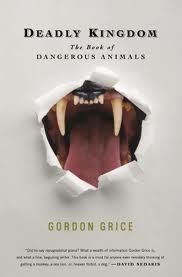
[READ: May-July 2012] Deadly Kingdom
If you have any kind of animal phobias–literally any kind: snakes, sharks, spider, rodents, bugs, stay away from this book. Indeed, even if you don’t have this kind of phobia, you may after reading this book. As the title says, this book tells you every single conceivable way that an animal can kill you–from biting to clawing to stomping to crushing to infections to diseases to parasites to long lingering diseases to numbness to elephantiasis (and that’s just chapter 1). Somehow the author is not afraid of everything that moves, and is even a collector (with his wee son) of all manner of unusual creepy crawlies–tarantulas, hissing cockroaches and the like.
Sarah bought me this book for my birthday because David Sedaris recommended it when we saw him speak. When Sedaris read from it, it was funny but dark. Sedaris’ comment that “Monkeys are such assholes “was certainly borne out by the book. Sedaris’ other comment–if you ever feel bad about eating meat, just read this book–is also completely accurate. Even cows can be assholes. This book is hard to digest in large doses. I found that I had to put the book down after a section or two because there’s only so much you-will-die-if-you-do-this reading that I could take.
Grice has done a ton of research–he has looked into all manner of medical and death records and talked to lots of scientists around the world. And he breaks the book into five major categories: The Carnivorids, Aquatic Dangers, The Reptiles and Birds, The Arthropods and Worms and Other Mammals. The introduction more or less explains his origin story for being interested in deadly animals–a cougar was on his Oklahoma panhandle property when he was six years old. His grandfather dispatched it, but he had to stay safely in the car during the ordeal. And he has been curious ever since.
The introduction also contextualizes the violence that animals do to humans. Is it all defensive (as we take over more and more land, it’s hard to know exactly what is defensive) or is it straight out aggressive. But he says the hardest part about this kind of descriptor is that “besides our usual biased views of all the parties involved, is that violence rouses strong emotions. We are almost forced to take sides with the injured humans or the slandered animals…. Many writers depict virtually all animal attacks as “provoked” by the victim. On the other side, some writers are at pains to paint dangerous animals as monsters of cruelty. All of these views are simplistic.” (xxiii).
But reducing things to any level is simplistic–saying that animals are predictable–studying a few tells you about all of them–is just wrong. Animals differ because of their environment and individual circumstances–dominance hierarchies, babies, food shortages, habitat.
So on to some things about different species: Wolves Dogs and Their Kin. Dogs can feel very threatened by children since children stare at them (an aggressive behavior for dogs) and are at eye level–this is why so many children are bitten on the face. And animals like coyotes have become accustomed to people which makes them even more dangerous–evidently the solution to coyotes in suburban and urban areas is shooting at them and missing often–killing a few with guns would teach them to be afraid of the us, showing them that humans are dangerous. The survivors would pass this knowledge into their clans. And they would learn over time to fear us.
And holy shit lets not even get into rabies–swallowing anything makes your throat spasm.
The Bears includes the scariest photo of a panda I have ever seen. Black bears are not predatory by nature (I read something in Mental Floss around the same time to know how to deal with bears: if it’s black fight back, if it’s brown lay down. You can frighten away a black bear if you are big and loud…not so much a brown bear). This of course doesn’t mean that a black bear won’t attack under certain circumstances. So best advice is to stay away. Or at the very least don’t do this:
Bill Bryson tells of a toddler whose mother smeared his hand with honey so she could shoot video of him playing with a black bear. It ate his hand (20).
The brown bear, on the other, hand is just a killer. (The five-inch claws of the brown bear can dismantle the human body). A brown bear can crush a moose’s skull. A brown bear can fit a human head int its mouth–in one instance it did just that but scalped the man–leaving him alive ! Oh and just forget polar bears–cute as hey are, they treat humans as prey without question. Other dangerous bears that we don’t have in the States are the sun bear and the honey bear. They’re both small, but they each have 3 inch claws (for digging up bugs) and they will certainly use them on people.
The Cats are listed simply as “the purest mammalian carnivore.” Lions will prey on humans (as in the example of lions snacking on people on a railroad site in Kenya where workers slept in tents and were easy pickings). And tigers are worse. In an ESL class, Grice asked a Vietnamese man if he knew anyone killed by a tiger, the man’s reaction was surprise that someone might not know anyone killed by a tiger. Tigers can reach 11 feet and 600 pounds. The Champawat tigress killed 200 people in Nepal and then 236 more in India. Grice recounts the story of the hunter who killed the tiger (while it was carrying its last victim’s body). And just go down the line of killer cats–leopards, lynx, hyenas (who get their own chapter they are so ferocious). The book is also filled with pictures with captions like: “A Cougar begins by opening the belly”.
Grice even has things to say about ferrets and skunks which can bite and scratch. Most of these are only dangerous in captivity–badgers, raccoons, meerkat (who keeps these as pets?) mostly attack when handled. There are also some mammals in the seas. We may not encounter them as often, but they will still see us as prey–leopard seals and walruses evolved from land carnivores and are still predatory. But most often, the animals think of boats as predators regardless of the boat’s intention.
More aquatic dangers means a section of a book that Sarah is not even allowed to glimpse (her shark fear is intense). And since he calls the shark “the idea of predation in concentrated form” she’s not wrong. Details of this section are as numerous as the pieces that are left after an attack.
Move on to the Bony Fish –barracuda, piranha, grouper, eels–none of these prey on humans, but they cause us trouble, mostly from collision. A sturgeon really hurts if it jumps out of the water and hits you–and just imagine what a swordfish might do. And there are also thousands of fish that have toxins–stinging catfish or scorpion- and lion- fish And some like the Stargazer (pictured in the book which is very creepy) camouflage in sand and wait for you to step on them. Oh and the electric eel can pack 600 volts which can knock you unconscious.
The Whales are actually kin to the hippopotamus, but evolved in the water to become huge! Toothed whales are active predators (the sperm whale is the largest predator on earth). Meanwhile the orca is the most formidable predator on earth (they are big and they work together to get prey). They are also very smart.
More aquatic dangers include the hagfish (the most repulsive of all animals–it scavenges anything on the ocean floor and devours the inside of the creature. They can devastate a fishing crew’s catch (but can also be sold in Asians markets). There’s also anemones and sea slugs (nudibranch) which lick the flesh from their prey with a toothed tongue. Some eat poisonous sponges and then become poisonous themselves. And of course, crabs will certainly do some damage.
And the cephalopods–squid, cuttlefish and octopus aren’t predators of humans (even if the giant squid reaches 43 feet and 600 pounds, they dwell so deep that they rarely attack people). Octopus can change color as a form of threat. But most people think this looks cool so they pick them up (little octopus of course). So the octopus bite–which doesn’t hurt–but there is venom in there which will get you later–paralysis with the ability to see and hear everything. Even adorable star fish–some have venom. And in and out of the water–the snapping turtle can bite your finger off. And then there’s the jellyfish. Some jellyfish can have a bell of 7 feet and tentacles 120 feet long. They all have nematocysts that are like projectiles that explode when touched. True, most jellyfish pose little or no threat but there are some which are deadly.
Ah the Snakes, Sarah hates snakes as much as sharks. And she has much more chance of encountering snakes than sharks. The most fascinating thing to me about this chapter was that even venomous snakes don’t always inject venom when they bite. Venom is a lot of work to make so they don’t just waste it–many first bites will be a warning, As with many things, the best way to get bitten is to hold them–be an owner of a herpetologist . Or live in India where cobras kill up to 20,000 people a year. And don’t forget those with 11 foot constrictors who get crushed by these pets.
When I finished the book, Sarah asked me what I was no most afraid of and I think the answer goes to Crocodiles which are faster, scarier and much more deadly than I knew. There are differences between alligators and crocs, but they’re both still scary. Alligators judge their prey by height. A 6 foot person is too big but, a 6 foot person bending over is just right. I liked that Grice suggests that the things that make a crocodile most dangerous are machismo and alcohol. Crocodiles are intelligent and can learn people’s habits. They can ambush people. Also, a crocodile bite has the power of 1000kg which if used in another way could lift a small truck.
As with most things, Australia is the most dangerous place for crocodile attacks. But there are other lizards that prey on people. I found an error in the book in the lizards chapter. And it’s not just a typo. “In 2003, Police in Newark, Delaware, called at the apartment of a forty-two-year-old man to make sure he was alright…. The officers knew that calls like this can lead to grisly discoveries but they couldn’t possibly have been prepared for what they found: seven lizards feeding on the man’s corpse.” They were Nile monitor lizards. An autopsy couldn’t determine if they killed the man of just ate him after he died from something else. So what’s the error? Well, three paragraphs later he writes, “the Nile monitor–the species that may have killed the man in New Jersey” Aha! An easy error to make confusing Newark, Delaware with Newark, New Jersey. Trouble is we’ll never know which state it really was in (without some research of our own).
There is venom in three families of lizards, but the only one dangerous to humans in the beaded lizard (the Gila monster and the Mexican beaded lizard. Most often they attack because they are out scavenging at night and people sleeping outdoors roll on them in their sleep.
The birds are mostly attacking people out of defense of their homes, but owls can snatch up small dogs. The most interesting thing about the birds is the cool technique of mobbing–where birds work together to remove a predator. And if a bird is dive bombing you, you’re probably near a nest, so back away. And lets not forget the flightless birds–emus, rheas and ostriches–they bite your arm and then twist their heads–rug burn! Even people who raise these large birds are susceptible, one of the ostrich farms Grice visited uses a supersoaker with soapy water to distract the birds when they inevitably come to bite them. But if you try to take ostrich eggs, you need to use more than that. “When I grand-slammed one [with a six-foot pole], he would shake his head exactly the way characters in Warner Bros. cartoons do when they get smacked. Then he’d keep coming” (155). Oh an emu can kick and open a human from pelvis to throat. And we all know that swans can be nasty little bastards.
By now you’re exhausted from the killing. But the animals keep getting smaller and many get more deadly.
Like spiders. There are some that are very deadly and some that are not so small (a huntsman spider has a 12 inch leg span). Although only a handful of the 40,000 species of spiders can actually hurt people, some give painful but harmless bites (the black and yellow garden spider of the US). Although much of the spider chapter is a retelling of his attempt to catch a black widow (on purpose!). Grice also has a scorpion for a pet. And here’s a scorpion tip–scorpions with big claws use them, those with small claws use their poisonous stinger. Most scorpions attack when they feel threteaned–like when they are hanging out in your shoes and you put them on.
Other arachnids are mites and ticks (and now they book starts giving me the heebie jeebies). Grice relates the story of his baby boy popping a millipede into his mouth. Then grimacing and spitting it out. They have a “repugnatory gland” to prevent being eaten. It’s a mild venom that doesn’t really hurt people. Unlike centipedes which are uglier and meaner.
Moving on to insects–grasshoppers don’t hurt unless they swarm. An estimate counted approximately 15 billion in one swarm. And a swarm will eat anything and everything in its path. Cockroaches (the hissing cockroach is apparently a very nice and clean pet by the way) carry all sorts of things on their feet. But they also communicate by scent–the dust they leave is what creates many allergens. We also get the definition of a bug– a bug is a group of insects that possess certain “specialized sucking mouthparts” (like stink bugs). Most are harmless, but there are some with venom (like giant water bugs).
For beetles, there are some surprises. Like that the imported Asian ladybugs we find in out houses (proper ladybugs prefer to nest in trees) will occasionally bite if handled–and will almost always leave a stink on a handler. Ugh and don’t get me started on flies which are more deadly than one can imagine. The rest of the chapter devolves into more repulsive categories-maggots, fleas, lice and things that invade human bodies . He even tries to disabuse people of the belief that butterflies are beautiful, by giving you details about their life cycle and habits.
He also talks about stinging insects–he was stung many times by ants and bees as a curious kid. But some ants bring a collective of friends around an attack all at once–to get mass stinging before the prey can escape!
He even delves into worms. Tapeworms have no anus (which is why the get so big in your stomach). Some worms have venom but many other worms resort to parasitism (like leeches). Then he talks about worms that invade the body and many who take up residence and just hang out. (One story about a worm in a woman’s foot will have you retching).
By the time you reach other mammals, it nice to have at least familiar animals again. The story of elk and buffalo protecting their turf is pretty intense (the buffalo that invaded a house is pretty amazing). Oh and sheep? Not passive and stupid at all (a ram being fattened up for sacrifice butted its owner off a rooftop pen ). Even horses can be nasty bastards (my neighbor’s miniature pony but me on the knee which left a bruise for two weeks). And how’s this for a photo caption: “Domestic pigs occasionally eat their keepers”. And what about hippopotamus? They are territorial about their water holes and will charge (and trample) if you get between it and the water. They weigh 10,000s pound and have 20 inch tusks.
Elephants can stomp on you and use their trunks for hurling projectiles. Grice has a story of a crocodile biting an elephant’s trunk and the elephant squashing it like a bug. Elephants are smart and don’t like their home grounds messed with.
Rodents. Gruce has a thoroughly disgusting story about a pie that his wife made and what he realizes after he ate it. And a really gross story about mice invading an abandoned feed storage place (where he once lived). Of course, rats’ teeth will keep growing which is why they have to gnaw on everything. And there’ an interesting story about rats and plague (the brown rats pushed out the black rats that carried the plague–brown rats actually saved humanity, until they contracted the plague and began spreading it hundreds of years later.
I also learned a lot a bout leprosy in this book. Lepers are often victims of rat biting. Leprosy does not cause your extremities to fall off, it just numbs them–which is why rats can nibble them. Squirrel and Porcupines are also rodents. Porcupines can’t throw their quills, but they can back up rapidly and force them into you.
Grice even ruins my beloved bats. Bats don’t really attack people, but their droppings can grow a fungus that is an airborne toxin (mostly found in caves, phew). But bats have their own diseases and can infect animals. Vampire bats mostly eat animal blood (but can eat from people). They don’t suck the blood, they cut open a vein and drink the blood (don’t you feel better knowing that).
The penultimate chapter is about minor mammal dangers–rabbits can bite fingertips, playtpus have spurs on the hind legs (which have a small venom), kangaroos can kick the hell out of you. And armadillos can transmit leprosy. And some shrews have venomous saliva.
The final chapter is about apes. There’s a fascinating introduction to the chapter which says that many apes and gorillas held in captivity for scientific testing have been injected with transmittable diseases, like AIDS. Even if they are “cured” they are not permitted to leave. In the Republic of Georgia one such facility was broken during civil unrest and escaped monkeys (some injected with AIDS) fled. Some may have been captured and sent to zoos or elsewhere), but many roam free. Incidentally, there have always been jokes about how people may have contacted AIDS from monkeys and of course, lots of monkey-on-man sex jokes. Turns out that people ate the infected monkeys, and that’s how the virus was spread.
Monkeys in the wild aren’t too dangerous except where they are accustomed to people (and in India where it is a crime to hurt them). There’s a fascinating piece about the septic bites of monkeys and how Alexander, the king of the Hellenes at the end of World War I died from a septic monkey bite. His death caused foreign powers to shift their alliances in the Greco-Turkish war. So yes, a monkey altered the course of history. Winston Churchill said “It is perhaps no exaggeration to remark that a quarter of a million people died from this monkey bite” (283).
And people who own monkeys at pets seem to inevitably get bitten–often in the face. An angry chimp looks like a little kid but it is much stronger and much more ferocious.
The only comforting thing in this section is that gorillas don’t often attack. They are usually bluffing. They’ll charge you but will often pull up short. Which is just as well as they are often 600 pounds. That’s not to say that gorillas won’t attack though, especially in zoos. Like when the (asshole) teenagers threw rocks at the gorilla and he leaped the 12-foot moat and 14 foot wall topped with electric wire–in one bound, and went on a rampage throughout the zoo.
Evidently, the orangutan is the least violent of all the apes. Just so you know.
The books ends with the standard notation that no animal is more deadly that people, but that’s mostly because of the quality of our weapons. Grice goes in a different direction with this though showing that humans really aren’t that special–not even on the evolutionary chart. Indeed, of the group that we most resemble (chimps, orang and gorillas), the orangutan diverged first, then gorillas. We’re first cousins to chimpanzees.
This books was fascinating, informative and mind numbing. I enjoyed it quite a lot–in the way one might enjoy having a horror movie in one’s head. The only thing I would have liked would have been a compendium or a map at the end that showed where most of these deadly animals live. Those of us in the North Eastern United States are pretty lucky in terms of predators (we just have the human kind to worry about).
Read at your own risk!

 I Just Read About That...
Leave a comment