 SOUNDTRACK: METRIC-Live It Out (2005).
 I enjoyed Metric’s Fantasies album so much that I bought their previous album (an album that I had written down as worth checking out about 5 years ago). At first I was a little disappointed–the album doesn’t have the glow (or perhaps sheen or polish) of Fantasies. Normally I prefer raw to polished, but it’s surprising to go the other way sometimes. And after a couple more listens I really started to appreciate this album’s rawness.
The guitars are loud and pushy. There are keyboards that dominate some songs, but they never make the songs poppy. And Emily Haines’ voice sounds great. The opener “Empty” has a lot of quiet sections, but the guitars really just burst forth. It’s 6 minutes long but that’s mostly through a long intro and outro. The rest of the songs stick firmly in the 3-4 minute range. “Glass Ceiling” has a cool stuttering riff and a kind of awkward bridge–these first two songs kind of resist admittance (the piano/guitar solo is certainly a weird combination–which I like now of course). “Handshakes” shows their more commercial side–a slick kind of guitar riff with Haines’ more aggressive vocals. True the siren sound may turn off some, but it’s certainly a signature. “Too Little Too Late” is a slow sultry number, but even more sultry is the sleazy-feeling (no doubt because of the keyboards) “Poster of a Girl.” In addition to a cool spoken word section in French (the whole song is bilingual), we get the English lines “Coming in your pants/For the off chance/With a…poster of a girl.”
“Monster Hospital” is a fun punk blast that is still a live favorite for the band. “Patriarch on a Vespa” has another rough riff with some cool bass. It also features some disconcerting singing (ahahs that sound more than a little spooky). “The Police and the Private” is one of the cool songs with easily singable but easily confusable lyrics. While “Ending Start” has some great guitar riffs near the end. “Live It Out” ends the disc with a staccato punk number. It’s a perfect summation of Metric before they got more commercial. And it’s a great addition for fans of the band.
[READ: July 8, 2012] The Big Meal
This play came as a supplement with Lucky Peach issue #4.
I have often maintained that it is much better to see a play than to read one. Not a daring opinion, by any stretch. I have taken that to something of an extreme however, which means that I pretty much never read plays. This has severely limited by Shakespeare intact, naturally. It also means that a lot of great works are lost to me.
I’m using that information by way of introduction, not because I think this play compares to Shakespeare, but because this is one of a few plays that I have read recently that I’ve really enjoyed. So I’m retracting some of my earlier thoughts about reading plays. True, some plays with multiple characters can be confusing to keep straight (since defining characteristics are not given). But in shorter plays or plays with not too many characters, it’s not so hard to read them. And in fact, it can be a quick and enjoyable read.
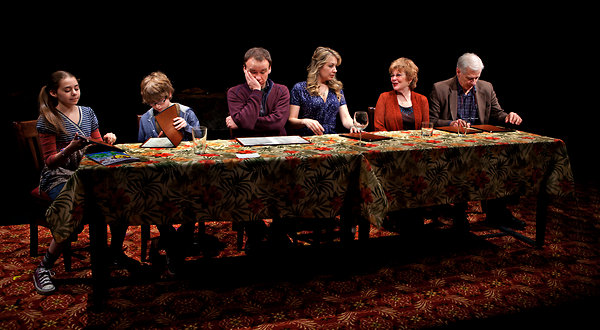
Although this play complicates things immensely because of its (very cool) setup. The setup is described in the introduction to the play: “The actors play multiple generations of one family…as they glide through time. As the characters age, their “essences” pass from younger to older actors.” So, the story takes places over a few generations of time. There are eight actors. Each actor plays multiple roles. These roles correspond to the characters at certain ages. So, for example, the youngest actor plays Character A as a child; the adolescent actor plays Character A as an older child; the middle-aged actor plays Character A as a middle-aged person, etc. So that’s a little confusing (although I’ll bet it makes sense seeing it live). What I like though is that this “gimmick” is not so much a gimmick at all, but a real indication of how we turn into our parents and an indication of how quickly time passes in this play.
The cast is listed in the dramatis personae as Older Woman, Older Man, Woman, Man, Young Woman, Young Man, Girl, Boy. Those are the actors. But the characters are listed below the; from that we glean a kind of tree (which was kind of hard to make in WordPress, so be kind).
………..ALICE—&—ROBERT
………………..\……./
………………….SAM——–&—–NICOLE ?—&—– JACK
…………………………..\…………../…………………………………..\…………../
….? ———–&———-MADDIE…………………………………….\…………/
………………..|…………..ROBBIE—————&—————–STEPHANIE
………………..|……………………………………….|
…………..SAMMY JACKIE
There are also several suitors for Robbie and Maddie (when they are young): Jessica and Steven, Marcus, Jeremy, Patrick, Michael
What adds to the confusion in reading it is that the story is printed vertically–turn the book lengthwise and there are eight lines of text from top to bottom (I wonder how it was handled professionally). Many of the characters don’t speak at any one time, so there will be maybe only two or three characters with lines at any given moment. But sometimes there are as many as all eight characters interrupting each other at the same time. It’s confusing but not impossible to read or even to keep straight (although there are moments when it’s hard to parse out the order of the dialogue).
The other confusing (but not really) thing is that there are what LeFranc describes as invisible shifts in the play. It says SHIFT in the stage directions and that indicates that a new time period has begun. But the actors aren’t meant to react any differently, they just inhabit the new character and switch roles. It must be challenging, but probably fun. He says it’s okay if the audience is a little behind the action.
As for the story itself, there’s not much in the way of plot–there’s basically the one family who we see growing from the main couple’s (Sam & Nicole) first meeting (he picks her up in a restaurant) until their grand kids (Sammy & Jackie) are born. We meet his parents (Alice & Robert). We met their kids (Maddie & Robbie) (and the people those kids date and bring home to meet the folks–see list above), we see how family jokes remain constant throughout the years and how certain characteristics are passed on–or not. And we also see some characters die. Which is quite surprising in what is largely a comedy.
Given this plot the title can be a little confusing. The whole story is set at mealtime, in a restaurant, with the characters coming to the table as they have dialogue (and just sort of hanging back when they don’t). Obviously it’s not the same meal, but there are times when certain characters do spend time eating alone.
The story is filled with little dramas (and major embarrassments) and it comes off as an interesting slice of life that just about anyone can relate to in some way.
It would certainly be fun to see it. And here’s a photo of it staged

 I Just Read About That...
Leave a comment