 SOUNDTRACK: SIX ORGANS OF ADMITTANCE-“Even If You Knew” (2012).
L ars from NPR’s All Things Considered picked this as his summer music preview song. I don’t know a thing about Six Organs of Admittance, but their discussion of this song makes it seem like this is atypical for the band (which has a massive output). Evidently they’re usually more droney sounding. But man, this song is pummeling and wonderful.
It’s seven minutes long and opens with a simple, plodding heavy bass riff. The vocals are kind of whispered and strained. But then comes the guitar solo–a raging piece of distortion that complements the bass. And that’s just the first three minutes.
The second half of the song features a quieter section–the bass is quieter, while the guitar noodles around and the vocals play over the rhythm. The song slowly builds again, and by the last minute or so there’s another fierce guitar solo. Until the song is exhausted by the final distorted notes.
This is some beautiful noise. And, no I have no idea what the band’s name means.
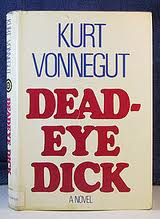
[READ: June 27, 2012] Deadeye Dick
Deadeye Dick is the last Vonnegut book that I was completely unfamiliar with. I had no idea what it would be about. So I didn’t realize until very late in the book, and then I looked online and confirmed that this book is set in the same location as Breakfast of Champions, Midland City, Ohio. Indeed, some of the same characters appear in this book as appeared in that book. But more about that later.
Vonnegut is not known for his happy books. Misanthropy is pretty rampant in his pages. But this book is one of his bleakest books yet. The story concerns the Waltz family–Rudy (the protagonist) and his brother Felix are the only children of Otto and Emma Waltz. Pretty early in the story we learn that Rudy is a double murderer. Yipes!
As with most Vonnegut stories, this one is told in a convoluted and non-linear fashion. He foreshadows (and really just casually mentions) a lot of crazy things that are going to happen in the book. Like the fact that Midland City is going to be devastated by a neutron bomb. In fact, his preface (like with many of his prefaces) tells us a lot about what’s in the book and who the characters are based on and the fact that there is a neutron bomb (but the reality of a neutron bomb is different from what he says). There is something about knowing this information ahead of time that impacts the way you read the story. Whether you think maybe he’s not telling the truth about what will happen (can the narrator really be a double murderer?) or maybe somehow the foreshadowing makes it even worse when it actually happens–the revelations are perhaps more deliberate. But the style–a recursive style in which he says what happens and then he goes back and fills in the details, makes the events that much more powerful.
The funny thing about this story is that a lot happens to the characters in the beginning of the story and then not too much happens to them after that. But that early stuff is pretty exciting and it has an impact all the way through.
Perhaps the most interesting conceit that Vonnegut throws in here is that Otto Waltz was friends with Adolf Hitler when Hitler was a young painter. Otto was a something of a ne’er-do-well but his parents wanted him to be an artist. So they built him a studio and paid for lessons. Then they shipped him off to Vienna to study art for real. But he was a terrible painter. And he basically spent all of his money on drinks and whores. When he finally went to get his painting professionally assessed, he was told that he stunk.  The applicant next to him was Hitler, a poor, struggling young painter. Hitler was also told that his painting sucked. Otto was so annoyed by the master that he bought Hitler’s painting right there for a ton of money (Otto’s family was very wealthy). Rudy points out that it’s very possible that if his father didn’t do that, Hitler may not have become, you know, Hitler. In case you didn’t know, Hitler was indeed a painter and the painting over to the right is one of his. It’s called The Minorite Church of Vienna and it’s actually pretty good.
When Otto is sent back to Ohio, he keeps in touch with Hitler and when Hitler rises to power (but before he became, you know, Hitler), he sent Otto a Nazi flag which Otto proudly waved and showed off to everyone. Of course, once Hitler became, you know, Hitler, Otto was terribly ashamed and the family was mocked behind their backs. But Otto always aspired to being more important than he was. He dressed in outlandish garb and spoke highfalutin language (even though he was not really educated and in one classic examples gets his metaphors mixed up). When Rudy’s crisis happens (see below), Otto takes the spotlight himself in a weirdly selfish selflessness.
He also spent a ton of money to have their house turned into a preposterous hexagon. The Waltz family also had black servants who more or less raised Rudy and Felix. Vonnegut has to be one of the most strong advocates of racial harmony that I know of. I mean, maybe by the mid 80s, this attitude wasn’t quite so radial, but he has always strongly stood for black people, often stating (by various characters) that they are better human beings than rich white folks.
Otto taught Rudy and Felix how to use guns. One of Otto’s expensive habits was collecting old armaments–they had a gun room at the top of their house. Felix and Rudy were excellent shots. And one day when Rudy was 12 he was given the key to the gun room. On that momentous day, Rudy went in, carefully polished his gun and then committed murder. Accidentally. The details are pretty surprising and unbearably horrifying, and Vonnegut really never lets you forget what happened. But as with any good social critic, Vonnegut also hates the way that Rudy and Otto are subsequently treated by the police and the town. It’s a delicate balance which Vonnegut threads nicely.
Felix pops into the story from time to time–usually with a new wife (he has six by the end). He is wildly successful in his life (becomes President of NBC) but also has some mighty failures (he is kicked out of NBC). But it’s his marriages that stand out as being nothing but disasters for him. And the details of how he met and married the women is quite funny.
Although the Waltz family is the center of the book, the heart of the story is Celia Hoover–who was briefly mentioned in BoC as the woman who drank Drano. Hoover is the prettiest girl in all of Midland City, bar none. But she is very poor and very antisocial. When Felix finds himself without a date for the prom (an accident of course, as he is class president) he decides to be a big man and ask out the strange but beautiful girl. Their date is hilariously disastrous. But Celia keeps appearing throughout the story. Once as an actor in Rudy’s play (more on that in a moment). And then later as drug addict (Vonnegut has awesome stuff to say about drugs). And then finally as the woman who drank Drano.
Celia Hoover’s husband is the car salesman Hoover in BoC. If I had read this book sooner (closer to reading BoC) I probably would have picked up on that sooner (of course it was nine years between these two books so I wonder who recognized it right away?). But it was through the mention of the homosexual piano player named Bunny that sparked this connection. Bunny is Celia’s estranged son. And basically this is a kind of fuller, sadder look at more of the characters of Midland City. Of course they were all killed by a neutron bomb so they probably won’t be back again.
Can you tell it’s not a happy story?
As for Rudy’s play…. Rudy entered a contest and wrote a play about a friend of his father who went in quest of Shangri-la. It won the contest and was performed in New York. For one night. But what’s interesting is that several times throughout the story, Rudy resorts to telling what happened to him as if he were in a play. He is able to cope with the terrible incidents if he puts himself at a remove from the action by being a character. It’s very effective in the story. And Vonnegut had been writing plays all along so he knows from dramatic usage.
This is a pretty bleak novel. My gut feeling is that I didn’t enjoy it as much as some of his others. And yet, it was a quick read, I couldn’t put it down and I certainly enjoyed parts of it. I think maybe there was a hopelessness to it that was more overwhelming than in his other books.
Geez, how bleak is Galapagos going to be?
By the way, interspersed throughout the novel are recipes. Vonnegut says he got them all from a cookbook which every cook should already have–Marcella Hazan’s The Classic Italian Cook Book and Bea Sandler’s The African Cook Book–so don’t try his versions. There are some delicious sounding dishes in there!

 I Just Read About That...
Leave a comment