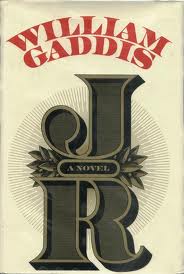
The edition I’m using.
SOUNDTRACK: RICHARD WAGNER-“Ride of the Valkyries” (1856).
 Possibly the most famous piece of music from any opera (known for a billion reasons other than the opera itself). This song was introduced to be by Bugs Bunny. And then cemented in my consciousness in Apocalypse Now.
It’s really impossible for me to listen to it without seeing helicopters dropping napalm.
I’ve never seen it performed before. Most of us think of it as an instrumental, but there are vocals, and they add a lot to the performance. I also didn’t realize that the whole first minutes is a prelude to the third Act–with a darkened stage. I just watched this version by the Danish Royal Opera in which the setting is updated. The Stage is amazing and it’s a pretty powerful image, that won’t leave me head too soon. And of course, the women sound phenomenal.
Smells like victory to me.
[READ: Week of June 19, 2012] JR Week 1
And so begins the saga of JR. A little of my background:
I read JR about a decade ago. I recall the structure and some of what happens, but not enough to actually remember anything ahead of time, plotwise.
Usually for these weekly group reads, I post fairly detailed recaps of the book. And usually I do that because there’s so much going on in a large book, that it’s one way for me to keep track. JR is going to be a little different. If you’ve gotten this far in the book, you’ll notice that there’s not a lot of plot going on. There’s a few scenes with lots of dialogue and maybe something comes of it, maybe not. So, I’m certainly not going to try to recap everything that happens in the dialogue, nor am I even going to try to figure out who said what or even who is in every conversation–I’m not even sure that’s possible. But I am going to talk about each scene a bit and see if I can pick out anything that seems important.
The book strikes me as being like an unedited film. Or like a Picasso–Gaddis wants to show you everything, and let you pick out the important bits. And so the book feels like a boom mike has been inserted into a room or scene. We’re not really sure who everyone is, or even who is talking at a given moment. But we hear everything that’s said. And then the boom mike pulls out and the camera pans somewhere else and the boom mike goes down and we hear some more. It’s not always clear even that a scene has shifted–although usually a dense paragraph of prose indicates a shift in scene.
As far as characters, it’s not clear if anyone mentioned early on is going to stay with us through the book. It’s clear that JR will be here (although his first real scene is right after my spoiler line for this week). There’s also the Bast family who will no doubt play some ind of important role. Then there’s a lot of teachers as well.
JR opens with dialogue—attributed to no one (and none of the dialogue is every attributed to anyone–fun! It talks at cross-purposes and is a bit unsettling. But once you get into the flow, it proves to be one of the more creative forms of exposition I’ve read. There are three characters in the scene: Coen, a legal representative, and two sisters, Anne and Julia Bast. Coen (whom the women keep calling Cohen—in a very funny joke that I’m not sure would even translate audibly) is trying to gather some information from the sisters about their dead brother Thomas in order to clarify his estate. The sisters, who clearly have lived together forever and have their own way of talking to each other, talk over him and seem to deliberately fog his questions (although they are also jumping ahead of him so it may not be deliberate). They misunderstand what he asks and go on tangents unrelated to anything. One of them even sews a button on his coat while he is talking to them. My favorite thing is that in addition to the women talking at him, they also react to him. So, although we don’t see a lot from Coen, we hear the sisters telling him to sit down or have a drink or that he broke his glasses. But Coen does speak, primarily in legalese (making this whole section of dialogue all the funnier because the sisters do not get what he is saying at all). Basically no one understands what is happening.
This goes on for 17 pages. And it is very funny indeed. It also sets up the way Gaddis is going to reveal information–you’ll have to glean stuff from what people say or don’t say. Through all of this we learn some basics about the Bast family (whom we assume will stay with us in some capacity throughout the story, but who knows). There were five children: Julia, Anne, Thomas, James and Charlotte. Charlotte went by Carlotta and had a stoke, although that’s not what killed her. James is a composer, and it seems, a musical inventor. Thomas founded General Roll, which we eventually learn sold player piano music rolls. Thomas and James fought about everything. Including, it seems, Thomas’ second wife, Nellie. Nellie eventually moved in with James. Coen wants to find out if Nellie and Thomas were ever divorced and exactly who is the father of Nellie’s son Edward—who stands to reap the benefits and pay the taxes on Thomas’ company. But it’s a lot funnier the way Gaddis tells it.
I trust everyone’s page numbers are the same–since there’s no chapter breaks at all, it will be very hard to keep everyone together. At the bottom of page 17 brakes squeal and we watch Coen’s car take off.
And we focus back in on a scene with Edward Bast (he’s Music Appreciation) and Mrs Joubert, two teachers who are, we will see, involved in videotaping lessons. But just as we think we’re going to get some more Bast information, Whiteback, the owner of the bank misinterprets who she is talking about and says that no, that’s Coach Vogel (more confusion as two people look in different directions). Turns out that Mr Bast is helping out at the Jewish Community Center, helping Miss Flesch teach her kids Wagner’s Ring for an upcoming production. In and of itself this is hilarious. For those out of the loop, Wagner’s Ring (from which “Ride of the Valkyries” comes) is a massive opera. A full performance of The Ring often takes place over four nights with a total playing time of about 15 hours. The first and shortest opera, Das Rheingold, which we will later learn they are practicing, typically lasts two and a half hours. And it’s all in German. There is also an undercurrent of antisemitism in the book, although just how widespread is unclear. Wagner had also written publicly anti-Semitic statements (although he was friends with Jewish men and women–weird–but funny for the set up here).
But back to the scene, Mrs Joubert is holding a bag of money (primarily coins) because her students are about to go into Manhattan and buy a share of stock. I love this plot idea. It seems like the kind of thing that may have happened in the past but probably doesn’t anymore. I wonder if it really ever did. Anyway, it makes me laugh that she has a bag of coins instead of trading it in for bills (they are literally across the street from Whiteback’s bank). Especially when Bast elbows her and she drops the coins and some slapstick ensues as they retrieve the money ($24.63).
The scene shifts to the school from which Gibbs is watching the proceedings. Gibbs becomes a prominent character, but I’m still not entirely sure what he does there. The “camera” pans around the school to show us the engraved motto: ΕΒΦΜ ΣΑΟΗ ΑΘΘΦΒΡ which will cause some stir throughout this week (and from what I can tell doesn’t mean anything in Greek). There’s a man who is writing it down (to use as the epigraph of his book). Someone later suggests it might come from Empedocles.
The book the man is working on is about technology. He tells the (actual) cameraman: “And get some of those blank faces. There, the one at that window having smoke in the boys’ washroom while his class is being taught by television, speaking of technological unemployment.” There’s some interesting stuff about education in this section–stuff that kind of foreshadows No Child Left Behind (perhaps this was all relevant in 1971 as well, I don’t know). Gibbs (I believe) says:
Before we go any further here, has it ever occurred to any of you that all this is simply one grand misunderstanding? Since you’re not here to learn anything, but to be taught so you can pass these tests, knowledge has to be organized so it can be taught, and it has to be reduced to information so it can be organized do you follow that? In other words this leads you to assume that organization is an inherent property of the knowledge itself, and that disorder and chaos are simply irrelevant forces that threaten it from outside. In fact it’s exactly the opposite. Order is simply a thin, perilous condition we try to impose on the basic reality of chaos… (20).
And of course, it encapsulates the very structure of the book–chaos is everywhere–how can we construct a plot out of so much chaos.
Then we meet Mister Dan diCephalis who, along with Miss Flesch (Gaddis is having some fun with names like Pynchon, eh?), Major Hyde and Whiteback (who we learn is president of the bank and principal of the school) have a discussion about new technological equipment. DiCepahlis did video driver training (as Bast did Music Appreciation on video) until Coach Vogel took over. Now diCephalis is being saved for math and physics. diCephalis is the school’s psychometrician in charge of all testing–and very concerned about the budget as we’ll see in the next scene. Dan claims that the problem isn’t the machines, it’s the holes in the computer cards. But there is much wringing of hands about the expense of all of this technology–some of which hasn’t even been opened yet. Then in comes Congressman Pecci (hilariously at the same exact time as salesman Skinner whom Miss Flesch is trying to avoid–more confusion ensues). And all present begin talking about finances for the school. They also discuss The Foundation who have sunk “seventy or eighty million into this school tv project nationwide.”
This leads to comments that really predates the TV in the classroom issue that was big in the 90s:
The point like I’ve been saying from the start is that in-school tv, to be in-school tv, it has to be in-school tv with lessons piped into school receivers in school classrooms for school kids in school classes, a simple interference-free closed-circuit school setup where every Tom, Dick and Harry can’t tune in on the kind of open-circuit broadcast you’ve got now and write letters telling you off on the new math. (27).
I also got a kick out of this: “Now the Senator, Assemblyman Pecci, that is, he has a bill he’s introducing that makes all this mandratory [sic], it will get this in-school television out of the community entertainment field and back into the school” (27). The characters even pronounce things wrong.
Then we get several pages of people interrupting each other as they watch examples from the tv in a classroom footage. It’s not always clear what’s happening, although helpfully, the TV dialogue is in a different font. Then Miss Flesch leaves with the salesman–she needs a ride over to where her kids are practicing Wagner. And we head over to the Jewish center to watch the kids working on the Rhinegold–where chaos ensues and lots of jokes about Wagner and music fill the air.
This scene finally introduces us to JR (in an oblique way). JR is a sixth grader who is supposed to be playing Alberich the dwarf but he is not there. He is the boy reading the newspaper by the window as the scene opens. When he finally gets back to the stage area, Bast realizes that the bag of coins is missing (the chaos never ends!). Then Ann DiCephalis takes Bast back to the school so that they can do some TV lessons.
We also finally meet someone from The Foundation–Mister Ford and Mister Gall (who was the man writing the book earlier). And they all watch Bast and Flesch recording and going way off script: “For believing and shitting are two very different things” (42) [see Simon’s comments for why Flesch is crossed out]. Then we see Mrs Joubert and her class interacting on the video screen (a new thing they’re trying–usually the kids are not on-screen). During her exchange we hear her suggest that they buy “–mond Cable or some other growth stock… –What did she say? what stock?” (48) because Wrigley’s gum is too pricey for them. Turns out that one of the men in the room owns Diamond Cable,and he’s pretty excited. Then things get ugly in the room. (Oh and Miss Flesch got into a car accident with the book salesman). There’s an amusing interchange in which Gibbs questions the Congressman’s bumper sticker “Keep God in America” Gibbs says “Didn’t know he was trying to get out Major, that’s all I…” (47). And there appears to be a bit about the “under God” in the Pledge of Allegiance. Gibbs also pokes some holes in the corporate speak: ‘tangibilitating unplanlessness where’d you pick up that language, Whiteback?” (50).
The scene pulls away as Mr and Mrs diCepahlis drive off. And they bicker the whole way home and into their house. Where he turns off lights (and she calls him cheap) and he tries to clean up, but the papers are her Foundation Grant application papers–why is he trying to throw away all her work?? They even bicker about anonymous computerized questionnaires. He is also looking to give back some of the tax refund they received because he estimated they would get $37.10 but they received $336. She thinks he’s crazy for doing this.
The scene shifts again and this time it’s Mr Bast walking home and JR catching up to him quickly. JR is carrying an armload of mail–free publications about all sorts of things (Gem School of Real Estate, Amertorg International Trading Corp, Ace Match Company) and Bast is baffled. “You just send away for it” JR explains matter of factly (59). As their quick encounter ends, JR shouts, “–I just mean like maybe we can use each other some time” (59).
The scene shifts back to the Bast home and Julia and Anna. They are talking with Stella Angel (formerly Bast). They are being indiscreet about the scar on her neck (“you might want to wear a necklace” (60)) and she tells them that the kids think she’s a witch. And they are indiscreet about her never having children with her husband Norman and how much Edward has a crush on her.
There are no photos of Nellie in the house. Then Stella notices a photo and asks if it is Edward as a little boy. But they point out that no it is Reuben the boy who James adopted because he was such a musical prodigy). The aunts say he never adopted the boy, that it was that Cohen that started that rumor. Then they show Stella Coen’s card and say it’s surprising they left the h off his name and he should get them reprinted (ha). Some more background is filled in–Thomas wanted to sell piano rolls but James thought he was nuts. And also that he used James’ connections. So that Thomas was asking people like Saint-Saëns (!) to record piano rolls for him. (Saint-Saëns died in 1921, so I don’t think that’s likely). There’s a little more antisemitism about Reuben (“not a jewy Jew” and he borrowed the name Bast and never returned it).
We learned that James gave Nellie trumpet lessons and that she had consumption–but there’s still not a lot of detail given about that part of the past.
And then Edward turns up with a beer can. I believe that he had a crush on Stella (all stemming from an incident when he caught a glimpse of her taking off her suit) but unless I am mistaken, they are, well, certainly related–possibly brother and sister they are cousins. (Stella is Thomas’ daughter). At any rate, is currently living in James’ studio (on the grounds of his older aunts’ house). He takes her over there and she notices that the window is smashed–someone seems to have broken in, but nothing is amiss. She puts on a record player and the music plays over the entire rest of the scene, adding unusual punctuation to their awkward conversation. Edward says he is no longer teaching [was he let go after the TV incident?], although he is trying to work on a composition. Again, their conversation overlaps and contradicts each other–about the room, their past, his music–he’s easily offended when she mentions it and thinks she is mocking him. Then he snatches a “knotted length of rubber stretched like a dead thing on the stair” hoping she hasn’t seen it. This has significance although I don’t know what exactly. (Drugs? Condom?). He puts the rubber in the beer can. And then Stella’s cab pulls up to take her to the train. Edward stuffs his beer can between the seat cushions and the cab drives off.
At the station, Stella runs into an old flame, Jack. Unfortunately she’s holding the beer can because the cab driver didn’t want it left in the car. The man is immediately hostile to her, suggesting that her father had financial reasons for getting her married off. She accuses him of being a drunk (which he returns at her when he sees the can) because he’s dressed like a bum. Turns out that he’s just come from a play rehearsal. After some back and forth, he offers to get in the train with her. She doesn’t refuse and the scene morphs into next week’s read, starring Mrs Joubert and her kids.
I enjoyed this reading an awful lot. There’ a lot of humor in it. Also, I’ve been reading a lot of books to my kids where every sentence of dialogue ends “said Jack” or “said Annie” so JR is making up for all that excess. It’s simultaneously impossible to follow and yet also not that big of a deal to follow. Some of the details get lost but for the most part they’re not relevant to the story, so that’s fine. However, when new characters come in and they are not introduced it gets a bit confusing. It’s also really hard to know what’s important and what’s not at this stage. Should you be carefully reading about what the kids are learning in school? My minor spoiler is that you should pay attention to what JR is doing as the book is named after him.
I have continued reading into the next section at this point and it is really a lot of fun. I hope others are enjoying it too.
I sign this: #OccupyGaddis.
[For spoiler-free information, read Simon’s comments below. It also includes links to more details than I’ll ever give!]
For ease of searching I include: Camille Saint-Saens

 I Just Read About That...
> nor am I even going to try to figure out who said what or even who is in every conversation – I’m not even sure that’s possible.
That’s definitely possible, but on re-reading the book (within weeks of the first reading), once all voices and events have gelled in your head. Still, you could also save on the preliminary reading by using the cheat sheet: Steven Moore’s complete scene outline @ http://www.williamgaddis.org/jr/jrscenes.shtml
> Coen (whom the women keep calling Cohen — in a very funny joke that I’m not sure would even translate audibly)
I reckon Coen is pronounced “cow-hun” (almost “cone” like Cohn), whereas Cohen is pronounced “cow-hen”. (There’s been an audiobook version of JR, how’s that? I’ve not listened it but I’m pretty sure the actor made an audible difference.)
> the engraved motto: [in Greek]
The motto story is a funny six-piece puzzle, five pieces being scattered throughout the novel, the sixth being (like so many other plot points) up to the reader to figure out, a bit like those complete-the-series IQ tests. I suggest keeping tabs on that motto affair and trying alone, but those who’ll give up will find a linear account (and the solution) within the meaty essay @ http://www.williamgaddis.org/critinterpessays/zeidlerworkalienationjr.shtml
> Gibbs (I believe) says: [order and chaos quote]
Gibbs indeed: the only one who ever writes or uses the word “entropy” in the novel, and named after physicist Willard Gibbs who refounded thermodynamics.
> how can we construct a plot out of so much chaos.
The novel isn’t a chaos but a shuffled jigsaw puzzle: its precise picture, cut into a thousand scattered pieces, is a kosmos only offering the apparence of a kaos. But as with a puzzle, you can fit back all the pieces to reconstruct a clear, complete picture…
> And they all watch Bast and Flesch recording and going way off script
Flesch never made it to the studio (we learn a few pages later she was in a car crash) and Bast was thus left alone with her script (mostly in disorder after the scene it was spilled on the floor) and her book about Mozart’s letters (mostly scatological): Bast was (as will be very usual) roped into doing it, and quickly had to improvise.
> So that Thomas was asking people like Saint-Saëns (!) to record piano rolls for him. (Saint-Saëns died in 1921, so I don’t think that’s likely).
Why so unlikely? The novel is set in Fall 1972: so for instance let’s say Thomas was born in 1900, then was a young entrepreneur aged 20 getting Saint-Saëns records in 1920, then died aged 72 in 1972 when the novel starts.
> [Edward Bast and Stella] are, well, certainly related – possibly brother and sister (Stella is Thomas’ daughter).
Edward and Stella are only cousins: we saw that Stella is the daughter of Thomas’s first wife, while Nellie was Thomas’s second wife and left him for James then had Edward out of wedlock. It’s only legally, on paper, that Edward could pretend to be Thomas’s son and claim a bigger part of the heritage, hence the need to obtain Edward’s signed renunciation to such a claim before the legacy can duly proceed. (If this seems difficult, brace yourself should you try Gaddis’s book about law, A Frolic of His Own.)
Wow, Simon, this is awesome. Thanks. I really appreciate the nudges and the setting straights. The further I read the more I see that everything is important!
I also appreciate your lack of spoilers. I’ll certainly check out those links at the end of the summer!
I could see spending the time to do the work that this book really asks for, if only I didn’t have, you know, a job, a family etc. But I think it might really pay off.
As I have found in a few later sections, questions I had are eventually revealed (like the status of Edward and Stella). And I’ll concede Saint-Saëns as well 🙂