 SOUNDTRACK: ESMERINE-La Lechuza [CST080] (2011).
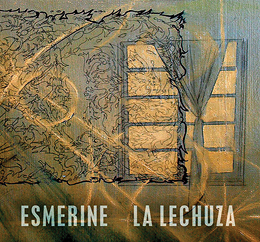 This album is a wonderful surprise. I had not heard of Esmerine before this CD (they have put out two previous records on a different label). All I knew about them was that violinist Becky Foon (who is all over the Montreal scene and who is really good) was one of the founders of this band. So I expected some epic instrumentals ala all of the Constellation Recordings bands that she has played with (Godspeed, Silver Mt Zion, etc).
I was delighted by the opening fast marimba notes of “A Dog River”. I’m not sure if the marimba can play minor key notes, but the melody that co-founder Bruce Cawdron plays is uplifting and mesmerizing. When Becky adds her strings, it takes on a new element–a kind of wistfulness. Then at nearly 3/4 of the way in, some loud guitars come in to give the whole song a feeling of urgency. And all the while it is very filmic. It’s a wonderful opening. “Walking Through Mist” is a much slower piece, and the marimba adds contextual pacing–they’re still not minor key or sad marimba notes, but they are not as uplifting as on the first track. “Last Waltz” introduces a vibrato’s piano as the primary instrument. It is at once unsettling. It’s also the first of three songs with vocals. The vocals work well on this song–they fit the mood perfectly–especially the wordless singing at around 4 minutes. But I have to admit that I like the instrumentals better. The same can be said for “Snow Day for Lhasa” (another song with vocals) which I find a little too slow to be impactful (it actually reminds me of a very slow version of Broken Social Scene’s “Lover’s Spit”).
“Trampolin” introduces a harp and some vibrant percussion. It’s uplifting and feels like a perfect song for a theatrical dance company to perform to. “Sprouts” is an uplifting new-agey sounding track. By itself it might veer uncomfortably into the new age scene, but amidst the songs of the album it works very well. “Little Streams Make Big Rivers” returns to that slower sound from earlier. But this song is short and feels like a slow building march. By the half way mark when the drums kick in, the song is unstoppable. The album proper ends with “Au Crépuscule, Sans Laisse” a slow filmic song that returns the album to the quiet sound it was toying with earlier.
I mentioned Lhasa earlier. Lhasa was a Canadian singer who had international fame (from my own experience, I know that X-Files creator Chris Carter wanted to go see her live–I know this because I was friends with his assistant and she told me the tale of trying to find tickets for this show). I checked out her stuff but it wasn’t for me. Anyhow, Beckie and Bruce were supposed to tour with Lhasa for her 2010 album, but sadly, she died of breast cancer (at 37, Jesus), right after the album came out. So this album is dedicated to her. The final song “Fish on Land” is a previously unreleased version of a Lhasa song that was made with Bruce and Beckie. I wish I liked it more, but as I said, she’s not my thing.
I absolutely love the instrumentals on this album and I’m going to have to check out their earlier releases, too.
[READ: May 24, 2012] “Referential”
This story is like a kick to the stomach. When you’re lying on the floor. After you’ve thrown up. And I mean that as very high praise indeed.
You know you’re in for trouble when the story opens: “For the third time in three years, they talked about what would be a suitable gift for her deranged son.” We quickly learn that the woman’s son was fine until he was about twelve years old when he stopped brushing his teeth and began muttering to himself. By then Pete had been dating the woman for about six years.
Pete and the woman had been coping with her son’s placement in the institution for over three years now. There were so many rules they had to follow when visiting the boy–almost nothing could be brought in for fear of its being used as a weapon–even the homemade jam was taken because it was in glass. Similarly, the woman has stopped wearing accessories, as a kind of solidarity–she would just have to remove them anyway. She is now aging naturally and (she fears/admits) not very prettily. An amazing slap in the face comes at the end of the first section with this amazing sentence: “‘To me, you always look so beautiful,’ Pete no longer said.” [Ouch!].
Pete has lost his job and is clearly unable to handle the strain of her son any longer (there’s a wonderfully painful scene where the boy asks Pete why he hasn’t come to visit lately).
The story is mercifully short (you can only take so much abuse, right?), but man is it brutal. Moore puts so many wonderful details into this story. Possibly the most subtle–the only person who is given a name is Pete.
There’s really no happiness in store for anyone here. But the writing is so good you don’t want to stop reading.
UPDATE: If you see the comments below you’ll see that this song is related to Vladimir Nabokov’s” Signs and Symbols.” Which I have posed about (and discussed Moore’s use of) here.

 I Just Read About That...
The story is plagiarized version of Nabokov’s perfect gem of a story, “Signs & Symbols”, from which all the “kick in the stomach” moments you mention are lifted virtually word for word. Perhaps this is the new face of fiction today for people who cannot write: use the the words of the literature’s giants and fill them in with “ouch” moments for the sophisticated (ouch!) tastes of today’s New Yorker readers.
That sounds like an excellent endorsement of the Nabokov story, which I haven’t read. I will certainly have to check it out. As for plagiarism, I can’t say. Oh, and hey, it’s available from The New Yorker too. I’m on it!