 SOUNDTRACK:SUPER MORRISSEY BROS (2012).
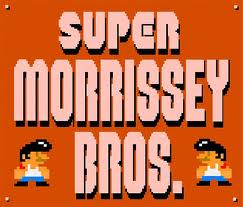 This is, as the title implies, a Smiths song done in the musical style of Super Mario Bros. And, why yes, it certainly is.
This song is especially amusing to me as we just got a Wii for Christmas so I am now far more familiar with the Super Mario Brothers musical style than I ever expected I’d be. The opening notes are spot on and while it is a bit long for something of a joke, at under 3 minutes it never wears out its joyousness..
The little sound effect of scoring points at about the 2 minute mark is as wonderful of a surprise as when you get the unexpected point in the game and it easily sustains the song until the end.
It doesn’t honestly warrant repeated listens, but two or three will certainly make you smile.
Check it out
[READ: March 6, 2012] The Great Gatsby
I knew I’d be reading Gravity’s Rainbow for a while so I wanted some shorter, easier works that I could use as occasional diversions. I’d read The Great Gatsby in college and really enjoyed it, but clearly, as I learned by reading it again, I didn’t remember anything about it and what I remembered, I’d remembered wrong.
The other thing I was thinking about is that I didn’t read this in high school. In fact, I didn’t read many books that I know people are supposed to read in high school. I don’t think it’s because I didn’t feel like reading it (that;s possible), I think it wasn’t assigned to us. My high school, as I recall, has a weird selection of texts that we read. For instance, I recall reading Táin bó Cúailnge (and hating it). Who is reading The Tain (which is an Irish epic) and not Gatsby? Kids in Ireland, that’s who!
Anyhow, this book is considered number 2 in The Modern Library’s 100 Best Novels of the 20th Century (Ulysses is #1–that’s a 1 and 2 that couldn’t be much more different!) and, as I said it’s on virtually every high school curriculum.
As I was reading it I wondered how well high school students could relate to this story. There are two cases of infidelity, there’s murder and suicide, there’s bootlegging alcohol and false identities. I mean, sure they should love it, but how well can they relate to it?
The novel opens with Nick Carraway reciting advice that his father gave him: “Whenever you feel like criticizing anyone, just remember that all the people in this world haven’t had the advantage that you’ve had.” This is an interesting quote to open with since the quote both applies and does not apply to the great Gatsby who is Nick’s neighbor.
How so? Well, because Gatsby is a supremely wealthy man and a swell guy, He hosts parties all the time, there’s a kind of open invitation to anyone who wishes to come, he hires caterers and has more booze than you can imagine. He’s also charming and calls everyone “old sport.” And he’s a genial host. But at the same time, Gatsby is not who he seems. He comes from a very poor family in the Midwest. He grew up with next to nothing and even lost the love of his life.
And he is clearly very lonely.
But we don’t meet Gatsby right away. Rather, we learn about Nick’s past and his current “eye-sore” of a house sandwiched between two mansions on West Egg (Great Neck) Long Island (his cost $80/month while the mansions were thousands a month). He knew that his second cousin, Daisy Buchanan (and her husband Tom, who he knew in college) lived over on East Egg (Manhasset Neck) the more fashionable of the two Eggs.
In the way of sitcoms today, Daisy and Tom have a daughter although she is all but forgotten in the book and may or may not even be necessary as a plot point. There’s an amusing line when Pammy comes out that “I don’t think he (Gatsby) had ever really believed in its existence before” (123). It’s fair to say the audience may not have either.
Tom goes over for dinner one evening and the first plot of the story gets under way. At the dinner is a professional golfer named Jordan Baker. Jordan and Daisy are friends and exude the excitement that wealthy white people felt in the roaring 20s. When Tom takes a phone call and Daisy goes to see who it is. Jordan explains that the call is from Tom’ mistress and that everyone (not sure if that includes Daisy) knows about her.
Indeed, Tom is having an affair with Myrtle Miller. Myrtle is married to George Miller, the mechanic that Tom often does business with–although Tom describes him as “so dumb he doesn’t even know he’s alive” (30). George thinks Myrtle is visiting her sister in New York, which technically she is although she is visiting her with Tom. Catherine (the sister) notes that neither Tom nor Myrtle can stand their spouses and wonders why they just don’t divorce. (Ostensibly, it is because Daisy is Catholic).
By Chapter 3, Nick is finally invited to Gatsby’s house, with apologies for the delay in invitation. Nick couldn’t miss the parties–Gatsby’s house had been lit up all hours of the night with dozens of party guests–the majority of whom had never met Gatsby and only knew rumors about him. And the rumors were frightening (like that he killed a man).
At the party, Nick finally gets to see inside Gatsby’s house. It is huge (and the library has real books!). Anything that anyone could want is offered around. Nick even runs in to Jordan, but he never gets to meet Gatsby. Soon enough, however, Gatsby himself asks for a private meeting with Jordan. And by the end of the night, Nick begins talking to Gatsby by accident; and they develop a kind of strange kinship.
Eventually Nick learns the truth about Gatsby (which I won’t reveal) but let’s just say that he is not who he says he is. But he also learns another truth about Gatsby which is that he is in love with Daisy Buchanan. He and Daisy knew each other five years previously. They had several romantic moments together and then Gatsby went off to the war. And he was stuck in France while Daisy could wait no longer and married Tom. When Gatsby moved to West Egg he knew that Daisy was right across the bay and he could see the green light of her dock at night.
Through some ministrations form Gatsby (via Jordan who is now an item with Nick), Nick invites Daisy to his house for a lunch while Gatsby waits to surprise her. Clearly Daisy knew that he would be there because she doesn’t gasp in astonishment when he walks in. Nevertheless, there is a great deal of awkwardness at first. But soon Nick excuses himself and the couple get on just fine, truly making up for their lost years.
So now at this stage we have each Buchanan having an affair. Daisy spends a lot of time with Gatsby (and some with Nick and Jordan). While there is some spark between them, Gatsby is really trying to impress her with his things and she doesn’t seem all that impressed by what he has–or by his parties.
On an outrageously hot day near the end of the summer (I enjoyed reading about this excruciating heat because it’s easy to forget that even the rich suffer from heat when there are no air conditioners) Daisy invites Nick and Gatsby for a lunch. By now Tom knows about her and Gatsby and is not happy about it (hypocrisy is a bitch, eh Tom?). But everyone is too proper to address the issue in front of them.
Rather than suffer in silence in their house, they decide to go to New York (where I believe they were going to rent hotel rooms so they could take cool baths??). Tom brings some whiskey and they plan for a jolly, awkward time. But when Daisy drives with Gatsby instead of Tom, things heat up even more and in the hotel, Tom confronts Gatsby who proclaims that Daisy never loved Tom. Daisy won’t acknowledge such a thing. And as tensions mount, Daisy demands to go home.
In a turn that I was completely surprised by, but which makes for a wonderful narrative experience, the couples race home and by the time we catch up with them, there has been a terrible accident. This accident impacts everyone (again in very surprising ways) and leads to a climactic sequence of events that seems out of keeping with the rest of the story but which never defies belief.
As the story ends and more truths about Gatsby come out, the real extent of Gatsby loneliness comes out and even Nick is surprised by what it all means.
The story is a really fast read–it’s quite short and the pacing is very quick. The arc of the story from wild party to lonely ending is quite dramatic a well.
There quite a lot of humor in the story (the endnotes explain a lot of them). Although much of it is circa 1920s humor (making fun of a very popular book, for instance), there’s also general mirth like the playwright named Vladimir Tostoff and the descriptions (and names) of the party-goers. Fitzgerald doesn’t quite reach the dizzying heights that Pynchon does when naming people, but there’s still some funny ones.
There’s also some uncomfortable racism in the book. Tom says, “if we don’t look out the white race will be–will be utterly submerged. It’s all scientific stuff; it’s been proved” (17). To which Daisy adds, “‘We’ve got to beat them down,’ whispered Daisy, winking ferociously toward the fervent sun” (17). I don’t know enough about Fitzgerald to know if this was him, his character, or the general tone of the 20s. Having it just thrown into the story though, tells something about the character of Tom, although I don’t think it says what the author intended anymore.
But that aside, the story was really enjoyable. Funny, breezy and quite surprising. If you haven’t read it since high school, it’s worth another look. And no, I didn’t even mention the eyes of Doctor T. J. Eckleburg.

 I Just Read About That...
You read the Tain in high school!? Weird! As for Super Morrissey Bros…oh dear, where on earth did you dig that out of?
Totally weird right? I can’t even remember why he chose that (except that his name was O’Connor).
Blame Lar for Super Morrissey. He found it and linked it on facebook!