 SOUNDTRACK: SUFJAN STEVENS-The Age of Adz (2010).
 Sufjan Stevens has released a bunch of albums of beautiful orchestral rock. It is multi-layered and complex with classical elements and all kinds of cool instruments.
And this album starts out with a beautiful acoustic guitar melody and Sufjan’s delicate vocals. Although it is a far more stripped down song than usual, “Futile Devices” seems like it is heading in the standard direction. But anyone who heard Sufjan’s Christmas album number VIII knows that he has been having some fun with electronics. And they show up with a vengeance on track two, “Too Much.”
All of the multilayered noise that was once orchestral and (some might say) precious has been replaced by a cacophony of gorgeous electronic noises. The beginning of the song reminds me of the sounds in Skinny Puppy’s “Stairs and Flowers” (how many Sufjan Stevens reviews mention Skinny Puppy?). The song is nothing like Skinny Puppy once the vocals kick in–it’s catchy and delicate–but those electronics underpin the whole thing, bringing his pastoralia into the twenty-first century. When I first reviewed this song I didn’t like it but once you get absorbed by Sufjan’s world, it’s an enticing place to be,
“Age of Adz” takes this electronic nonsense even further with an 8 minute brew of strange sounds and choral voices. But he always manages to throw in some catchy parts, no matter how strange the song gets.
For me one of the highlights of the disc is “I Walked” it features one of my favorite Sufjan things–falsetto vocals in a beautiful but unexpected melody. And this song has them in spades. “Now That I’m Older” has a very disconcerting sound–his voice is slowly warbled and mournful. It’s a beautiful melody that is alienating at the same time.
“Get Real Get Right” returns to his earlier style somewhat (there’s more layers of music, although the electronica is still in place). “Vesuvius” is a beautiful song and “All for Myself” is another of those great falsetto tracks that I like so much.
“I Want to Be Well” eventually turns into a manic electronic workout in which he repeats the chorus “I’m not fucking around.”
But nothing compares to “Impossible Soul” a twenty-five minute (!) multi-part suite of electronic chaos. It’s a fantastic song complete with autotune (used to very cool effect), repeated swelling choruses (it’s like a Polyphonic Spree tribute), electronic freakouts, and acoustic comedowns. All in a positive, happy message. I can’t stop listening to it. “It’s not so impossible!”
Sufjan continues to impress me.
[READ: November 10, 2011] McSweeney’s #9
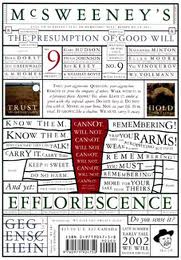
After the excesses of McSweeney’s #8, I was excited to get to the brevity (and urgency) of McSweeney’s #9. This one is a paperback and looks like the first couple of issues. The cover is mostly text with a hodgepodge of phrases and pleas. You get things like: Thankful, Emboldened, The (Hot-Blooded/Life-Saving) Presumption of (Perpetual/Irrational (or More Likely, Irreducibly Rational) Good Will, Efflorescence, Our motto this time: We Give You Sweaty Hugs,” Alternative motto: ” We Are Out Looking,” GEGENSCHEIN (no more), and the promise: “We will Do Four This Year.”
This is the kind of issue that makes me love McSweeney’s. There are some wonderful short stories, there are some nice essays and there are some dark moments all centered vaguely and tangentially around a theme. There are some great authors here, too.
The back cover image is called Garden Variety by Scott Greene and it’s a fantastic painting. You can see it here (navigate through the 2000-2004 paintings, but I have to say I really like the style of all of his work.
There are no letters and no nonsense in this issue. So let’s get to it.
WILLIAM T. VOLLMANN-“Three Meditations on Death”
This is, indeed, three meditations on death, a subject that Vollmann seems to be obsessed with (most recently in the November 2010 Harper’s, but he also wrote an entire multivolume work about it). For this article Vollmann considers death in three ways. The first is in the Parisian catacombs where thousands of bones are lined up and many of them are decorative. It seems like an intense place where nervous laughter is the norm.
In Part II he goes to an autopsy. He watches as the attendant saws open a dead body to determine if the cause of death corroborates (it does–which makes the attendant happy). Many morbid jokes are told in this setting as well and Vollmann notes that it would be impossible to keep your sanity if you didn’t tell them.
In Part III he goes to the Choeung Ek Killing Field–a cartographical representation of Cambodia made of murdered skulls. He also ponders death in Sarajevo and how death from war is so much different.
Vollmann is a pretty intrepid reporter and he really gets inside a question. Despite the intensity and the obviously sad stories, it’s a really good read.
A.M. HOMES-“Georgica”
I love A.M. Homes. She embraces subjects that are so weirdly taboo I often wonder what made her think of these things in the first place. And yet afer the initial shock, she totally brings you over to caring about the people. In this story a woman stalks the beaches looking at all of the young boys getting ready to have sex. She leaves condoms at all of the local watering holes. And you think you know where the story is going. Maybe. But why is she using night vision goggles? And, wait, why is she collecting the condoms afterwards? And wait, no really, what is she doing with them?
After we learn about what happened between her and her fiancée (they had a spectacular car accident) and the other things she’s been through, the story makes a twisted kind of sense. And again, we care about this woman despite our disapproval of what she does. It’s very disconcerting.
NATHANIEL MINTON-“A Threefold Cord”
This is a strange story about a man and his mother who are lost in the desert. They regularly travel to the desert to map out the locations of where they’ve been. And they do this because the husband/father can’t. So, for him, the mother and son travel to the desert with old cartographer’s equipment and plan what they can. But what will happen to them when they are abandoned and, although they have the equipment to get out, they don’t have the supplies or the GPS that they had carried (which was cheating anyhow). Can your landmark be a dead camel?
K. KVASHAY-BOYLE-“Saint Chola”
This was a wonderful story about the plight of a Muslim teenager in an American school. Once she comes of age she is encouraged to wear her head scarf. But once she does, she is mercilessly attacked in school. The title is a great surprise that comes out of nowhere. Wonderful.
GABE HUDSON-“Notes from a Bunker Along Highway 8”
This was a fascinating story told in multiple parts. I really enjoyed it and could have read much more. It begins with G.D., a soldier in the titular bunker. As the story progresses we learn that he is a U.S. solider fighting in Iraq but he had a moment of clarity which caused him to flee with a fellow soldier (who just had his arm chopped off and is unconscious). They flee to the bunker where G.D. changes his name to Help People and plans to do just that.
The other part of the story is about G.D.’s dad, a decorated Vietnam vet who is so opposed to the Iraq war that he publicly announces that he will now be gay until the war is ended. And throughout the story we see the letters that G.D.’s dad sends about his objections to the Iraq war. Mix in some chimpanzees and yoga and you have an excellent story that is topical and pointed as well.
DENIS JOHNSON-“Soul of a Whore”
I am not a part of the cult of Denis Johnson. I have enjoyed some of his works but I’ve never been a huge fan. This one-act play was okay but was circular in many way and was a little annoying. It may have been fun to see performed, but, after reading the one-act play from Eugene O’Neill (totally unfair comparison, I know), I can really see what a one-act play can do. And this one didn’t. It was kind of funny though.
VAL VINOKUROV-“Talking Fiction: What is Russian Skaz”
Skaz is a Russian style of writing that is the antithesis of the large Russian novel that people think of when they think of Russian literature. Skaz is in the tradition of using slang and colloquialisms to bring the short story back to the people. This article looks at a number of skaz stories and discusses how they are often written in reaction to some major event. Some authors include Gogol, Nikolai Leskov and contemporary author Liudmilla Petrushevskaya.
He also includes an entire skaz story by Mikhail Zoshchenko called “A Lousy Custom” which is about tipping and is very funny (as he says, it’s not unlike a Seinfeld skit). The next piece is a skaz story which Vinokurov translated
ISAAC BABEL-“Salt”
Val Vinokurov translated this brief skaz story from Isaac Babel. In the above article there is talk about the skaz stories seeming more oral than written and you get a feel for that here–it is story told to friends. The basic premise is that women have been stealing salt and trying to sneak it aboard trains. The narrator is a military man who won’t stand for that sort of thing. And he tells of a time when a woman came under suspicion.
DOUG DORST-“A Long Bloodless Cut”
This story surprised me in many ways. First because the narrator jumps back and forth to different scenes and the details of those scenes don’t really come to light until several pages in. You begin to realize that all of these characters are not only interconnected, they will react to each other and put the story (which we assumed was already under way into motion).
The story opens with a young man guarding a head. The head is the young man’s general’s competition for the Queen’s hand. And the general wishes to toss the head over the wall for the Queen to see. But when the young man wins something from another soldier…a soldier with a lot more power, the story morphs into a power struggle. And a question of what kind of plumage should be on the general’s hat. This was really good.
ELLEN MOORE-“Gateway to the West”
This was a dark story about a woman who is quite unhappy with her husband (and rightly so). It’s a story about spontaneity and how one attempt at spontaneity can crush later plans. It’s also about a man who can only communicate by blinking or by typing with a dowel attached to his hat. Oh, and Chekov and acting. The interspersing of Chekov in one’s own story could be risky, but it was handled very well.
JEFF GREENWALD-“My New Best Friend”
This was a nonfiction story about a man’s attempt to climb Mount Kailiash in a Himalayan pilgrimage. But rather than actually talking about the climbing, this terrific piece looks at the journey getting there. He is beset by Maoist rebels (who give him a receipt for the money they extract from him), and by a German woman who feels that his aura is black and he can’t be trusted. (This is a woman who is married yet whose sole purpose for coming on this trip is to seduce one of the sherpa guides and entice him to go back to Germany). You meet some strange people on a pilgrimage.
ROY KESEY-“Pacazo”
A pacazo is a five foot lizard who sits in trees and waits to shit on you. At least in Piura they do. The narrator moved to Peru, to Piura, because he believed that hot women would go for an unattractive man like him. Which was more or less true. He even married and had a child with such a woman. But then something disastrous happened (man, the taxi drivers are awful south of the border). And the rest of the story is about how he will enact his revenge. This story took a dark turn, but it was really worth it.
This was a great issue. Wonderful fiction, interesting non-fiction and really great writing.

 I Just Read About That...
Leave a comment