 SOUNDTRACK: COLIN STETSON-Live at All Tomorrow’s Parties, October 4, 2011 (2011).
 In addition to playing SXSW, Colin Stetson also played All Tomorrow’s Parties, and NPR was there. Unlike with SXSW, this set appears to be full length (about 50 minutes–which is a pretty amazing amount of time for him to blow that horn). Like SXSW (and the album) Stetston starts with “Awake on Foreign Shores” and “Judges.” What I love about this recording is that after Stetson finishes “Judges” a guy in the audience shouts (in a voice of total amazement) “That shit was off the hook!” And he is right. It’s not even worth me going into how amazing Steston is once again (check previous posts for that), but man, just look at the size of that horn he’s playing (seriously, click on the link to see it bigger).
Stetson plays a few more songs from New History Warfare, Vol. 2: Judges like “The Righteous Wrath of an Honorable Man” (which is outstanding) and “A Dream of Water” (which works without Laurie Anderson, although he does say he’s sorry she’s not there). He also introduces two news songs “Hunted 1” and “Hunted 2” which show new levels and new styles that Stetson employs.
This is a remarkable set, and Steston is clearly in his element (and the crowd is rapt). The only problem I have is the recording level. It must be very difficult to maintain recording levels for Stetson’s brand of noise–his louds are really loud–but you can’t hear him talk at all. And most of the time, the introductions to his songs are worth hearing. I’m sure if they tried to get the speaking level a little louder the music would have sacrificed though, so I think they made the right choice–I only wish there was a transcript available.
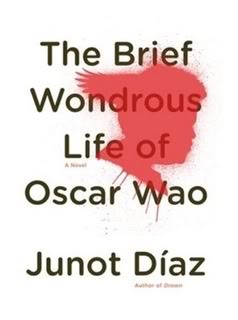
[READ: October 31, 2011] The Brief Wondrous Life of Oscar Wao
Apparently it’s pronounced, “Wow”, by the way.
Because of my new job, I don’t have a full hour of lunch-time reading like I used to. And so this book took considerably longer than I intended. However, once I set aside some time to read it, I flew through the book.
I’m going to get this part out of the way because I was thinking about it throughout the book and I want to mention it without having it bog down the post. This story reminded me a lot of Roberto Bolaño. On the surface, sure this is because they are both writers from “Central America” (Diaz is originally from the Dominican Republic but moved to the US, while Bolaño is originally from Chile but moved to Mexico and then Spain). But I’m not really talking about their origins so much as the style of storytelling.
Without going into a lot of Bolaño here, I’ll just say that Bolaño tends to write very detailed character studies–stories that follow one person throughout his whole life on something of a fruitless quest. And the details of that person’s life include information about family members and distant relatives. Further, Bolaño has written about the brutalities of both Chile and Mexico and how a person can survive in such a place. Similarly, Díaz follows the life of Oscar and his extended family and he talks about the brutalities of the Dominican Republic.
This is in no way to suggest that there is any connection between the two writers. I mean, The Savage Detectives came out in the States in 2007 (same years as Oscar Wao) and while he certainly could have read it in Spanish, I have no evidence that he did (and as I recently found out, the first draft of the Oscar story was written in 2000). Again, the parallels are only from my reading and have nothing to do with Díaz himself.
Okay, now that that’s out of my system…
This is the story of Oscar de Leon. But more than that, this is the story of a fukú–a curse that befalls the de Leon family and follows them through several generations. Oscar is the youngest member of the family and the person whom the narrator knows best. So we see this fukú as it impacts Oscar. And although the book is ostensibly about Oscar, it is about much more.
Oscar was born in Paterson, NJ (the town next to where I grew up!) and went to Don Bosco Tech High School (where many of my friends went). Oscar is Dominican (his mother is from the DR, but he and his sister were born in NJ), but unlike every other Dominican male, Oscar is totally uncool, into geeky sci-fi and D&D and is clearly destined to be a virgin because he is fat with terrible hair and no social skills.
And, (no spoiler), as the title states, his life will be short.
High school was brutal for him, obviously, but that didn’t stop him from falling in love (and making a fool out of himself) with every woman he saw (there was one who seemed to like him, but only until her boyfriend came back from the army). Oscar’s only salvation was fiction–both reading it and writing it. And he wrote a lot–several hundred pages at a time. He knew that when high school ended and he started college, things would be different. Except, of course, it wouldn’t.
I really liked the structure of the book in that after this introduction to Oscar (where we meet most of his family), the narrative shifts to the first person and Chapter Two shows us the life of Oscar’s sister, Lola. Lola (as established in the first part) was a fairly normal girl with an oppressive mother. But soon enough, she hit puberty and she became smoking hot. And hot-tempered.
Her mother, Beli, tries to keep her homebound, but Lola will have none of it (even when her mother develops cancer and tries to blackmail her into sympathy, she still fights tooth and nail). Eventually Lola moves with one her crappy boyfriends to the Jersey Shore. Obviously this can’t last, and when she reaches out to Oscar for help, Oscar helps her but fails her at the same time.
Lola winds up spending a lot of time back at her mothers homeland in the Dominican Republic, under the watchful eye of La Isla, Lola’s “grandmother.”
Having shown Beli as an oppressive mother, Chapter Three introduces us to Beli as a young woman, whose full name was Hypatía Belicia Cabral. It also introduces us to the (real) figure of Rafael Trujillo (more on him later) the dictator of the DR. Beli’s family was destroyed by Trujillo–and Beli, who was just a baby, was sent to various adoptive families before finally ending up with La Inca, who was her aunt.
Beli was very dark-skinned–which got her ostracized in her community and in her school. She longed for the light-skinned class president but he wanted nothing to do with her. Until, that is, puberty gave her huge breasts. And then suddenly all the boys wanted her. Including the class president. And she took him…assuming that they would be married right after school. They weren’t. And when they were caught, she was kicked out of school.
Beli fought La Inca and refused to go back to school. Instead, she got a job at a Chinese restaurant and began dating a gangster. The gangster had ties to the Trujillo clan (of course) but Beli doesn’t quite release (or won’t acknowledge) this because she loves him. He takes care of her. And she knows that they will be married. And she starts making more and more demands. And then she steps over a line.
The Trujillo clan looks to get rid of her, in a particularly brutal way (in a way that echoes throughout the story and is really wonderful–brutal, but wonderful). Her family, knowing that she is marked in the DR, sends her to New York, where our story began.
Chapter Four brings us back to the present and to Oscar and his miserable life at Rutgers. He realizes that his life is not going to change and he is not going to suddenly find love and sex. He also learns that even the women who will talk to him still don’t want him. The chapter ends with Oscar hitting rock bottom.
Chapter Five takes us further back into the history of the Dominican Republic. It also fully introduces us to the reign of Trujillo. You can find a lot of information about Trujillo online, but let me quote the Spartacus Education website for a very brief idea of the man:
In 1930 Trujillo ran against incumbent Horacio Vasquez for president. Trujillo was able to use his power to win the election. He afterwards claimed he had won ninety-five percent of the vote. After he gained power Trujillo established a secret police force that tortured and murdered the opposition to his rule…..Rafael Trujillo was assassinated on 30th May 1961 when his car was machine-gunned by a group of men on a quiet road outside the capital. Before the CIA could get their people in power, Rafael Trujillo Jr. rushed home from France and installed himself as the country’s new ruler. Over the next six months he executed all his known opponents.
So that’s just the tip of the iceberg. Oscar Wao does not hold back in its appraisal of Trujillo…his brutality, his…well, evilness. And even if Díaz is exaggerating (and its unlikely that he is), the novel gives an excellent sense of what it was like to live in the DR from 1930 to 1961.
Anyhow, this chapter looks at Abelard, who is Beli’s father (and obviously, Oscar and Lola’s grandfather). This section felt the most like Bolaño to me–damn, it had to slip out again. Abelard is a doctor, an intellectual and a well-respected man in the DR. He hates the Trujillo government, but is smart enough to never say anything about it. And because he is a wealthy doctor, he moves in circles in which he and Trujillo can bump into each other.
But once Abelard’s oldest daughter begins to show signs of being a smoking hottie (there’s a thread here, you see), Abelard learns of the Trujillo rumor–that El Jefe will simply take any hot girl he pleases and do with her what he wants.
His daughter is naive and his wife doesn’t believe the rumor, but this leads Abelard into a full-blown panic of what to do to protect his daughter. But how can a man keep something from a dictator who has eyes everywhere? He can’t. And when he pushes Trujillo too far, well, the book lets you decide for yourselves what exactly happened to get Abelard in the position that he winds up. And that position is terrible–Abelard becomes a broken man–in graphic (but not excessive) detail. And this destroys his family and sets the fukú in motion.
This also gives us the first introduction to Beli, when she was only a few months old. And we see some details about what happened to her after her family was essentially destroyed (details that she hasn’t told anyone). It also shows how La Inca managed to find her. This kind of layered, interweaving narrative was really compelling–we know a lot of the what and Díaz slowly unveils the how, a how we didn’t even know we wanted to know.
Chapter Six returns us to Oscar after college as he tries to sort out what he is doing with himself. He decides to go to the Dominican Republic for the summer and to live with La Inca. Oscar, being Oscar falls in love with a neighbor–an older, former prostitute. And, of course, a DR prostitute, is not exactly unattached.
The title tells us that Oscar’s life will be brief, so it is not a spoiler to say that it is. In fact, Yunior has been letting us know from the beginning that things would not go well for Oscar. But the spectacular ending of the story ties together so many wonderful threads and really sends the story into the heights of amazingness.
This story received a lot of hype–all of it is deserved. For what seems like a simple enough story about a fat loser from Paterson, NJ, this novel brings together politics, science fiction, love, personal politics and gender relations. All in a kind of bilingual style that moves smoothly and is chock full of footnotes.
A few important things to note about the story. The narrator is seemingly omniscient, giving a kind of mystical proceedings to the beginning of the story–how does he know such much since he seems to be a person, not just a Voice. Eventually, it is revealed how he knows so much. The narrator also fills us in on his own life–how he came to know Oscar, how he came to be entangled in Oscar’s life and how this loser has such a profound effect on him.
There’s a lot of Spanish (specifically Dominican) slang in the book. I was asked by a Spanish speaker if I found this bothersome and the answer is no. I know a little Spanish from high school and I know a bit of Spanish slang, so I could usually get the gist of what was happening. It’s true that there were a number of places where I simply didn’t know what the word was meant to be, but context usually helps for most of it. And of course, one could always look up some of the obscure words. But for the most part it flowed seamlessly.
I had been reading a lot of Diaz over the last year or so and I had been really wanting to read this book. I’m only sorry it took me so long as it was really a wonderful story. And because of my location where I grew up and some similarities between my childhood and Oscar’s I felt a real connection to this story. But even without the connection, it was still fantastic.
For ease of searching I include: Junot Diaz, Roberto Bolano, fuku, Hypatia.

 I Just Read About That...
Leave a comment