 SOUNDTRACK: MC PAUL BARMAN-It’s Very Stimulating (EP) (2001).
 So is this guy a joke? Well, he’s very funny. Very funny, in fact. But to my ear, not in a novelty sort of way. He’s got the kind of rhymes that make you laugh but still work upon multiple hearings. And, yes, Paul Barman is a squeaky, Jewish boy from Ridgewood, New Jersey (again!) and he really can’t rap on the beat and he really doesn’t have much in the way of rhythm, but got awesome skills in the lyrics department and he has production from Prince Paul (that’s the kind of credentials that anyone would like).
The theme of this EP is Paul’s utter failure to get with women (even in his fantasies). He’s crass and vulgar and yet he’s also quite smart and rather witty (“I think about all the pube I got while reading the Rubaiyat“) . The music is more or less inconsequential. As Prince Paul noted, the craziness comes from the lyrics, so you don’t want to overkill the song. But there’s some great samples and some solid beat work as well. Nevertheless, we’re here for the words. So, sample a few of these rhymes:
“The Joy of Your World”
It was time to copulate but we didn’t want to populate
So my bold groin reached for my gold coin proooophylactic
I unwrapped it, you can’t know how I felt
It wasn’t a gold coin condom, it was chocolate Chanukah gelt
The white part crumbled on her tummy and the rest began to melt
Foiled again…..
“School Anthem” or “Senioritis” (this song was renamed for the reissue of the disc it seems)
Homework is tell major lies or plagiarise encyclopedias, so boring
Fresh-faced teachers want to tickle ’em
but a test-based curriculum excludes exploring
I’ll let a mystery gas out of my blistery ass
Just to disrupt the misery of history class
“Salvation Barmy”
She said, “Go get a haircut”
So I showed her my bare butt
Pulled down my Carhartts put my moon in her star-charts
“I’m Frickin’ Awesome” ( I love this especially for the Lila Acheson bit)
It’s nice to be hypnotized by a man you don’t despise yet
He had a type of flow and I can’t quite label it
All I know it made me want to take off my cableknit
Sweater, Oh he better be hetero
I hope they don’t catch us in the Lila Acheson
Wallace Wing when Paulus brings the mattress in–rudely
He backlashed my booty
like I was Susan Faludi over the Grace Rainey Rogers Room rostrum
“MTV Get Off The Air, Pt 2” (the first two lines are fantastic, but the whole thing is genius).
Smirkin’ jocks with hackysacks
in Birkenstocks and khaki slacks
I’m the hypest lyricist
while they’re like, “What type of beer is this?”
Just wait until the full length for the utter genius that is “Cock Mobster” (how can be s o smart and so stupid at the same time?)
[READ: October 10, 2011] E Pluribus Venom
Like most people, I learned the name Shepard Fairey because of his iconic prints for Barack Obama. In addition to supporting Obama, I really liked the design of the prints–simple, bold, an easy iconic style (which has since been lifted, morphed and used everywhere). I know that many of Fairey’s prints actually come from other people’s original photos. He has a print of Muhammed Ali in this book, and he clearly didn’t take the original photo (I don’t know where it came from). But since all art is theft, I’m okay with Fairey taking someone else’s work and making something new from it. I’ve always felt that attribution should be enough if you modify the original enough to call it different (which I feel this print does). [The fact that he didn’t acknowledge the source does bug me, of course]. But that’s neither here nor there because this book predates all of that.
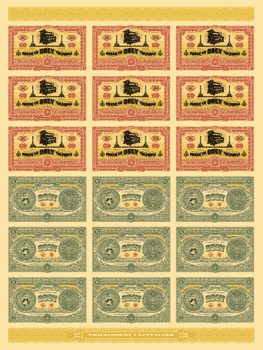 This book documents events that occurred in 2007. The E Pluribus Venom show was based largely around two images that Fairey designed to reflect the two sides of capitalism. The image to the right really doesn’t do any justice to the work itself, but you can kind of see that he created two-sided faux dollar bills. The front showed all the good things that capitalism can do. The back showed all of the evils that capitalism causes. The images resemble dollars, but the text is straightforward in its message. As with a lot of what Fairey does, it’s blunt and obvious but pretty cool.
As far as I’m concerned, though, this is the least interesting image in the book. Although I love that they made dollar bill sized prints of these faux dollars and left them scattered around in cities to promote the show. They way they were folded made them look at a glance like actual currency. Very cool.
What attracted me so much to Fairey’s poster style was its similarity to Soviet art. To paraphrase The Big Lebowski “I mean, say what you like about the tenets of the Soviet Union, Dude, at least it’s an ethos.” Fast, easy to reproduce, bold and effective, the Soviet style art would have been the best ad campaign around if they believed in capitalism. I’m including two gorgeous prints from the Soviet era. And, just so nobody gets mad, these two prints are not from Shepard Fairey and I’m not claiming that he has even seen them; his style reminds me of them is all. Jeez, some people.


There’s also a book called Soviet Commercial Design of the Twenties which shows hundreds of these cool posters,
To show another side in the 1930s, in the U.S., the WPA created a series of gorgeous prints to promote American life and welfare. I love the WPA project in and of itself and I think the art that they produced was truly wonderful. So here’s just two WPA prints:
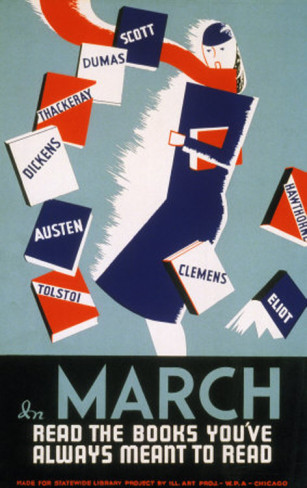

And yes, Posters for the People is an excellent book that collects hundreds of these prints. And, of course, the Library of Congress has an awesome collection of WPA prints that you can view online.
This has all gone pretty far afield from Fairey, except that his work, in addition to being beautiful and very graphic, is also political. (More on that).
The book itself opens with several shots of the space where the prints were exhibited. I feared that the whole book would be images like this (darkish photographs trying to convey an exhibition space), but fortunately once we get through those–nice documentation, but little more than that–the actual prints appear on the page. Now the strange thing about this exhibit (which is explained in one of the introductions) is that Fairey had two exhibitions spaces (or something like that, i got a little lost in the details). So the first half of the book shows the prints in full size, pasted to the walls. The second half shows the more formal gallery space, which has more of the smaller prints.
I really like this print below with the girl holding the rose and the grenade. This is one that you can see in both the proper print form and in this guerilla form (you can see that it’s pasted on a wall). Many of the “wall” art pictures are shown in context like this, which is quite cool, although obviously you see much better detail in the prints when they are on the gallery wall.

The picture on the right is called Guns and Roses (which is both literal and funny), and is quite clearly akin to the Soviet style pictures above. Many of the works in this book have that style of striped background/rays of the sun feel.
  And as yo can see there is a political message to it. Most of his causes are anti-violence.
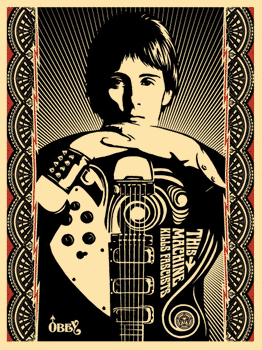
The picture on the left is called This Machine Kills Fascists. This print has one of the longer explanations in which he tells us that the person is no one in particular, not Woody Guthrie (although he acknowledges that it does look a bit like Paul Weller). This musical tie-in has led to many genuine musical posters over the years, although none are included in this book. However, he did create a series of “album covers” for himself that are included. I don’t like them as much for some reason–just not my style.
There’s a lot of duplication in this book, which I don’t really care for or see the need for, but that’s okay. I suppose it works well as a “complete” document.
Fairey has some explanatory notes for many of the prints, which I found helpful. They’re brief enough that he’s not going on and on, but they are informative enough to get a little story behind the idea. The three introductions were also quite helpful, too.
 In Fairey’s introduction, he gives a brief summary
 y of his work as a graffiti artist and his inspirations for much of what he has done over the years. There’s even a brief mention of his “Andre the Giant has a Posse” which I recall seeing in Boston on signposts everywhere circa 1992 (he had started making them in 1989). It has since morphed int0 his more iconic style with simply the word “Obey” (the image on the right). And I like how if you know the original, you can see Andre in this newer version, but if you don’t it’s just an interesting graphic. I’m not even entirely clear if one could tell it was Andre the Giant in this new version if you didn’t already know.
I must admit that the middle introduction, from Sarah Jaye Williams was full of all kinds of “artistic” arguments going into the depth and breadth of Fairey’s artistic merits. Now, as I’ve said I really like Fairey’s work, and I think he has an excellent eye for design and a cool grasp of propaganda, but I’ll leave it there. The hyperbole of his vision as presented by Williams was a little much, frankly.
The end of the book shows clipping form the scandal that happened at his gallery opening–a guy brought some smoke bombs into the gallery designed to disrupt the premiere (he was caught before lighting them off). There’s also a vandal called the “splasher” who seems to go around and splash paint on all of Fairey’s graffiti art. If you don’t follow the outside art wars, as I don’t, you’ll find this countercultural war of artists fascinating. And I’d actually like to read (a little) more about it.
So this is a pretty decent collection of Fairey’s works (circa 2007). Evidently there is a more comprehensive book out there (from before 2007), but most of his prints are available for viewing on his Obey site. He’s had a pretty good run for an outsider.
And here is a more up close version of one of the Two Sides of Capitalism print.


 I Just Read About That...
[…] Shepard Fairey–E Pluribus Venom: The Art of Shepard Fairey (2008 … Leave a comment « Rose centerpiece Comments are closed. […]