 SOUNDTRACK: KISS-Love Gun (1977).
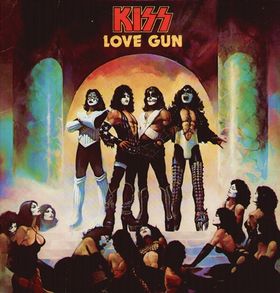 This was the first Kiss album I’d ever heard. I’ll never forget my cousin bringing it to Long Beach Island in the summer of 1977. I loved “Christine Sixteen” (of course, I was 8 and had no idea what it was about, I just loved singing it). And the album has always held a magical mystique for me.
And even now I think the opening guitars of “I Stole you Love” are fantastic–fast and furious. And the processing (or is that harmonizing) on Paul’s vocals make this song so urgent it’s really amazing. I also got a kick out of the “guitar!” comment before the solo–certainly not the first band to do it, but surely the first I’d ever heard (they may be the first to say “Listen” at the end of a solo, though). “Christine Sixteen” is a preposterously poppy song (listen to the bouncy, happy piano!), how could an 8-year-old not love it. It is, of course, utterly creepy when Gene sings it now, (actually, my calculations show that he was 27 when he wrote the song–still pretty fricking creepy–and in some places, illegal).
The choppiness of “Got Love for Sale” makes the song different from many other Kiss songs, which were all about flow. The guitars are choppy, the drums are choppy: t’s pretty cool. It’s all hard and heavy (except for the doo wopping “got love for sale” backing vocals). Ace Frehley finally gets a lead vocal turn on the awesome “Shock Me.” This has always been one of my favorite Kiss songs although listening to it now it sounds a little weak on this album (really uninspired backing vocals, eh?) but the solo is ripping–and the live versions are much more intense.
My first version of Love Gun had a skip at the beginning of “Tomorrow and Tonight” which made me not like the song very much. Now I just think of it as a piece of filler–it sounds like it could come from Paul’s solo album (what’s up with the backing singers?). I assume that they were trying to dip into the anthemic power pop well one too many times with this one. But all is forgiven with the next song, “Love Gun.” Yep, sex metaphors abound in Kiss, but this one is pretty awesome. Beyond that, the sound of the guitars is great: the powerful power chords and the amazingly full chorus are also great. And the staccato drums (and blistering solo) obviously make the song genius.
The rest of “Side two” is pretty interesting. “Hooligan” is an odd little number. It’s Peter’s song and it swings–Peter was always more into older rock than anything else, and this song, if it was stripped of its rougher edges (and cool solo) would fit pretty well on any of Peter’s (not very rocking) solo albums. Although “dropped out of school when I was 22” is a pretty great line. “Almost Human” is a weird song with some crazy guitars. The solo is absolutely insane–I’d love to have seen the recording of it–just noises upon noises, very cool. And the music itself has an odd eastern feel. There’s great vocals and effects and all kinds of interesting things going on. It’s an overlooked gem from this disc.
Then there’s “Plaster Caster” the song about the woman who makes plaster casts from rock singer’s penises. I still laugh at the euphemism of “if you want to see my love, just ask her”. I’ve always loved this song even though listening to it now, it sounds kind of anemic (of course, the guitars were sampled in Tone Loc’s “Funky Cold Medina” so that’s got to mean something, right?)
The album ends with a cover of “Then She Kissed Me.” Even though Kiss likes that kind of music, I never did, so this song has always been my least favorite song of all of the first six Kiss albums. But hey, the album runs 32 minutes in total–without those three minutes, you’re under half an hour. That’s why I assume it was included. The solo is nice though.
The album is pretty heavy overall and has some great guitar solos from Ace. They’re not as anthemic and pretty as on Destroyer but they really show off his guitar skills. And even though I tend to like Destroyer, Love Gun might be #1 for me on any given day.
[READ: October 4, 2011] “The House on Sand Creek”
This short story was on the surface very funny even though underneath there was exceptional sadness. The events that set the story in motion are pretty unlikely–a couple rents out a property sight unseen (as if–especially since he is a realtor) and it turns out to hold so much karmic malfeasance that it quickly makes the wife, Monika, flee the god forsaken countryside and fly back to Bosnia.
The narrator falls into a rhythm with his neighbor Bob (this part of the story reminded me of parts of Wells Towers’ stories–two men, out in the middle of nowhere, bonding despite obvious differences). But the story quickly moves back out of Tower territory when the narrator gets a call from Monika (about two years after she left).
Her new marriage in Bosnia didn’t work out and she’s moving back in with him and bringing her new son as well. (Again, it seems unlikely that this could just happen–that she would just call and say she was moving back in with him after two years, but whatever, it moves the plot). And so, the narrator and his ex-wife move back in together with Monika’s son, Karel. Karel is the son of an African man and Monika hopes he will grow into a Mandingo (this seems unlikely since the boy’s father is actually a short neurosurgeon from Yoruba–a West African village).
Monika is as dismissive of the house this time as she was previously and she is even more dismissive of her ex husband. But she gets into architecture school and they hire a hot babysitter to look after young Karel. Except that the narrator and Bob (who, upon seeing Karel for the first time, brings over a book about Martin Luther King, a James Brown record and a rubber chicken leg to teethe on (!)) find themselves really enjoying the boy’s company. And eventually, Bob starts taking care of the boy more than anyone else (I loved the idea that this boy’s father was three people removed from his daily caregiver–see. it’s tragic underneath but quite comical on the surface).
When the story finally comes to a head, it seems like a giant push towards the status quo. It’s not a “satisfying” ending at least for what the reader might hope, but it seems pretty inevitable given the personalities involved. I only wish we learned more about what happened to the neurosurgeon at the end. I really enjoyed this piece.

 I Just Read About That...
Somehow I doubt this marriage was headed anywhere good…. The story left a lot of loose ends, though I found it enjoyable to read. The wife (its not even clear to me that they divorced) is a bizarre creature. Her braying laughter at him for his crash-and-burn with the nubile babysitter was a very odd and pivotal part. Earlier, she emphasized to him how “large” her later mate the surgeon was — in sum, she wants to break this guy so she can hate him more.
Anyway, skillful writing and a loose-jointed plot leaving us hanging…..
Andrew, I think you’re right on with this assessment. Thanks.